



How to Improve Call Center Customer Service
Whether it's trip planning or handling customer comments or complaints, transit agencies nationwide are using new software and providing operators with specialized training for skills they lacked.
These days, calling a customer service line usually leads to a never-ending maze of automated prompts or, if you are lucky enough to reach a live person, a frustrating conversation that doesn’t resolve the problem or answer the question. Either option can leave transit customers cold.
Many transit systems are beginning to address these types of customer service issues by revamping their call centers to provide simplified trip-planning options, more user-friendly automated systems or, in some cases, a live person with the ability to assess complaints and address them immediately.
However, not all agencies are faced with the same challenges in their customer call centers, so each must find a solution that best suits their needs.
Enhance service, reduce load
The main goal most agencies share for improving their customer call centers is to enhance customer service while reducing call volume for customer service representatives (CSRs). Volume overload often occurs when call centers provide trip planning in addition to customer service.
Several other agencies that provide “live” trip planning as well as customer service have chosen new software programs that help limit the number of calls that are actually taken by CSRs.
Capital Metro Transit in Austin, Texas, chose an automated voice response system from Vancouver, B.C.-based Ontira Communications. It launched the system in June 2006.
The system enables Capital Metro customers to use voice prompts (in English or Spanish) or keypad prompts to obtain bus schedules, time points or trip-planning information. It also allows the customer to transfer to a CSR if more detailed information is needed.
“Within the first several months, we saw a 20% to 25% reduction in calls that had to be handled by our live customer service reps,” says Adam Shaivitz, spokesman for Capital Metro. “Having the system certainly improves our level of customer service and reduces the chance that a customer would have to wait on hold.”
Because the automated system operates 24 hours a day, Shaivitz says paratransit customers can now place, confirm or cancel reservations at any time. In addition, they enjoy the benefit of no longer having to wait on hold for assistance.
Overall, Ontira’s solution has helped Capital Metro increase the number of calls it handles without augmenting its staff. Shaivitz adds that the only drawback at this point is that the agency must enhance the system to clarify the pronunciations of some street names.
Meanwhile, Pinellas Suncoast Transit Authority (PSTA) in St. Petersburg, Fla., and IndyGo in Indianapolis chose Montreal-based GIRO Inc.’s HASTINFO software to address its trip-planning customer call load.
The software program allows customers to enter starting locations and destinations in a variety of ways, including by landmark, intersection or street address, according to Terry Parks, customer relations manager for PSTA. HASTINFO also enables callers to customize their requests based on variables such as shortest walk, fewest transfers or fastest overall travel time.
The software can be deployed internally on a CSR’s desktop or via a link from the agency Website. IndyGo is currently running the system at its customer service center and plans to launch the full Web version to the public this fall, according to Communications Manager Ronetta Spalding.
PSTA’s Parks says that the new software system is helping CSRs the most when it comes to looking up more complicated trips.
“Most of our CSRs have been with us for at least 10 years, so they know most routes and runs by heart,” Parks explains. “But it has proven to be helpful when PSTA implements service changes.”
Parks adds that the new software also helps CSRs with detailed information for more than 5,600 bus stops, including which stops have benches or bus shelters and what businesses or landmarks are located nearby.
PSTA has also experienced a significant upgrade when training new CSRs.
“In the [past] it would take at least eight weeks to train somebody to the point where they can take calls on their own,” says Parks. “With the new software, we find that CSRs should feel comfortable taking calls on their own after about a week.”
Training and retraining
In addition to the challenge of juggling customer service call overload, some agencies, such as the Southeastern Pennsylvania Transportation Authority (SEPTA), discovered that their problems arose from call center employees lacking certain basic skills.
“Many of our customer service reps did not have adequate skills to become good customer service liaisons,” explains Rohan Hepkins, SEPTA’s director of customer service.
In particular, SEPTA found that many of their agents lacked experience working with computer database systems, as well as good arithmetic skills, which prevented them from being able to calculate the agency’s different fare structures.
To rectify the problem, the agency, with the help of its human resources department, found a company to develop a series of exams that tested prospective CSRs on a number of topics, including math, reading, writing, grammar, customer service and computer databases.
SEPTA also gave existing CSRs computer database tests and provided in-house, hands-on remedial training for those who needed it.
Because of the sensitive nature of the tests, Hepkins says that he cannot give out the name of the company that provides the exams, but adds that results to this point have been positive.
“Our talk time went down from about a minute-thirty to about a minute-seventeen, so we saw an immediate change that translated into many more calls answered,” Hepkins says. “Our abandoned calls also dropped from about 3.5% to 2%.”
Tighter job prerequisites and training are only the latest changes SEPTA made in hopes of improving its call center. In an effort to expand its customer service hours, the agency combined the call center with its travel information department in 2004. Hepkins explains that the move was made in part because the Travel Information center was open seven days a week, compared with customer service’s limited hours of 8 a.m. to 4 p.m., Monday through Friday.
“The end result is that we have a more user-friendly delivery system for customers,” says Hepkins, who also adds that the “one-stop” shopping style and extended hours of service have helped increase the agency’s efficiency and improved customer relations.
SEPTA has also recently approved the replacement of its automated voice system with an updated text-to-speech system slated to be up and running by next year.
All of the changes, Hepkins says, have helped the agency actually decrease its call center workforce.
“Ten years ago we had 57 agents answering calls, now it’s down to 47,” he says. “By continuing to improve our technology and training, we can do more with less and get a better return on investment.”
Out with old, in with new
Pace Suburban Bus in Arlington Heights, Ill. (suburban Chicago), was faced with a slew of reasons to improve its customer call center, the most major being its archaic system of handling complaints, which included a DOS-based system, a lot of back-and-forth faxing and the inability of its more than 50 paratransit contractors to access the system.
“To be generous, I’d say that it would take three to six weeks to answer complaints properly,” says Tony Bowman, Pace’s marketing manager. He adds that the delayed responses weren’t due to a lack of trying, but that operators were saddled with a “legacy system,” which was past its prime.
Aside from the outdated system, Bowman explains that Pace also recently took over the entire paratransit operations for the Chicago area, increasing its paratransit ridership by more than 140% — nearly doubling call volumes in the process.
To improve its system, Pace sought the help of Fairfax, Va.-based Technology Solution Providers (TSP), which provided its Customer Assistance System (CAS).
CAS is a Web- and Windows-based system that enables Pace’s paratransit contractors to access the system and its CSRs to provide real-time complaint processing.
The system also allows Pace to scan handwritten letters from customers. It can also generate template letters. The real added benefit, Bowman explains, is the ability to track customer complaints and comments throughout the entire process.
“At any given moment, someone can look up a complaint and see whose inbox it might be sitting in waiting for a response,” he says. “To keep the process moving quickly, it will even generate an e-mail to somebody saying this complaint/comment is sitting in your inbox, it’s been three days, please respond. If that person is not there to respond, it will generate an e-mail to their manager so that they can get on with responding.”
Bowman adds that switching to TSP’s CAS system has also created a shared ownership by everyone involved in addressing and solving customer issues.
Because of that shared ownership, the agency has reduced its complaints on average and can now provide answers to customers within a day, or in a worst-case scenario, within 10 days.
Bowman also says that Pace’s CSRs are currently handling about 1,000 complaints/comments a month without any effort, has eliminated its backlog of complaints and increased its overall efficiency.
“Usually we aim for an 80% efficiency rate in our call center,” Bowman explains. “There were times before where we could easily drop down to 30% efficiency, but now we’re consistently over 80% and at certain times during the day we can hit 100%.”
Pace plans on adding a new feature to its Website soon that will allow customers to create their own account and actually track the progress of recent complaints and also view how previous concerns were handled.
More Management
PSTA Modernizes Workforce Management with Digital Bidding System
The award-winning Workforce Transit Modernization project replaced paper bidding with a transparent digital platform, cutting administrative effort while improving access for operators.
Read More →
Chicago to Host Public Transportation's Biggest Gathering at APTA TRANSform & EXPO 2026
North America’s largest public transportation gathering returns to Chicago, connecting transit decision-makers with the technologies, ideas, and partnerships driving the industry forward.
Read More →
New Tricks for Old Bureaucracies: Joshua Schank on Making Transit Innovation Stick
Former LA Metro Chief Innovation Officer Joshua Schank discusses why good ideas aren't enough, how transit agencies can overcome resistance to change, and why today's challenges demand more innovation.
Read More →
Washington's Community Transit Sets Six-Year Roadmap for Growth, Expansion
Approved TDP targets more bus service, new mobility options, Swift BRT expansion, and a potential Everett Transit annexation.
Read More →
OKC Streetcar Makes Zero-Fare Service Permanent
Ridership increased an average of 71% compared with the same period a year earlier during the fare-free pilot.
Read More →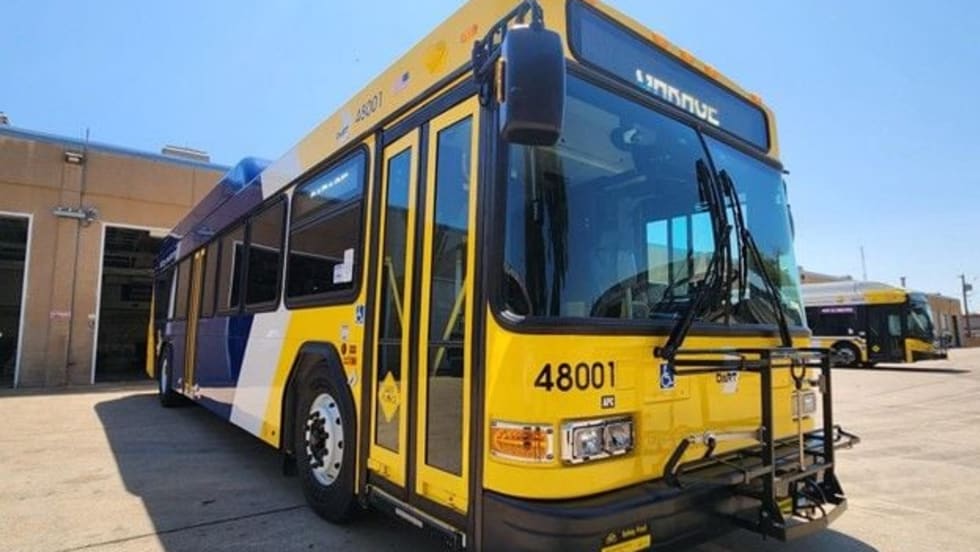
DART Customer Satisfaction Reaches Six-Year High
Overall satisfaction rose to 74.9%, while the agency’s Net Promoter Score reached a record 33.7.
Read More →
House Surface Transportation Bill Advances as Transit Funding Debate Intensifies
A bipartisan transportation package moving through Congress could redefine how the U.S. funds highways, transit, and motorcoach travel, while igniting new fights over electrification, regulation, and federal priorities.
Read More →
How Data, Strategy, and Community Engagement Are Reshaping Transit
In this edition of METROspectives, strada360 CEO Steve Lassey discusses how transit agencies can better align planning with operations, leverage data to improve decision-making, and build public trust as they prepare for the future of mobility.
Read More →
Amtrak Board Advances Plan to Restructure Organization, Seeks Public Input
The proposal, developed by Amtrak management and approved by the board for further consideration, is intended to modernize the organization's structure while improving accountability, operational efficiency, and customer service.
Read More →
Turn Transit Data Into Action
Discover how leading agencies are using connected technology to gain real-time visibility across operations, improve service reliability, and reduce disruptions.
Read More →