



New Tricks for Old Bureaucracies: Joshua Schank on Making Transit Innovation Stick
Former LA Metro Chief Innovation Officer Joshua Schank discusses why good ideas aren't enough, how transit agencies can overcome resistance to change, and why today's challenges demand more innovation.

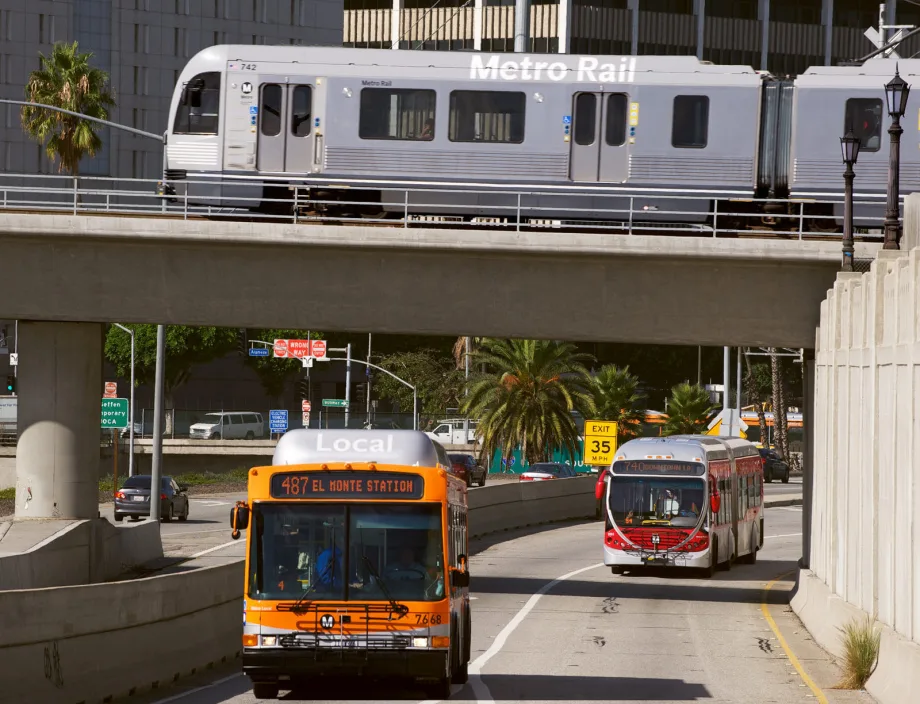
During a recent episode of METROspectives, Josh Schank reflected on what worked at LA Metro, what didn't, and what today's transit leaders can learn from both during his tenure at the agency's Office of Extraordinary Innovation.
LA Metro
- Joshua Schank emphasizes that innovative ideas need effective implementation strategies within transit agencies to succeed.
- Transit agencies must actively confront and navigate resistance to change to foster innovation.
- Schank highlights the necessity for increased innovation in transit systems to address contemporary challenges effectively.
*Summarized by AI
An urban planner by training, Joshua Schank began his career at New York's MTA before leading the Eno Center for Transportation. In 2015, he joined LA Metro as its first chief innovation officer, building the Office of Extraordinary Innovation under then-CEO Phil Washington.
Today, Schank is a partner at Infrastrategies, executive director of the ACES Mobility Coalition, and co-author of New Tricks for Old Bureaucracies, which draws lessons from the difficult work of creating lasting change inside government.
During a recent episode of METROspectives, Schank reflected on what worked at LA Metro, what didn't, and what today's transit leaders can learn from both.
Creating an Incubator for Change
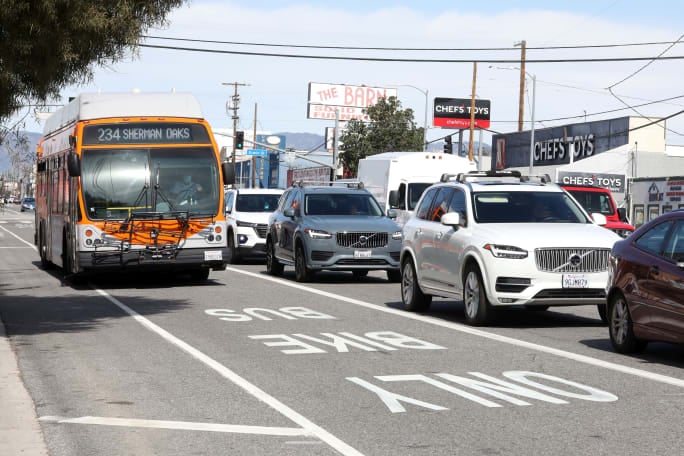
Metro already operated priced express lanes, but Schank and his colleagues began pushing a more ambitious idea around 2018 and 2019: Pricing streets or lanes motorists had previously used for free.
LA Metro
When Washington was considering taking the top job at LA Metro, Schank was president and CEO of the Eno Center for Transportation, where Washington served on the board. The two saw an opportunity in Los Angeles.
Metro was preparing for enormous infrastructure investments, while new technologies and mobility models were beginning to disrupt traditional transportation. Washington envisioned an Office of Extraordinary Innovation, and brought Schank in to build it.
“The original vision…was that the office would be an incubator for new ideas within LA Metro,” Schank said.
That meant serving as a bridge to academia, think tanks, and the private sector while also tackling strategic planning, new project-delivery approaches, and an unsolicited proposal program designed to bring private-sector ideas into the agency.
But Schank quickly learned that generating ideas was the easy part. One of the office's initiatives was bringing on-demand transit to Metro.
Today, microtransit and other forms of on-demand service are common across the industry. At the time, the idea was unfamiliar territory for an agency built primarily around fixed-route bus and rail operations.
Schank's team therefore had to convince people throughout the organization that the new model was worth pursuing.
“You can't do any of this stuff alone,” he said. “If you don't have buy-in from all the different people within this 12,000-person agency that need to operationalize what it is you're recommending, it's really not going to go anywhere.”
That became one of the lessons behind New Tricks for Old Bureaucracies: Make friends and collaborate.
“The power of a good idea only goes so far,” Schank said.
Every agency has employees who prefer familiar processes. But Schank argues that every agency also contains people who believe they have a responsibility to improve things. Find those people, he said, and innovators can build a network of allies across departments.
“When you find those people, and you develop that network of allies, you can build support for new initiatives across the agency,” Schank explained.
Winning Battles to Make Change
Congestion pricing presented a different challenge.
Metro already operated priced express lanes, but Schank and his colleagues began pushing a more ambitious idea around 2018 and 2019: Pricing streets or lanes motorists had previously used for free.
The biggest obstacles weren't necessarily inside Metro. They were political. Schank believed congestion pricing could be transformational for Los Angeles, but that didn't mean the agency could ignore the politics surrounding it.
“One of the lessons from the book is I always say, ‘Pick your battles and win them,’” he said. “That was a battle we thought was worth picking for sure because congestion pricing could be so transformative in Los Angeles.”
The challenge was finding the right moment and strategy to move it forward. For Schank, resistance to congestion pricing also illustrates a larger problem confronting innovators: People tend to fear change before they experience its benefits.
“It's really just a political issue of getting people to be comfortable with change,” he said. “That's really what the Office of Extraordinary Innovation was all about — helping people become accustomed to the pace of change and the idea that something different could be way better than the status quo.”
Two accomplishments from Schank's Metro tenure stand out to him. The first is automated bus-lane enforcement.
Cars illegally parked in bus lanes, particularly along Wilshire Boulevard, were slowing buses and undermining the purpose of dedicated lanes. An unsolicited proposal led to the idea of camera-based enforcement.
There was one significant obstacle: It wasn't legal. Metro first had to secure legislative authority from Sacramento, then move through procurement before the technology could be implemented. Automated bus-lane enforcement is now being used by Metro and other transit operators.
“That's a real difference maker that I feel very proud of,” Schank said.
His other major accomplishment was broader: Vision 2028, Metro's strategic plan adopted in 2018. The plan challenged the organization to see itself as more than a transit operator or infrastructure builder.
“We're not just a transit agency, we're not just a builder of infrastructure,” Schank said. “We are taking responsibility for making mobility work in this county.”
That shift emphasized outcomes. Instead of simply asking whether Metro was operating service or delivering promised projects, the agency could ask whether its investments were actually improving people's ability to move around Los Angeles County.
Knowing When to Walk Away
Not every effort succeeded. One of Schank's biggest frustrations involved fare payment.
His team wanted Metro to move toward technologies such as open-loop payments, allowing riders to use credit cards and phones rather than relying exclusively on a dedicated transit card.
But the innovation office ran into entrenched resistance within the organization. Schank now believes his team spent too much time and too many resources trying to overcome it.
“You have to recognize the impenetrable fiefdoms that may exist,” he said.
Even if innovators can find allies within a department, change may remain impossible when senior leadership is firmly opposed.
“You have to figure out where the battles are that I cannot win,” Schank said. “Where are the fiefdoms that cannot be penetrated? And move on.”
If he could do it again, Schank said he would identify those situations sooner and redirect limited resources toward opportunities where change was possible. Perhaps the biggest obstacle to public-sector innovation, according to Schank, is status quo bias.
Agencies often evaluate the risks of changing something much more aggressively than the risks of continuing with an approach that isn't working. The incentives are understandable.
Stick with the status quo, and few people will blame an individual employee if conditions deteriorate. Try something new and fail, and suddenly someone is to blame.
Schank compares it to football coaches historically punting on fourth down rather than taking the statistically justified risk of going for a first down.
Once enough coaches began making the unconventional choice, however, the perception of risk changed. Transit needs the same permission to experiment.
“When you have a collective authority within the agency to fail and to have the ability to fail, that's when innovation happens,” Schank said.
At Metro, Washington provided that protection.
“We had a leader in Phil Washington who was willing to accept that failure for us and to have our backs when things didn't go our way,” Schank said. “That's why our office was successful where it was.”
Has the Industry Changed?
A decade later, many ideas once considered innovative have become commonplace.
On-demand transit has spread across the industry. Real-time information and fare technology have improved. Agencies are paying far greater attention to customer experience.
“That is encouraging,” Schank said. “There has also been a shift towards a greater emphasis on customer experience across the industry. And that's really positive.”
But he worries that the pandemic reinforced transit's natural tendency toward risk aversion. Agencies are dealing with fiscal pressures, ridership challenges and potential service cuts. In that environment, simply getting back to where things were can become the priority.
Schank argues the opposite should happen.
“You would hope that crisis creates the opportunity for innovations, creates the opportunity to say, ‘Hey, we got to try something new,’” he said.
Instead, he still sees too many agencies afraid to take risks.
“The pace of change always needs to be accelerated,” Schank said. “When there's a crisis, when there's a real challenge as we're facing now, it needs to be accelerated even more urgently.”
Schank now applies those lessons through his work at Infrastrategies, where he helps transit agencies with strategic planning and innovation. The approach begins not with consultants telling agencies what to do, but with asking employees what they think should change.
“The people within the agency know what the changes are that should occur,” Schank said.
The goal is to identify those ideas and gradually build support for them throughout the agency, with executives, boards, and the public.
“We're not just coming in and saying, ‘Here's a good idea, you should do this,’” he said. “That wouldn't get anywhere.”
Schank is also continuing to connect public agencies with emerging mobility technologies as executive director of the ACES Mobility Coalition.
ACES — autonomous, connected, electric and shared — seeks to build partnerships between public transit and private mobility providers, including services that can connect passengers to and from transit.
“It's very much similar to the work that I did at LA Metro,” Schank said, “because it is again bringing public and private together to accomplish larger public policy goals.”
This article, generated using OpenAI, was edited for accuracy and style and based on an episode of METROspectives
Quick Answers
Good ideas often struggle in transit agencies due to entrenched bureaucratic structures and resistance to change. Effective implementation requires overcoming these systemic barriers.
*Summarized by AI
More New Mobility

From Hardware to Digital Partner: Luminator Charts Its Next Chapter
CEO Magnus Friberg discusses Luminator’s shift toward becoming a digital partner, the growing importance of software and interoperability, and how AI can help agencies improve operations and passenger experience.
Read More →
Biz Briefs: Alstom Lands Canadian Contract, LYT to Supply California TSP, and More
In METRO's latest installment, we take a look at recent news from Complete Coach Works, Beep, FlixBus, and more partnerships making headlines across the transportation sector.
Read More →
CharterUP’s Armir Harris on Technology, AI, and the Future of Group Mobility
In a recent episode of METROspectives, CharterUP Founder/CEO Armir Harris discussed the company’s evolution from an online charter bus marketplace into a technology platform supporting public- and private-sector mobility and much more.
Read More →
Jacksonville’s NAVI Project Charts a New Course for Autonomous Public Transportation
Through its NAVI program, JTA is showing how autonomous vehicles, intelligent infrastructure, and coordinated operations can work together to deliver everyday public transportation.
Read More →
Biz Briefs: Luminator Marks Milestone and More
From manufacturers and suppliers to transit agencies and motorcoach operators, these updates offer a snapshot of the projects, partnerships and business moves driving the industry forward.
Read More →
How DART's GoPass Is Redefining Regional Mobility
Serving 14 transit agencies, GoPass simplifies multimodal travel by allowing riders to plan, pay for, and manage an entire trip through one app.
Read More →
Biz Briefs: OCTA Taps Clean Energy for Hydrogen Station, Stadler to Supply Via Rail Vehicles, and More
From manufacturers and suppliers to transit agencies and motorcoach operators, these updates offer a snapshot of the projects, partnerships and business moves driving the industry forward.
Read More →CharterUP Expands Into New Mobility and Autonomous Transportation
Vice President of New Mobility Stephen Joos discusses how CharterUP is leveraging its nationwide transportation network, technology platform, and autonomous vehicle partnerships to expand into workforce mobility, campus shuttles, and transit solutions.
Read More →
METRO Magazine Announces 2026 Innovative Solutions Awards Winners
Projects Recognized for Advancing Mobility Through Technology, Accessibility, Workforce Innovation, and Operational Excellence
Read More →
Biz Briefs: STV teams with Amtrak, Motorcoach Operators Boost Fleet and Land Contracts, and More
From manufacturers and suppliers to transit agencies and motorcoach operators, these updates offer a snapshot of the projects, partnerships and business moves driving the industry forward.
Read More →