



Brampton Transit to be part of electric bus demonstration project
Will work with two Canadian transit vehicle manufacturers (New Flyer Industries and Nova Bus) and two charging station manufacturers (ABB Group and Siemens Canada) to deploy up to 10 electric buses and four overhead electric charging stations that plug into an open protocol known as the OppCharge protocol.

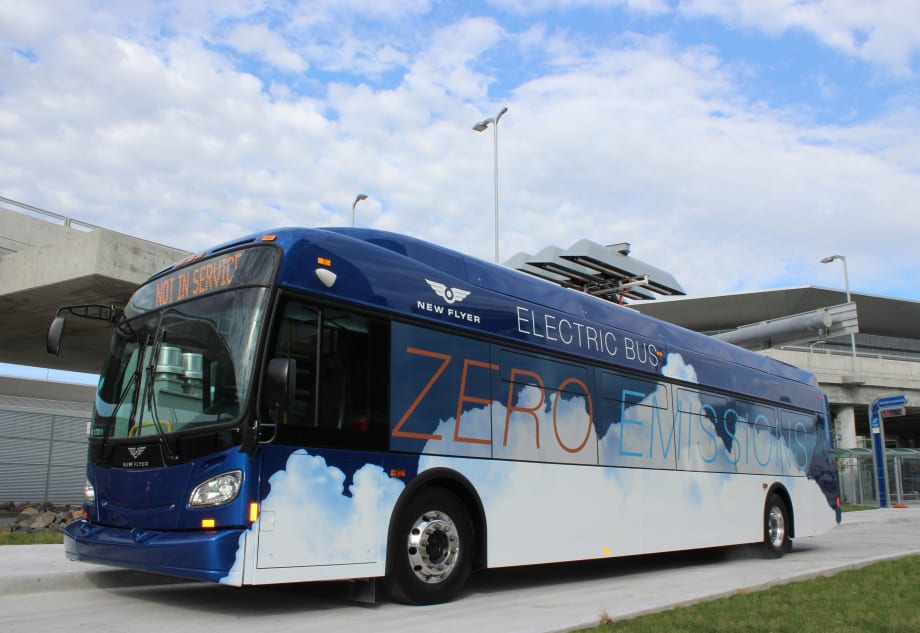
Ontario, Canada’s Brampton City Council approved its involvement in the Pan-Ontario Electric Bus Demonstration and Integration Trial — the first of its kind anywhere in the world. The Canadian Urban Transit Research and Innovation Consortium (CUTRIC) has brought funding partners, research teams, technology tools, and manufacturing stakeholders together with Brampton Transit to ensure this world-leading demonstration trial launches locally this year.
“This milestone marks the first time that competitive bus manufacturers and competitive charging station manufacturers are designing and delivering interoperable charging systems for on-route charged e-buses,” says CUTRIC Executive Director/CEO Josipa Petrunic. “There is nowhere else in the world where this type of collaboration is in place.”
The City of Brampton has agreed to work with two Canadian transit vehicle manufacturers (New Flyer Industries and Nova Bus) and two charging station manufacturers (ABB Group and Siemens Canada) to deploy up to 10 electric buses and four overhead electric charging stations that plug into an open protocol known as the OppCharge protocol — first jointly developed by Siemens and Volvo Bus Corporation. The protocol standardizes the design of the robotic off-board pantograph that connects the charging station to the bus, communications between the bus and the charger, and performance metrics of the overall system.
The trial aims to encourage long-term job growth in e-bus manufacturing and overhead charging system design and development in Canada in the future.
“This is good news for Canadian job growth in the manufacturing and the tech sectors,” states Petrunic. “Growth in skilled trades will be allied to electric bus manufacturing by Nova Bus and New Flyer, charging system innovation by ABB Group and Siemens, and electric mobility maintenance support in Canada.”
Brampton Transit is joining a consortium of partners in several jurisdictions in Canada that have collectively sought financial support from the Government of Canada, the Province of Ontario, and several municipal jurisdictions. The trial will integrate proposed neutral third-party vehicle and system analyses by the National Research Council of Canada, the University of Ontario — Institute of Technology, York University, Brock University, University of Quebec in Trois-Rivières, and the University of Victoria. St. Clair College will also help to lead the development of a training program for e-bus and charging system maintenance staff.
CUTRIC is a member-based organization that partners members of transit and transportation industries with academic researchers. The consortium supports industry-academic collaborations in the development of next-generation technologies to help drive forward innovation in transportation across Canada, leading to job growth, economic development, and significant GHG reductions.
More Technology

From Hardware to Digital Partner: Luminator Charts Its Next Chapter
CEO Magnus Friberg discusses Luminator’s shift toward becoming a digital partner, the growing importance of software and interoperability, and how AI can help agencies improve operations and passenger experience.
Read More →
Beyond the Checklist: A Structured Approach to Transit Maintenance
Reliability-Centered Maintenance helps transit agencies move beyond routine checklists to focus limited resources on the assets and failures that have the greatest impact on safety, reliability, and service.
Read More →
NJ TRANSIT Advances Bus Technology Upgrades Across Statewide Fleet
More than 1,500 buses now feature upgraded technology designed to improve arrival predictions and provide free Wi-Fi, with deployment expected to reach nearly 2,000 buses by the end of 2026.
Read More →

Building a Flexible Path to Transit Electrification
John Hroncich discusses BAE Systems’ modular and scalable approach, lessons learned from decades of real-world operations, and how agencies can identify electrification strategies that fit their fleets.
Read More →
Biz Briefs: Alstom Lands Canadian Contract, LYT to Supply California TSP, and More
In METRO's latest installment, we take a look at recent news from Complete Coach Works, Beep, FlixBus, and more partnerships making headlines across the transportation sector.
Read More →
From Legacy Silos to Conversational Intelligence
What if transit leaders could ask any operational question and get a trusted answer in seconds? Conversational AI is transforming how agencies use their data.
Read More →
USDOT Announces Rail Vehicle Replacement Grants, Chattanooga AV Shuttle Funding
More than $191 million in federal funding will help three transit agencies replace aging rail vehicles and support a new autonomous shuttle service in Chattanooga.
Read More →
Bus Tech Talk: Keeping Transit Technicians Ahead of the Technology Curve
LA Metro’s Obed Mejia discusses technician training, evolving maintenance technology, fleet replacement, and strategies for getting the most out of today’s transit fleets.
Read More →
Biz Briefs: RIPTA Unveils New Frontrunners, Clevland RTA Adds New Siemens, and More
In METRO's latest installment, we take a look at recent news from Siemens, Prevost, Dodge, and more partnerships making headlines across the transportation sector.
Read More →
Why Simulating Pedestrian Movement Has Become Essential for Modern Rail Stations
Pedestrian microsimulation is helping rail planners identify bottlenecks, test station designs, and prepare complex transit hubs for growing passenger volumes.
Read More →