



MTA, NYCDOT Expand Bus Lane Camera Enforcement Program
Since bus-mounted camera enforcement began last year, there have been improvements in M15 bus speeds on First and Second Avenues, with increases of up to 34% in some segments.
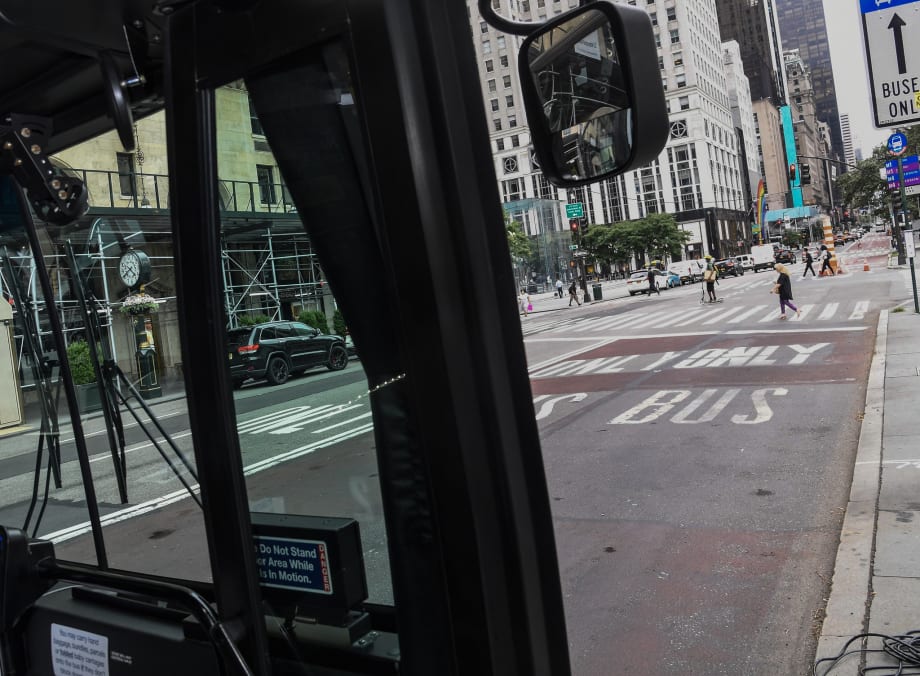
Each bus lane corridor has signage indicating the hours that the bus lanes are operable and that the lanes are camera-enforced.
MTA
New York’s Metropolitan Transportation (MTA) and the Department of Transportation (DOT) announced that stationary and bus-mounted cameras to enforce bus lane restrictions are coming to a host of new corridors and bus routes across the city, with a 60-day warning period beginning Aug. 10. With the announcement of the Better Buses Restart plan and new routes featuring bus-mounted cameras, the two agencies remain committed to increasing bus speeds with the help of automated camera enforcement of bus lanes. That enforcement is expected to help ensure that congestion is reduced and bus speeds and commute times are improved for riders.
Bus lane camera enforcement technology currently exists in all five boroughs, and expansion is planned for all five boroughs as well. There are currently eight corridors in Manhattan, five corridors in Brooklyn, four corridors in Queens, three corridors in the Bronx, and one corridor in Staten Island with bus lane camera enforcement.
Each bus lane corridor has signage indicating the hours that the bus lanes are operable and that the lanes are camera-enforced. NYCDOT will issue warnings to motorists for 60 days, in accordance with state law, to ensure that drivers are informed about the program before any fines are imposed. After that, a single violation will cost $50, and increased fines will be added for repeat offenders. Since violations are issued against the vehicle, not the driver, points are not deducted from motorists’ licenses. Issuance of violations for all these routes will begin Oct. 9.
Since bus-mounted camera enforcement began last year, there have been improvements in M15 bus speeds on First and Second Avenues, with increases of up to 34% in some segments. The MTA’s bus-mounted cameras are also on the M14, B44 and B46 routes, where speeds have also increased because of the cameras.
Approximately 1.3 million violations have been issued from NYCDOT’s stationary bus lane cameras since the program’s inception in 2011, with 37,518 violations and warnings being issued from the MTA’s bus-mounted cameras since that program’s inception in October 2019.
Stationary or bus-mounted camera enforcement is already in effect on 21 different street corridors citywide. A law passed by the state legislature in 2019 eliminated the cap on all automated bus lane enforcement and created a new tiered fine structure: fines now begin at $50 and escalate for each fine in a 12-month period, up to $250. Additional routes, with stationary and/or bus-mounted cameras will be added over time. NYCDOT also works with NYPD to enforce bus lanes citywide through traditional methods. The MTA is planning to expand bus-mounted cameras as part of the 2020-2024 Capital Program.
More Bus

New York MTA Plans Largest Bus Fleet Upgrade in More Than a Decade
The agency is seeking manufacturers for 650 new CNG buses to replace aging vehicles, improve reliability, and advance its broader fleet modernization strategy.
Read More →
Building a Flexible Path to Transit Electrification
John Hroncich discusses BAE Systems’ modular and scalable approach, lessons learned from decades of real-world operations, and how agencies can identify electrification strategies that fit their fleets.
Read More →
Bus Tech Talk: Keeping Transit Technicians Ahead of the Technology Curve
LA Metro’s Obed Mejia discusses technician training, evolving maintenance technology, fleet replacement, and strategies for getting the most out of today’s transit fleets.
Read More →
Biz Briefs: RIPTA Unveils New Frontrunners, Clevland RTA Adds New Siemens, and More
In METRO's latest installment, we take a look at recent news from Siemens, Prevost, Dodge, and more partnerships making headlines across the transportation sector.
Read More →
People Movement: Holly Arnold Joins Transdev and More
In this edition, we also cover recent appointments and announcements at Pace, CamTran, MCI, and more, showcasing the individuals helping to shape the future of transportation.
Read More →
The High Cost of Transit Buses: Industry Leaders Look to Procurement Reform
Transit leaders and policymakers examine how standardized bus designs, streamlined procurement, and predictable funding could help agencies stretch budgets and deliver better service.
Read More →
The Business Voice Behind Public Transportation
As chair of APTA’s Business Members Board of Governors, Ray Melleady explains how more than 850 business members are partnering with transit agencies to advance funding, innovation, and industry-wide collaboration.
Read More →
From Surviving to Thriving: Building Stronger Transportation Organizations
Bus Business Consultants founder Brian Dickson shares lessons on leadership, organizational health, and creating options for long-term success in a changing transportation industry.
Read More →
Finding the ‘Happy Medium’: Optimizing Maintenance Without Sacrificing Reliability
The key to maintenance optimization isn’t doing less work—it’s doing the right work at the right time on the right assets.
Read More →
LA Metro, City of West Hollywood, and Partners Advance Smarter Bus Lane Enforcement
The award-winning partnership combines AI-powered detection with human oversight to improve bus reliability, accessibility, and enforcement efficiency.
Read More →