



Metrolink’s Refurbished Train Car Now in Service
The train car is the first of 50 slated for renovation.

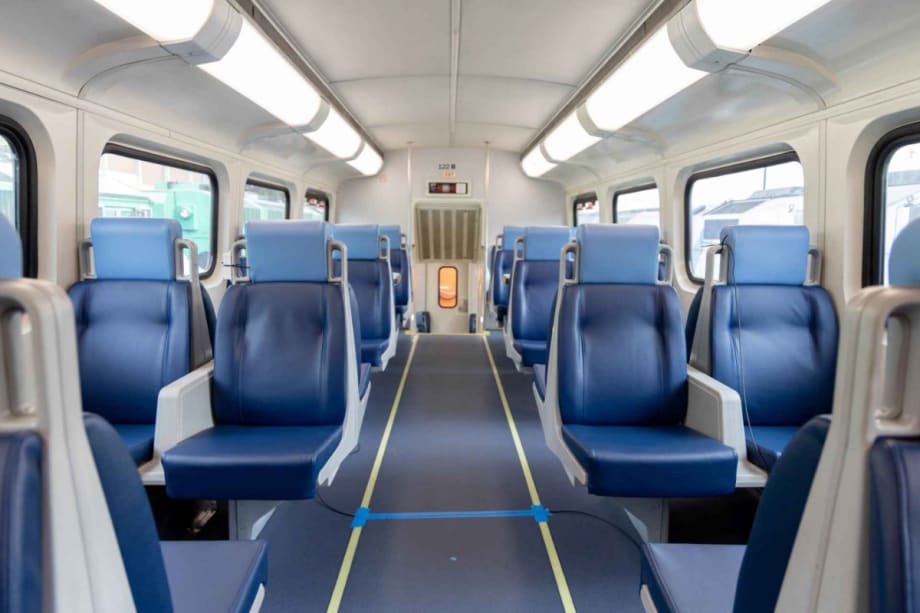
The order to rebuild 50 of the 121 Bombardier train cars was placed with Talgo-SYSTRA joint venture in June 2019.
Photo: Metrolink
Southern California's Metrolink put into service a refurbished passenger train car featuring new and improved passenger amenities designed for a more productive and safe ride.
The train car is the first of 50 slated for renovation.
“We are thrilled to begin the roll out of the renovated train cars, with upgrades to enhance passengers’ travel experiences, into our system,” said Darren Kettle, Metrolink CEO. “The ‘new’ train cars have a contemporary interior, charging ports at each seat, and a number of enhancements providing passengers with a safer and more comfortable ride with elevated amenities.”
Enhancements include features that make the train cars easier to clean, such as vinyl seating and non-carpeted flooring, as well as enhanced air filtration and UV lighting for bacteria, air pollutant, and virus protection.
Other features include new energy-efficient lighting and bathrooms with a modern look and better odor control. For enhanced safety, the refurbished cars also have side door obstacle detection, three emergency intercom buttons on every car, and emergency fresh air ventilation in case of power loss.
Metrolink has a total of 121 passengers train cars that were originally built by Bombardier between 1992 and 2002.
The order to rebuild 50 of the 121 Bombardier train cars was placed with Talgo-SYSTRA joint venture in June 2019. Metrolink expects to have 17 refurbished cars in service by the end of 2022, and all 50 cars should be available by early 2024.
More Rail

New York MTA Advances Final Contract for Second Avenue Subway Expansion
Contract Four is the largest in the Second Avenue Subway Phase 2 project and includes construction of station infrastructure, tracks, and signals for the subway expansion, MTA officials said. Work on Contract Four will begin in 2027.
Read More →
San Diego MTS Breaks Monthly Trolley Ridership Record
Agency officials said July’s ridership indicates MTS’s continued recovery from the pandemic.
Read More →
Report Examines NJ TRANSIT Reliability, Funding Challenges
The Garden State Initiative analysis examines the roles of Amtrak infrastructure, fleet management, and agency operations while recommending a more performance-based approach to improving reliability.
Read More →
Stadler, CapMetro Sign Long-Term Rail Fleet Support Agreement
Beginning in 2027, Stadler will provide on-site technical expertise, spare parts support, training, and obsolescence management to help extend the reliability and longevity of CapMetro’s GTW fleet.
Read More →
Biz Briefs: Alstom Lands Canadian Contract, LYT to Supply California TSP, and More
In METRO's latest installment, we take a look at recent news from Complete Coach Works, Beep, FlixBus, and more partnerships making headlines across the transportation sector.
Read More →
CATS Gold Line Marks 5 Years of Service, 2.8M Passenger Trips
With a six-mile expansion planned, the Charlotte streetcar is positioned to connect more neighborhoods and major transit hubs across the region.
Read More →
Why Simulating Pedestrian Movement Has Become Essential for Modern Rail Stations
Pedestrian microsimulation is helping rail planners identify bottlenecks, test station designs, and prepare complex transit hubs for growing passenger volumes.
Read More →
Amtrak Begins Major Construction at New York’s Sunnyside Yard
The new maintenance facility will support Amtrak’s Airo trainsets while improving maintenance efficiency and turnaround times in New York.
Read More →
Chicago Leaders Unveil Plans for O’Hare Airport Express Train
The privately developed project would offer a 15-minute trip between downtown and O’Hare’s Terminal 2, with trains operating every 15 minutes on a dedicated track. The service would use battery-electric trains and three existing freight rail rights-of-way.
Read More →
OCTA Maps Out 30-Year Strategy to Protect Coastal Rail Corridor
The draft feasibility report identifies strategies to protect the coastal rail line for decades as the agency continues near-term stabilization and sand placement efforts.
Read More →