




Read More: NTSB Urges Action for Bridges Nationwide
NTSB Determines Cause of Fatal Collision in Missouri
The June 27, 2022, collision occurred when a dump truck crossed over rail tracks without stopping at a stop sign and crossbucks located at the grade crossing.
August 3, 2023
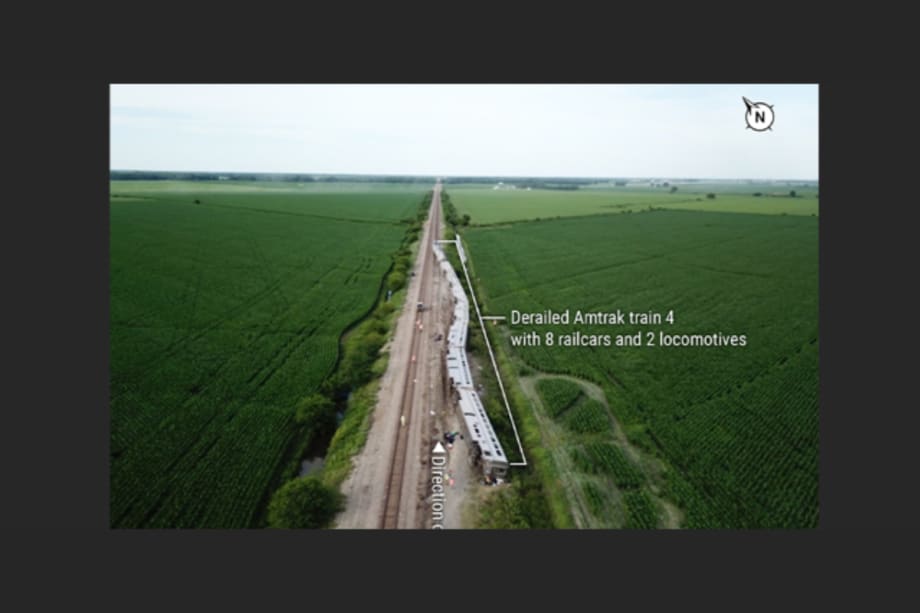
An aerial view of the accident scene, derailed Amtrak train 4 after the collision.
Photo: BNSF
2 min to read
The National Transportation Safety Board announced it has determined that the steepness of the road grade and the angle of the intersection at a passive grade crossing contributed to a collision between a dump truck and an approaching Amtrak train in Mendon, Mo., last year.
The June 27, 2022, collision occurred when a dump truck crossed over rail tracks without stopping at a stop sign and crossbucks located at the grade crossing. The truck was struck by Amtrak train 4, killing the truck driver, three train passengers, and injuring 146 passengers and crew. The collision derailed both locomotives and all eight railcars.
The NTSB noted the steepness of the road grade in this instance was 13 times the maximum slope recommended by the American Association of State Highway and Transportation Officials (AASHTO), making it difficult for a truck to accelerate through the crossing if it came to a complete stop as required by Missouri law. Additionally, the angle of the intersection was 30 degrees sharper than the lower limit of the range recommended by AASHTO.
“The safest rail grade crossing is no rail grade crossing. But at the very least, every road-rail intersection should have an adequate design to ensure proper visibility so drivers can see oncoming trains,” said NTSB Chair Jennifer Homendy. “Communities across the country deserve safer crossings so these types of accidents don’t happen again.”
NTSB investigators noted that the train’s horn was compliant with federal regulations and sounded at the regulation-specified distance from the crossing. The investigation found that the driver was not using a cell phone; toxicological testing did not indicate that the driver was impaired; the train was traveling at an authorized speed; and there were no weather-related risk factors for reduced visibility or audibility.
Crossing Closed Since the Incident
Since the collision occurred, the NTSB noted the involved crossing has been closed.
Additionally, the City of Chillicothe, in collaboration with the Missouri Department of Transportation, and Chariton County, has developed a plan to close several other passive crossings and redesign local roads to direct traffic through active crossings.
The Missouri Department of Transportation will use a portion of the funds out of their latest budget signed by Governor Mike Parson to address passive grade crossings.
“As the member-on-scene, I was pleased to bring federal, state, county, local, and community leaders together to take a serious look at this crossing,” said Homendy. “I commend the Missouri General Assembly, Governor Parson, the Missouri Department of Transportation, Chariton County, local municipalities, and countless others for taking swift action to address grade crossing safety. As a result of these efforts, lives will be saved.”
More Rail

New York MTA Advances Final Contract for Second Avenue Subway Expansion
Contract Four is the largest in the Second Avenue Subway Phase 2 project and includes construction of station infrastructure, tracks, and signals for the subway expansion, MTA officials said. Work on Contract Four will begin in 2027.
Read More →
San Diego MTS Breaks Monthly Trolley Ridership Record
Agency officials said July’s ridership indicates MTS’s continued recovery from the pandemic.
Read More →
Report Examines NJ TRANSIT Reliability, Funding Challenges
The Garden State Initiative analysis examines the roles of Amtrak infrastructure, fleet management, and agency operations while recommending a more performance-based approach to improving reliability.
Read More →
Stadler, CapMetro Sign Long-Term Rail Fleet Support Agreement
Beginning in 2027, Stadler will provide on-site technical expertise, spare parts support, training, and obsolescence management to help extend the reliability and longevity of CapMetro’s GTW fleet.
Read More →
Biz Briefs: Alstom Lands Canadian Contract, LYT to Supply California TSP, and More
In METRO's latest installment, we take a look at recent news from Complete Coach Works, Beep, FlixBus, and more partnerships making headlines across the transportation sector.
Read More →
CATS Gold Line Marks 5 Years of Service, 2.8M Passenger Trips
With a six-mile expansion planned, the Charlotte streetcar is positioned to connect more neighborhoods and major transit hubs across the region.
Read More →
Why Simulating Pedestrian Movement Has Become Essential for Modern Rail Stations
Pedestrian microsimulation is helping rail planners identify bottlenecks, test station designs, and prepare complex transit hubs for growing passenger volumes.
Read More →
Amtrak Begins Major Construction at New York’s Sunnyside Yard
The new maintenance facility will support Amtrak’s Airo trainsets while improving maintenance efficiency and turnaround times in New York.
Read More →
Chicago Leaders Unveil Plans for O’Hare Airport Express Train
The privately developed project would offer a 15-minute trip between downtown and O’Hare’s Terminal 2, with trains operating every 15 minutes on a dedicated track. The service would use battery-electric trains and three existing freight rail rights-of-way.
Read More →
OCTA Maps Out 30-Year Strategy to Protect Coastal Rail Corridor
The draft feasibility report identifies strategies to protect the coastal rail line for decades as the agency continues near-term stabilization and sand placement efforts.
Read More →