



NTVC Report Makes Short-, Long-Term WMATA Recommendations
The report makes near-term recommendations that can provide immediate relief to WMATA and the Virginia localities that provide funding to WMATA, as well as critical actions that must be taken in the coming months.

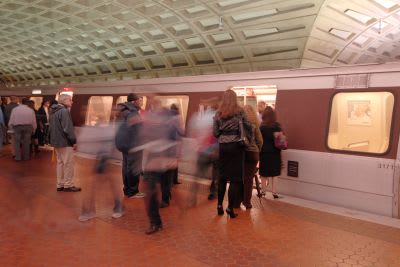
The NVTC's recommendations offer the region a framework to guide long-term regional funding and reform discussions.
Photo: WMATA
The Northern Virginia Transportation Commission (NVTC) makes recommendations to the Washington Metropolitan Area Transit Authority (WMATA) to help the transit agency solve its structural funding deficit as it faces the potential of devastating service and staff cuts.
NVTC published the recommendations today as part of its annual "Report on the Condition and Performance of WMATA."
“While this is the beginning of the process, NVTC recognizes that Metro's proposed budget clearly lays out the harsh service cuts the region will endure unless the District, Maryland, and Virginia jointly take action," said NVTC Chair Dalia Palchik. "The Northern Virginia cities and counties that pay for Metro are ready to work with Metro, its Board, and Richmond to close the gap, knowing that it will take all sources of funding — local, regional, state, and federal — as well as smart financial management at Metro to avoid these devastating service cuts that will affect our regional and statewide economy.”
NVTC Makes Near-Term Recommendations
The report makes near-term recommendations that can provide immediate relief to WMATA and the Virginia localities that provide funding to WMATA, as well as critical actions that must be taken in the coming months.
Near-term recommendations include:
Seek administrative or legislative opportunities to permit WMATA to re-baseline its FY 2025 operating subsidy bill to reflect the impact of the COVID-19 pandemic.
Advocate for additional state aid in FY 2025 to match local funding for WMATA.
Seek a commitment from federal, state, regional, and local funding partners to develop long-term, sustainable, dedicated funding to meet WMATA’s capital and operating needs.
Return federal workers to the office and secure a replacement for the region’s losses in fares from riders using federal transit benefits.
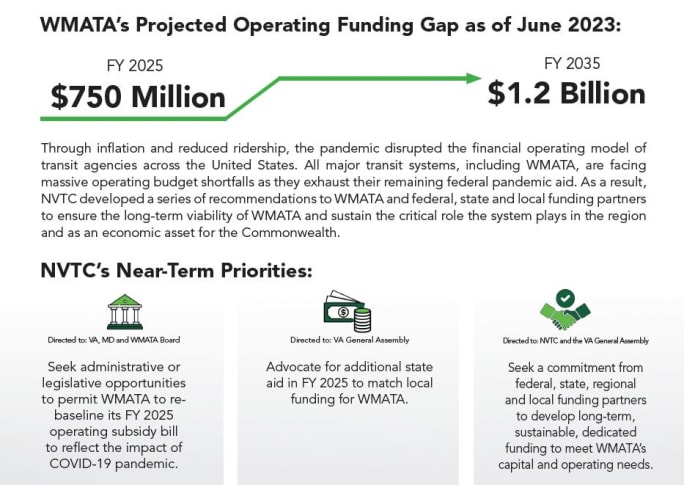
While the Greater Washington region pursues temporary actions to stabilize WMATA, the region must develop longer term solutions.
Photo: NVTC
NVTC’s Long-Term Recommendations
While the Greater Washington region pursues temporary actions to stabilize WMATA, the region must develop longer term solutions. The recommendations offer the region a framework to guide long-term regional funding and reform discussions, and include:
Manage labor cost escalation through reforms to pension and other post-employment benefits (OPEB), including increased worker contributions to pensions and OPEB; limiting or prohibiting overtime earnings toward retirement pay; and implementing Office of the Inspector General (OIG) findings to improve controls and governance and explore alternative retirement plans.
Seek Amendments to the federal Wolf Act that would require consideration of WMATA’s fiscal condition and jurisdictions’ ability to pay in binding arbitration.
Establish a revised Virginia and Maryland legislative operating assistance growth cap that addresses the unintended consequences of the current cap.
Improve farebox recovery by raising fares for Metrorail and Metrobus.
Formalize the functions and scope of a WMATA board audit committee to enhance oversight via a coordinated jurisdictional audit.
Secure one or more sustainable and reliable sources of dedicated revenues to support additional operating funding.
Establish a rainy-day fund at WMATA.
Secure one or more sustainable and reliable sources of dedicated revenues to support additional dedicated capital funding
Sustain NVTC’s technical, policy, financial, and legislative efforts to support the implementation of recommendations
NVTC publishes the "Report on the Condition and Performance of WMATA" annually and submits it to the governor and General Assembly, as required by Virginia law.
More Management

METRO Opens Submissions for 2026 Motorcoach Awards
Nominations are now being accepted for METRO Magazine’s Operator of the Year and Innovative Operator of the Year awards.
Read More →
New York MTA Advances Final Contract for Second Avenue Subway Expansion
Contract Four is the largest in the Second Avenue Subway Phase 2 project and includes construction of station infrastructure, tracks, and signals for the subway expansion, MTA officials said. Work on Contract Four will begin in 2027.
Read More →
Transit Agencies Highlight Safety Gains at National Summit
Leaders from 15 major transit systems shared crime-reduction results and safety initiatives while discussing the role of continued federal support.
Read More →

NITA Names New Leadership, Expands Reduced-Fare Program at First Board Meeting
The new regional transit authority appointed its first board chair and interim executive director while extending reduced fares across CTA, Metra, and Pace for eligible riders.
Read More →
Beyond the Checklist: A Structured Approach to Transit Maintenance
Reliability-Centered Maintenance helps transit agencies move beyond routine checklists to focus limited resources on the assets and failures that have the greatest impact on safety, reliability, and service.
Read More →
APTA 2026 Nominating Committee Selects Leadership Slate, Names Chair and Vice Chair Nominees
Leadership changes will help shape the association’s priorities and its representation of the transportation industry during the 2026–2027 term.
Read More →
DART Launches Major Security, Fare Enforcement Initiative
The 90-day demonstration will deploy coordinated security teams at five light rail stations while testing controlled access and gathering data to guide future investments.
Read More →
Advancing Fare Collection Through Technology and Innovation
Learn about delivering 1300 gates at 91 stations while managing fare evasion. Explore the large scale deployment, solution customization and real-world results that affect the region. Prepare for deployment in your region now.
Read More →
Game Day in Motion: Moving Millions During the 2026 World Cup
Between packed transit stations and team motorcoaches, see how agencies and operators across North America tackled the transportation demands of the 2026 FIFA World Cup.
Read More →
Surface Transportation Extension Averts Shutdown, Leaves Transit Funding Gap
The stopgap keeps federal transportation programs moving, but missing advance funding could complicate the transit and rail projects agencies are planning next.
Read More →