



Brightline West Project Approved for $2.5B in Private Activity Bonds
DOT previously approved a private activity bond allocation of $1 billion for Brightline West in 2020, bringing the total allocation for this project to $3.5 billion.

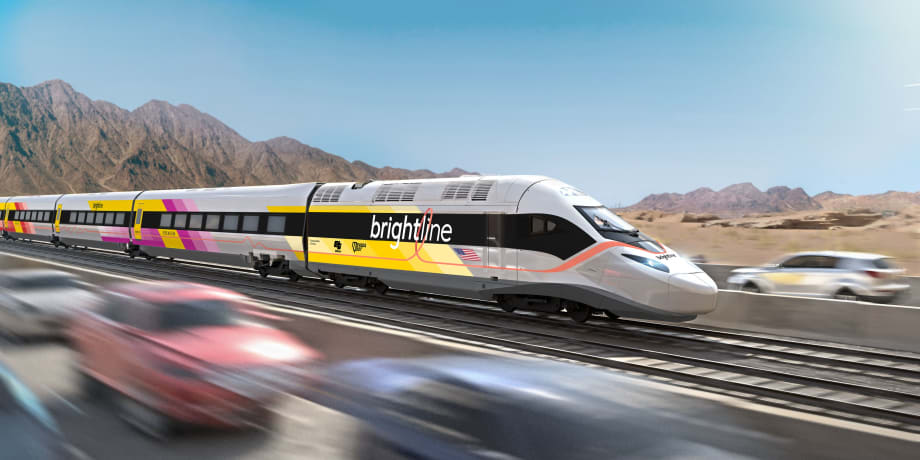
Brightline West’s $12 billion high-speed rail project will be a fully electric, zero-emission system to become one of the greenest forms of transportation in the U.S.
Photo: Brightline West
The U.S. Department of Transportation (DOT) approved $2.5 billion in private activity bonds authority allocated for the Brightline West High-Speed Intercity Passenger Rail project connecting Las Vegas and Southern California.
DOT previously approved a private activity bond allocation of $1 billion for Brightline West in 2020, bringing the total allocation for this project to $3.5 billion.
In December, DOT also awarded a $3 billion grant from President Biden’s infrastructure law to the Nevada Department of Transportation for this project. In June, DOT awarded a $25 million grant to San Bernardino County Transportation Authority (SBCTA) through the Rebuilding American Infrastructure with Sustainability and Equity (RAISE) Program that will be used for the construction of the Brightline West stations in Hesperia and Victor Valley, Calif.
“As the first true high-speed rail system in America, Brightline West will serve as the blueprint for connecting cities with fast, eco-friendly passenger rail throughout the country,” said Brightline Founder and Chairman Wes Edens. “Connecting Las Vegas and Southern California will provide wide-spread public benefits to both states, creating thousands of jobs and jumpstarting a new level of economic competitiveness for the region. We appreciate the confidence placed in us by DOT and are ready to get to work.”
The Brightline West Project
The 218-mile, high-speed rail line will primarily run along the I-15 median with trains capable of reaching 186 mph or more, cutting the trip to two hours — half the time to travel by car.
Brightline West’s $12 billion high-speed rail project will be a fully electric, zero-emission system to become one of the greenest forms of transportation in the U.S. The project will bolster tourism, create 35,000 good-paying jobs, ease traffic on I-15, and cut more than 400,000 tons of carbon pollution each year.
“Today, the Biden-Harris administration takes the next step to fulfill the promise of high-speed rail in the American West, with $2.5 billion in private activity bond authority to lay tracks, create jobs, and connect American cities,” said U.S. Transportation Secretary Pete Buttigieg. “President Biden’s historic infrastructure package gives us the opportunity to build safe, green, and accessible rail systems that will deliver benefits to the American people for generations to come.”
West Coast High-Speed Rail
Brightline West and the California High-Speed Rail project form the building blocks of a planned West Coast Corridor connecting Las Vegas, Los Angeles, and San Francisco.
California is scheduled to complete its first 171-mile operating segment in the Central Valley between 2030 and 2033, which also will be the world’s first solar-powered bullet train.
Once the West Coast Corridor is up and running, it will carry over 40 million riders every year, on trains traveling at sustained speeds of 186 miles per hour, connecting America’s biggest regional economy with true high-speed rail on a par with those seen across Asia and Europe.
Adding to the West Coast Corridor, the High Desert Corridor project, which will connect Brightline West and California High Speed Rail between Palmdale and Victorville, has over $1 billion in committed funds from L.A. County and is moving through the environmental permitting process.
Continued Passenger Rail Investment
To date, the Biden-Harris Administration has announced nearly $31 billion in unprecedented investments for our nation’s rail system, the most significant investment in passenger rail since the creation of Amtrak.
Including the new Railroad Crossing Elimination (RCE) program grants and Consolidated Rail Infrastructure and Safety Improvements (CRISI) grants announced last year, President Biden’s Investing in America Agenda is laying the foundation for a safe and modern rail network.
More Rail

New York MTA Advances Final Contract for Second Avenue Subway Expansion
Contract Four is the largest in the Second Avenue Subway Phase 2 project and includes construction of station infrastructure, tracks, and signals for the subway expansion, MTA officials said. Work on Contract Four will begin in 2027.
Read More →
San Diego MTS Breaks Monthly Trolley Ridership Record
Agency officials said July’s ridership indicates MTS’s continued recovery from the pandemic.
Read More →
Report Examines NJ TRANSIT Reliability, Funding Challenges
The Garden State Initiative analysis examines the roles of Amtrak infrastructure, fleet management, and agency operations while recommending a more performance-based approach to improving reliability.
Read More →
Stadler, CapMetro Sign Long-Term Rail Fleet Support Agreement
Beginning in 2027, Stadler will provide on-site technical expertise, spare parts support, training, and obsolescence management to help extend the reliability and longevity of CapMetro’s GTW fleet.
Read More →
Biz Briefs: Alstom Lands Canadian Contract, LYT to Supply California TSP, and More
In METRO's latest installment, we take a look at recent news from Complete Coach Works, Beep, FlixBus, and more partnerships making headlines across the transportation sector.
Read More →
CATS Gold Line Marks 5 Years of Service, 2.8M Passenger Trips
With a six-mile expansion planned, the Charlotte streetcar is positioned to connect more neighborhoods and major transit hubs across the region.
Read More →
Why Simulating Pedestrian Movement Has Become Essential for Modern Rail Stations
Pedestrian microsimulation is helping rail planners identify bottlenecks, test station designs, and prepare complex transit hubs for growing passenger volumes.
Read More →
Amtrak Begins Major Construction at New York’s Sunnyside Yard
The new maintenance facility will support Amtrak’s Airo trainsets while improving maintenance efficiency and turnaround times in New York.
Read More →
Chicago Leaders Unveil Plans for O’Hare Airport Express Train
The privately developed project would offer a 15-minute trip between downtown and O’Hare’s Terminal 2, with trains operating every 15 minutes on a dedicated track. The service would use battery-electric trains and three existing freight rail rights-of-way.
Read More →
OCTA Maps Out 30-Year Strategy to Protect Coastal Rail Corridor
The draft feasibility report identifies strategies to protect the coastal rail line for decades as the agency continues near-term stabilization and sand placement efforts.
Read More →