JTA and FSCJ are launching AVs on FSCJ's downtown campus, becoming the first college campus in the state of Florida to receive autonomous shuttles for students and visitors.
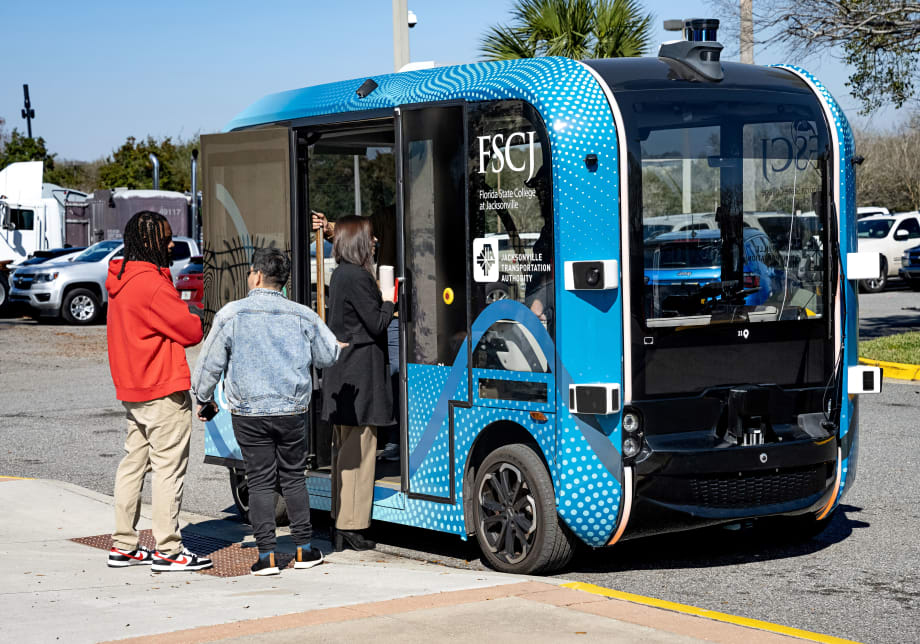
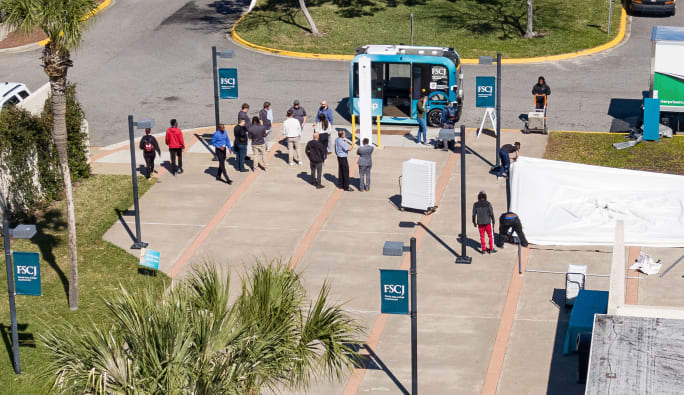
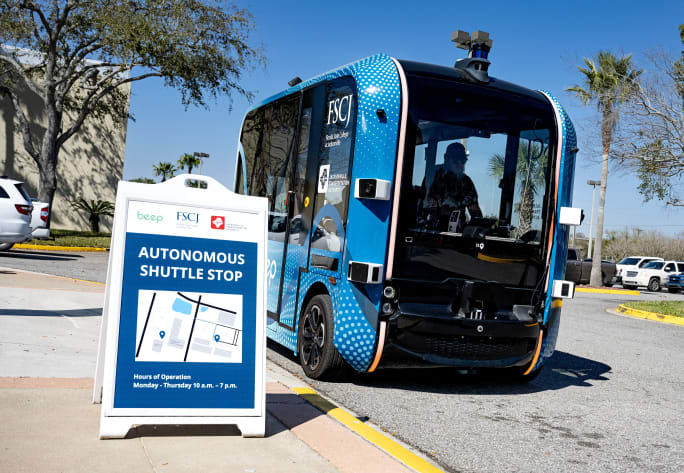
The shuttles operated by Beep, which incorporate self-driving software from Oxa, will connect students, faculty, and visitors across the segmented FSCJ Downtown Jacksonville campus on a one-mile route that connects the Advanced Technology Center with four buildings on campus.
Photo: Beep/JTA
4 min to read
The Jacksonville Transportation Authority (JTA) and Florida State College at Jacksonville (FSCJ) are launching autonomous vehicles (AV) on FSCJ's downtown campus, becoming the first college campus in the state of Florida to receive autonomous shuttles for students and visitors.
“This initiative is a testament to years of hard work and collaboration between the private and public sector, including the U.S. Department of Transportation,” said JTA CEO Nat Ford about the project. “We are eager for the FSCJ campus and the wider Jacksonville community to experience these AVs firsthand to see the benefits these vehicles bring as we prepare for the launch of Phase 1 of the U2C program, the Bay Street Innovation Corridor, in 2025.”
Ad Loading...
Expanding a Partnership
In 2020, JTA and FSCJ executed a joint Memorandum of Understanding to explore ways to educate, transport, and improve roadway and pedestrian safety through enhanced mobility options in the City of Jacksonville.
The shuttles operated by Beep, which incorporate self-driving software from Oxa, will connect students, faculty, and visitors across the segmented FSCJ Downtown Jacksonville campus on a one-mile route that connects the Advanced Technology Center with four buildings on campus.
“JTA have been partnering for a couple of years in this important area of technology to advance the testing of autonomous vehicles, but also to develop a unique curriculum to extend the FSCJ program for legacy automotive maintenance and engineering that includes the future of electric and autonomous platforms in their student studies,” said Joe Moye, CEO at Beep about his company’s role in the partnership. “Beep supported FSCJ in the creation of that curriculum and is putting in place internships to ready our workforce of the future. This places Jacksonville and FSCJ in a leadership position in this area.”
In 2020, JTA and FSCJ executed a joint Memorandum of Understanding to explore ways to educate, transport, and improve roadway and pedestrian safety through enhanced mobility options in the City of Jacksonville.
Photo: Beep/JTA
Building AV Shuttle Capabilities
The launch of the electric and autonomous platforms builds upon years of testing and validation done by JTA at the FSCJ Cecil North Campus test and learn track and at the Armsdale Test and Learn Center. Both facilities are devoted to evaluating the “best of breed” autonomous technologies ahead of Phase 1 of the U2C, known as the Bay Street Innovation Corridor, in 2025.
The FSCJ shuttles’ autonomous capability is delivered by Oxa Driver software, which has safety as a key design principle.
Ad Loading...
“When JTA started its testing almost eight years ago, the technology was far more limited. We went from single sensor technology to fused vision and sensor technologies that provide a much faster and more complete picture of the roadway than a human, with the additional benefits of never being distracted and the ability to respond to an event three times faster than a human,” said Moye about the evolution of AV shuttle tech. “To use one simple example, think of how phone camera technology has advanced over the past several years — it’s a good comparison to how vision technologies have improved to enable ever-greater capabilities in autonomous technologies.”
The launch of the electric and autonomous platforms builds upon years of testing and validation done by JTA at the FSCJ Cecil North Campus test and learn track and at the Armsdale Test and Learn Center.
Photo: Beep/JTA
The U2C Program
The first phase of the U2C program will implement a full-scale autonomous shuttle network with connected technology down Bay Street in 2025.
The entire U2C program comprises three main phases. Each will incrementally build the 10-mile transportation network connecting key downtown Jacksonville corridors, including the Sports/Entertainment District, the Downtown Northbank, and Southbank, with branches into surrounding neighborhoods.
“The initial downtown U2C program creates arterial services that provide extended mobility options to further activate the downtown area and connect surrounding communities,” said Moye. “With the planned development underway in downtown Jacksonville, the need to provide safe, convenient transportation will be an important element of this revitalization and will be a key tenet in attracting businesses, residents, and visitors to both sides of the river downtown.”
Ultimately, the partners in the project hope the U2C program, and other similar programs taking place here in the U.S., will prove the long-term viability of autonomous shuttles as yet another viable mobility alternative.
Ad Loading...
“Autonomous technologies will have a huge societal impact in many areas,” said Moye. “Having the flexibility to provide on-demand services, flexible routes, and more convenient public transit will transform public transportation while enabling the revitalization of so many urban areas through affordable and extensible options as compared to fixed rail and other such systems that take significant time and dollars.”
CEO Magnus Friberg discusses Luminator’s shift toward becoming a digital partner, the growing importance of software and interoperability, and how AI can help agencies improve operations and passenger experience.
Reliability-Centered Maintenance helps transit agencies move beyond routine checklists to focus limited resources on the assets and failures that have the greatest impact on safety, reliability, and service.
More than 1,500 buses now feature upgraded technology designed to improve arrival predictions and provide free Wi-Fi, with deployment expected to reach nearly 2,000 buses by the end of 2026.
John Hroncich discusses BAE Systems’ modular and scalable approach, lessons learned from decades of real-world operations, and how agencies can identify electrification strategies that fit their fleets.
In METRO's latest installment, we take a look at recent news from Complete Coach Works, Beep, FlixBus, and more partnerships making headlines across the transportation sector.
What if transit leaders could ask any operational question and get a trusted answer in seconds? Conversational AI is transforming how agencies use their data.
More than $191 million in federal funding will help three transit agencies replace aging rail vehicles and support a new autonomous shuttle service in Chattanooga.
LA Metro’s Obed Mejia discusses technician training, evolving maintenance technology, fleet replacement, and strategies for getting the most out of today’s transit fleets.
In METRO's latest installment, we take a look at recent news from Siemens, Prevost, Dodge, and more partnerships making headlines across the transportation sector.
Pedestrian microsimulation is helping rail planners identify bottlenecks, test station designs, and prepare complex transit hubs for growing passenger volumes.