



California High-Speed Rail Authority Signs MOU to Advance High Desert Corridor
The agreement deepens collaboration between the California High-Speed Rail Authority and the High Desert Corridor Joint Powers Agency, supporting design integration, cost savings, and faster delivery of a key Southern California rail link.

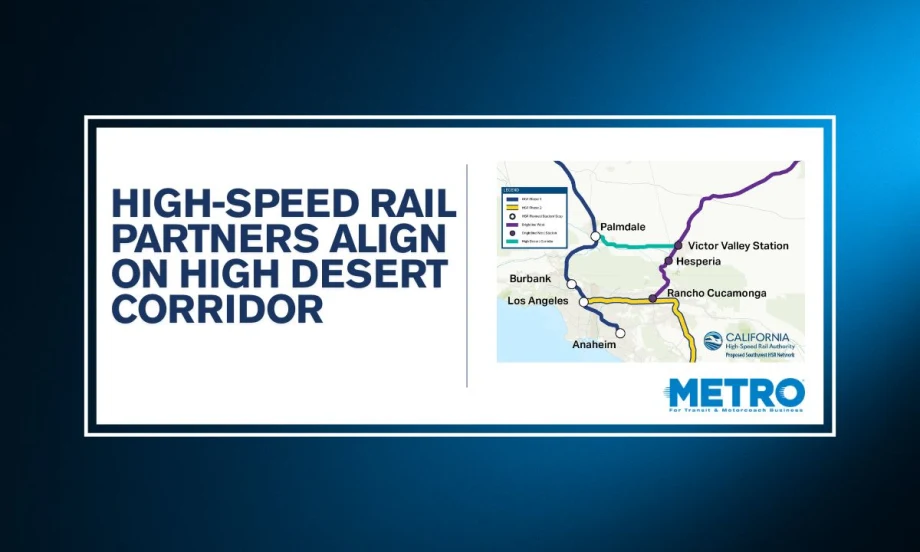
The approximately 54-mile corridor is envisioned as a regional connector between the California High-Speed Rail system, Metrolink, and Brightline West, providing seamless travel between California's Antelope Valley, the Victor Valley, and eventually Las Vegas.
METRO
- A memorandum of understanding has been signed between the California High-Speed Rail Authority and the High Desert Corridor Joint Powers Agency.
- This agreement focuses on enhancing collaboration for designing and integrating the High Desert Corridor rail link in Southern California.
- The partnership aims to achieve cost savings and expedite project delivery for this crucial transportation link.
*Summarized by AI
The California High-Speed Rail Authority (Authority) signed a new Memorandum of Understanding with the High Desert Corridor Joint Powers Agency (HDC JPA), a major step in advancing California’s vision for a statewide electrified high-speed rail network.
Through the MOU, the Authority and HDC JPA will deepen coordination on environmental clearances, station integration, and design, particularly at Palmdale Station.
Additionally, by working together, the Authority and HDC JPA will seek to reduce costs to the public and accelerate delivery through coordinated materials purchases and construction.
HDC JPA is comprised of Los Angeles County, Los Angeles County Metropolitan Transportation Authority (LA Metro), the cities of Palmdale and Lancaster in Los Angeles County, and the cities of Adelanto and Victorville in San Bernardino County.
The HDC JPA also leads the High Desert Multipurpose Corridor, including the first phase high-speed intercity rail connection between Palmdale and Victor Valley.
“As we prepare to begin track, electrification, and systems installation in the Central Valley later this year, this new partnership underscores the momentum behind building a clean, modern transportation system that will serve Californians for generations,” said Ian Choudri, CEO at the Authority.
About the HDC Project
As previously featured in METRO, the HDC is a planned high-speed rail connection that would link Palmdale and Apple Valley, creating a critical missing segment in Southern California's emerging passenger rail network.
The approximately 54-mile corridor is envisioned as a regional connector between the California High-Speed Rail system, Metrolink, and Brightline West, providing seamless travel between California's Antelope Valley, the Victor Valley, and eventually Las Vegas.
Designed to improve mobility in one of the nation's fastest-growing regions, the project would serve communities across Los Angeles and San Bernardino counties, where affordable housing has fueled population growth, but transportation options have not kept pace. The corridor is expected to significantly reduce commute times for residents traveling to employment centers while expanding access to education, healthcare, and other essential destinations.
Project leaders emphasize that the HDC is more than a transportation investment. The corridor would improve connectivity for historically underserved and disadvantaged communities, support regional economic development, create construction and long-term employment opportunities, and encourage transit-oriented growth.
By linking with larger statewide and interstate rail networks, the project also aims to strengthen Southern California's multimodal transportation system and improve access to major economic and tourism destinations.
As an electrified high-speed rail line, the HDC is expected to deliver substantial environmental benefits by reducing automobile dependence, lowering greenhouse gas emissions, and decreasing vehicle miles traveled. The project aligns with California's climate and mobility goals while offering an alternative to expanding highway capacity in a rapidly growing region where additional roadway construction has become increasingly challenging.
"Residents have been flocking to this area for more than 30 years because it offers some of the most affordable housing in the region," said HDC Joint Powers Authority Chair Kathryn Barger in 2022 about the project. "This trend will continue well into the future. But as the region continues to grow, so will mobility challenges, as many tens of thousands of individuals will engage in commutes to the greater L.A. basin for employment, education, and other opportunities."
High-Speed Rail Progress
Work continues daily on the high-speed rail project, with major segments from Merced to Bakersfield under design and construction. Nearly 90 miles of guideway are complete, along with 61 fully completed major structures and 30 more structures underway across Madera, Fresno, Kings, and Tulare counties.
The project continues to advance statewide, with 463 miles of the 494-mile San Francisco to Los Angeles/Anaheim system fully environmentally cleared and construction-ready.
Throughout construction, the project has created nearly 19,200 good-paying jobs — most filled by Central Valley residents — and generated nearly $27 billion in economic impact and growth across the state, according to the Authority, with up to 1,700 workers reporting to high-speed rail construction sites each day.
Quick Answers
The MOU is aimed at enhancing collaboration between the California High-Speed Rail Authority and the High Desert Corridor Joint Powers Agency to support design integration, achieve cost savings, and expedite the delivery of a key rail link in Southern California.
*Summarized by AI
More Rail

Report Examines NJ TRANSIT Reliability, Funding Challenges
The Garden State Initiative analysis examines the roles of Amtrak infrastructure, fleet management, and agency operations while recommending a more performance-based approach to improving reliability.
Read More →
Stadler, CapMetro Sign Long-Term Rail Fleet Support Agreement
Beginning in 2027, Stadler will provide on-site technical expertise, spare parts support, training, and obsolescence management to help extend the reliability and longevity of CapMetro’s GTW fleet.
Read More →
Biz Briefs: Alstom Lands Canadian Contract, LYT to Supply California TSP, and More
In METRO's latest installment, we take a look at recent news from Complete Coach Works, Beep, FlixBus, and more partnerships making headlines across the transportation sector.
Read More →
CATS Gold Line Marks 5 Years of Service, 2.8M Passenger Trips
With a six-mile expansion planned, the Charlotte streetcar is positioned to connect more neighborhoods and major transit hubs across the region.
Read More →
Why Simulating Pedestrian Movement Has Become Essential for Modern Rail Stations
Pedestrian microsimulation is helping rail planners identify bottlenecks, test station designs, and prepare complex transit hubs for growing passenger volumes.
Read More →
Amtrak Begins Major Construction at New York’s Sunnyside Yard
The new maintenance facility will support Amtrak’s Airo trainsets while improving maintenance efficiency and turnaround times in New York.
Read More →
Chicago Leaders Unveil Plans for O’Hare Airport Express Train
The privately developed project would offer a 15-minute trip between downtown and O’Hare’s Terminal 2, with trains operating every 15 minutes on a dedicated track. The service would use battery-electric trains and three existing freight rail rights-of-way.
Read More →
OCTA Maps Out 30-Year Strategy to Protect Coastal Rail Corridor
The draft feasibility report identifies strategies to protect the coastal rail line for decades as the agency continues near-term stabilization and sand placement efforts.
Read More →
The Business Voice Behind Public Transportation
As chair of APTA’s Business Members Board of Governors, Ray Melleady explains how more than 850 business members are partnering with transit agencies to advance funding, innovation, and industry-wide collaboration.
Read More →
FRA Announces $5.3B in Rail Investments, Including $2B for Amtrak
Funding will support grade-crossing improvements, infrastructure upgrades, and new Amtrak equipment in 23 states.
Read More →