



CharterUP Expands Into New Mobility and Autonomous Transportation
Vice President of New Mobility Stephen Joos discusses how CharterUP is leveraging its nationwide transportation network, technology platform, and autonomous vehicle partnerships to expand into workforce mobility, campus shuttles, and transit solutions.

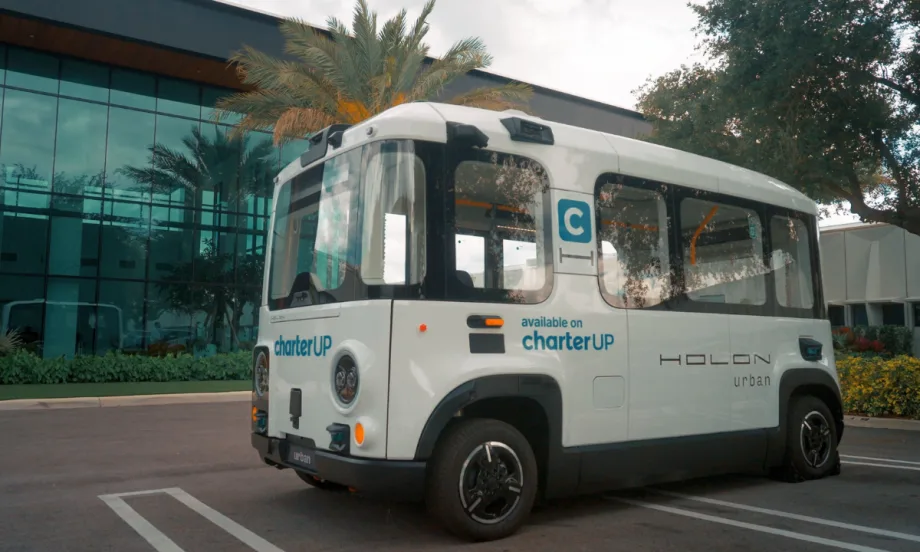
Leveraging a nationwide network of more than 800 operators and 10,000 vehicles, CharterUP is applying its technology platform to recurring transportation services while exploring how autonomous vehicles can complement traditional transit operations.
CharterUP
- CharterUP is utilizing its extensive transportation network to enter the workforce mobility sector.
- The company plans to implement its technology platform to enhance campus shuttle and transit services.
- Partnerships in autonomous vehicles are integral to CharterUP's strategic expansion efforts.
*Summarized by AI
As CharterUP continues to grow beyond its roots as a charter bus marketplace, the company is expanding into workforce mobility, shuttle operations, and autonomous transportation.
Leveraging a nationwide network of more than 800 operators and 10,000 vehicles, CharterUP is applying its technology platform to recurring transportation services while exploring how autonomous vehicles can complement traditional transit operations.
METRO Executive Editor Alex Roman recently spoke with Stephen Joos, Vice President of New Mobility at CharterUP, about the company's evolution, its investments in technology, partnerships in the autonomous vehicle sector, and how it sees new mobility solutions supporting campuses, employers, and public transportation providers.
Expanding into Mobility and More
Q: CharterUP has been in the charter bus space for a long time. What led the company to expand into mobility services and autonomous transportation?
Joos: CharterUP was founded in 2017 and grew quickly to become a leader in the charter transportation market. While companies like Uber and Lyft focus on smaller passenger vehicles, CharterUP simplified the process of booking larger vehicles. As our footprint expanded across the US, we began seeing opportunities for recurring transportation needs, including shuttle services and other innovative mobility programs.
Today, we leverage a network of approximately 800 operators and 10,000 vehicles. That allows us to provide technology, compliance support, and operational expertise to transportation providers that may not otherwise have access to those resources. It also enables us to create customized mobility solutions for customers across a variety of markets.
Q: What types of markets are you targeting as you expand these services?
Joos: Campuses are a major focus for us because they are ideal environments for optimized transportation solutions. That includes universities, corporate campuses, workforce mobility programs, and crew transportation.
We also operate some of the most complex airport shuttle programs in the country, running 24 hours a day and transporting millions of passengers annually. Managing numerous programs at that scale has helped us develop significant expertise in shuttle operations.
The Growing AV Landscape
Q: How did CharterUP become involved in autonomous vehicle programs, and how is that effort progressing?
Joos: It was really a natural evolution. Transportation operators continue to face challenges such as driver shortages, rising labor costs, and increasing fuel expenses. Customers began asking how autonomy could help improve efficiency and what the timeline looked like for autonomous vehicle deployment.
We see autonomy as a transition rather than an overnight change. Operators still need traditional, human-driven transportation services, but autonomy can gradually be integrated where it makes sense. Because CharterUP already manages transportation networks and has access to a large operator base, we can support that transition while maintaining service reliability.
When evaluating autonomous vehicle partners, we wanted a purpose-built vehicle with meaningful passenger capacity. We weren't interested in deploying fleets of small vans because that doesn't align with goals such as reducing congestion on campuses. Holon stood out because of its 15-passenger autonomous vehicle platform, which fit our vision for scalable mobility solutions.
Q: How much do you think the COVID-19 pandemic affected the development of autonomous transportation?
Joos:COVID had a significant impact on the entire group transportation industry. Charter transportation was hit particularly hard because people weren't traveling in groups.
The pandemic also created supply chain challenges involving batteries, infrastructure, and vehicle production. At the same time, sectors like last-mile delivery experienced tremendous growth, which accelerated investment in autonomous logistics solutions. On the passenger transportation side, demand largely disappeared during that period.
That said, the underlying technologies continued to advance. LiDAR, sensors, computing systems, and other autonomous vehicle technologies kept improving, and today's mobility providers benefit from those advancements.
Q: You mentioned campuses and other controlled environments. Are smaller transit agencies also potential partners?
Joos: Absolutely. Historically, much of our work has centered on flexible transportation solutions, including bus bridges, construction-related transportation, crew movements, and workforce mobility.
That's one reason we're active at industry events like APTA. CharterUP is investing in the transit space and exploring opportunities where our model can help agencies meet transportation needs efficiently and flexibly.
Investing in Platform and Tech
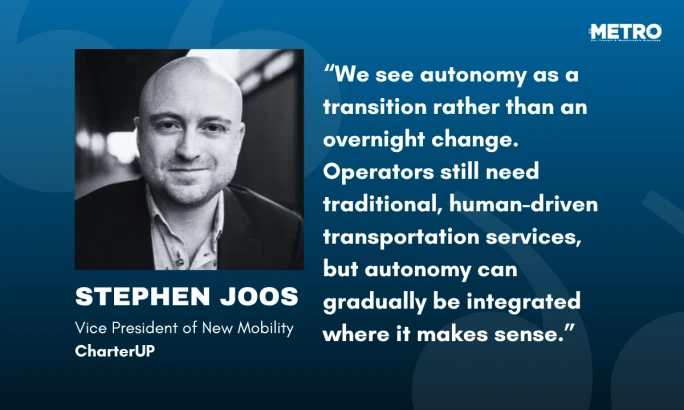
METRO Executive Editor Alex Roman recently spoke with Stephen Joos, Vice President of New Mobility at CharterUP, about the company's evolution and more.
CharterUP/METRO
Q: CharterUP has also made significant investments in its platform and technology. Can you talk about that?
Joos: We completed a substantial Series A funding round of roughly $60 million, and those resources were invested directly into our platform and business growth.
The company has performed very well, and that investment has allowed us to continue expanding. That's part of what attracted both me and my colleague Pete to CharterUP. We see tremendous opportunity to apply the company's existing transportation network to new mobility solutions.
One of our advantages is that we can leverage existing assets rather than purchasing entirely new fleets for every project. That creates flexibility in both deployment and cost. Given today's high interest rates and capital costs, utilizing existing transportation resources is a more sustainable approach.
Q: Who do you see as CharterUP's competitors in this space?
Joos: Companies such as Via, Spare, and RideCo operate in similar areas, but the mobility industry is highly collaborative. Often, opportunities that aren't a good fit for one company are referred to another.
What I appreciate about this sector is that organizations frequently work together to solve transportation challenges. There's competition, but there's also a strong sense of partnership when it comes to advancing mobility solutions.
Q: Is there anything else you'd like to add?
Joos: One milestone we're especially proud of is the scale we've achieved. Earlier this year, CharterUP surpassed 10,000 vehicles in its network, reached 50 million miles traveled, and moved 25 million passengers.
Those accomplishments demonstrate that we're not standing still. We're continuing to invest, grow, and expand the ways we can support mobility across the country.
Quick Answers
CharterUP is expanding into workforce mobility by leveraging its nationwide transportation network and technology platform to provide tailored mobility solutions for employees.
*Summarized by AI
More New Mobility

From Hardware to Digital Partner: Luminator Charts Its Next Chapter
CEO Magnus Freiberg discusses Luminator’s shift toward becoming a digital partner, the growing importance of software and interoperability, and how AI can help agencies improve operations and passenger experience.
Read More →
Biz Briefs: Alstom Lands Canadian Contract, LYT to Supply California TSP, and More
In METRO's latest installment, we take a look at recent news from Complete Coach Works, Beep, FlixBus, and more partnerships making headlines across the transportation sector.
Read More →
CharterUP’s Armir Harris on Technology, AI, and the Future of Group Mobility
In a recent episode of METROspectives, CharterUP Founder/CEO Armir Harris discussed the company’s evolution from an online charter bus marketplace into a technology platform supporting public- and private-sector mobility and much more.
Read More →
Jacksonville’s NAVI Project Charts a New Course for Autonomous Public Transportation
Through its NAVI program, JTA is showing how autonomous vehicles, intelligent infrastructure, and coordinated operations can work together to deliver everyday public transportation.
Read More →
Biz Briefs: Luminator Marks Milestone and More
From manufacturers and suppliers to transit agencies and motorcoach operators, these updates offer a snapshot of the projects, partnerships and business moves driving the industry forward.
Read More →
New Tricks for Old Bureaucracies: Joshua Schank on Making Transit Innovation Stick
Former LA Metro Chief Innovation Officer Joshua Schank discusses why good ideas aren't enough, how transit agencies can overcome resistance to change, and why today's challenges demand more innovation.
Read More →
How DART's GoPass Is Redefining Regional Mobility
Serving 14 transit agencies, GoPass simplifies multimodal travel by allowing riders to plan, pay for, and manage an entire trip through one app.
Read More →
Biz Briefs: OCTA Taps Clean Energy for Hydrogen Station, Stadler to Supply Via Rail Vehicles, and More
From manufacturers and suppliers to transit agencies and motorcoach operators, these updates offer a snapshot of the projects, partnerships and business moves driving the industry forward.
Read More →
METRO Magazine Announces 2026 Innovative Solutions Awards Winners
Projects Recognized for Advancing Mobility Through Technology, Accessibility, Workforce Innovation, and Operational Excellence
Read More →
Biz Briefs: STV teams with Amtrak, Motorcoach Operators Boost Fleet and Land Contracts, and More
From manufacturers and suppliers to transit agencies and motorcoach operators, these updates offer a snapshot of the projects, partnerships and business moves driving the industry forward.
Read More →