The Simple Way to Buy, Deploy Digital Fare Systems
The fear of the hassle and complexity of procurement is why decision makers in transit agencies often delay the introduction of new fare collection systems.
by By Brian Frank, GM, Kuba North America
March 15, 2024
With the collaborative approach, pioneers such as ticketing technology specialist, Kuba, and payment service provider, Littlepay, have delivered “tap-to-ride” systems in cities like Besançon in France.
Photo: Kuba North America
5 min to read
Jumping feet first into a process you know will stretch your time and budget to the limit is nobody’s idea of fun. The fear of the hassle and complexity of procurement is why decision makers in transit agencies often delay the introduction of new fare collection systems.
New ways to implement digital ticketing could provide reassurance, however — enabling transit agencies to feel the fear and do it anyway.
Ad Loading...
The Dreaded RFP
It’s a rigmarole transit agencies dread. To procure a fare system, they must develop a Request for Proposal (RFP) document. Those pages of requirements and specifications are the culmination of months of consultancy, meetings, drafts, and re-drafts. Eventually, it’s ready to issue and a formal bidding process begins, inviting vendor responses.
Ironically, it’s the agency — not the technical experts that provide these solutions — that has to determine how the system will work. They must ensure every last detail of the spec they need is covered. Even with the support of consultants, it’s a complex undertaking and a drain on time. Frustratingly, it takes them away from the day-to-day of serving their riders.
Added to which, the high specification of a product, and the expectation one vendor will provide it, beats competition out of the marketplace. Typically, respondents to the RFP will be suppliers of expensive design-build-operate-and-maintain solutions. Specialists that could provide “lots” of a cheaper, more flexible modular solution are left out in the cold.
Doing Things Differently
It's been more than a decade since open payments and mobile ticketing arrived on transport networks — with London and Boston among the major cities leading the charge. In that time, the mobility sector has caught the eye of technology and payments innovators. Determined to break the mold, they are rethinking the way fare systems are built and purchased.
Instead of monolithic products being designed to meet rigid specifications, they have deconstructed the model into components that can be provided separately and then integrated.
Ad Loading...
In a contactless open payment system, for example, we are seeing suppliers working together to integrate their fare validators, transit back offices, and payment services.
This type of modular fare collection system can be provided out-of-the-box. With an open architecture, there’s more vendor choice for transit agencies and they can select solutions that fit their needs and budget.
With this approach, transit agencies don’t need to do all that legwork to define how their system will work. It plugs-and-plays, with configurable elements, such as travel products and fare structures that can be tested and optimized.
Trailblazing in California
With the collaborative approach, pioneers such as ticketing technology specialist, Kuba, and payment service provider, Littlepay, have delivered “tap-to-ride” systems in cities like Besançon in France. And across the Atlantic, they are also integral to a groundbreaking initiative with the State of California and the California Integrated Travel Project (Cal-ITP).
To make it easier and cost-effective for transit agencies to buy contactless fare collection systems, the State has awarded Master Service Agreements to vendors who supply the components needed to offer contactless fare collection. Transit agencies can select products and services via the Cal-ITP Mobility Marketplace and buy them directly from The California Department of General Services (DGS), taking advantage of pre-negotiated fees.
Ad Loading...
Kuba, Littlepay, and payment processor Elavon have been chosen by transit agencies in Monterey (MST), Santa Barbara (SBCAG, SBMTD), Northern California (CCJPA), and South Carolina (Coast RTA) to supply their parts of a contactless system. Over the last few years, several successful contactless demos have been launched and are transitioning to roll-out.
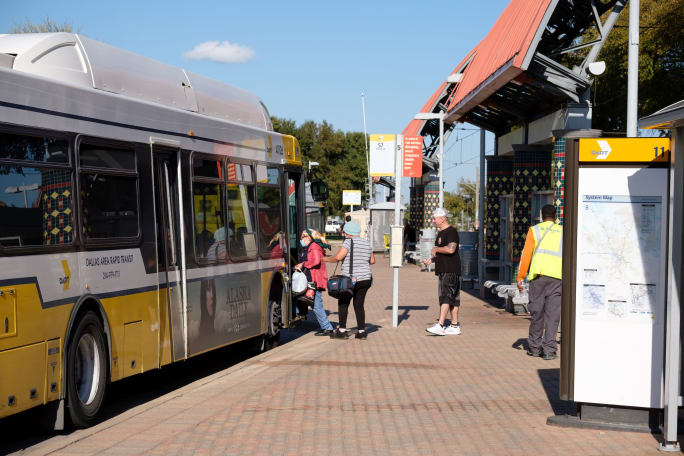
Dallas Area Rapid Transit’s award-winning GoPass app is now used by eight agencies.
Photo: DART
Mobile Platform Made for Sharing
Mobility-as-a-Service is another technology becoming easier to deploy. Similarly to contactless fare collection, the key is to cut ties with the idea of designing and buying proprietary systems and focus on finding a ready-made solution that can be adapted.
Agile and scalable, with toggle-on or -off functionality, a cloud-based platform can power any number of apps. The potential of this type of system is making an impact in Texas. Dallas Area Rapid Transit’s (DART’s) award-winning GoPass app is now used by eight agencies.
Originally developed for mobile ticketing, it has evolved into one of the most comprehensive Mobility-as-a-Service solutions in the U.S.
Providing a single app for planning and paying for public transport and microtransit services, it enables transit agencies to offer seamless multimodal journeys from the first and last mile.
Ad Loading...
GoPass is powered by Kuba’s mobility platform, but it is owned by DART and any transit agency that wants to come on board can buy the app directly from them. It can be deployed as “GoPass” or agency-branded. With DART’s deep knowledge of the platform, its team is an excellent support for onboarding and delivers an efficient roll-out in just a few weeks.
Partnerships Drive Progress
These examples of simplified procurement processes show the power of partnerships to ease the adoption of new technologies.
They place the onus on technical experts to provide best-in-class solutions that can be reused, rather than reinvented time and again.
With collaboration between technology leaders, transit agencies, and government, the industry is beginning to challenge the way things have always been done. This disruption could save transit agencies precious time and money and enable them to focus on what counts most: serving riders, connecting the community, and increasing opportunities.
Brian Frank is GM Kuba in North America. With a heritage in fare collection spanning three decades, Kuba launched in 2019 to bring a fresh idea to the mobility payments space.
CEO Magnus Friberg discusses Luminator’s shift toward becoming a digital partner, the growing importance of software and interoperability, and how AI can help agencies improve operations and passenger experience.
Reliability-Centered Maintenance helps transit agencies move beyond routine checklists to focus limited resources on the assets and failures that have the greatest impact on safety, reliability, and service.
More than 1,500 buses now feature upgraded technology designed to improve arrival predictions and provide free Wi-Fi, with deployment expected to reach nearly 2,000 buses by the end of 2026.
John Hroncich discusses BAE Systems’ modular and scalable approach, lessons learned from decades of real-world operations, and how agencies can identify electrification strategies that fit their fleets.
In METRO's latest installment, we take a look at recent news from Complete Coach Works, Beep, FlixBus, and more partnerships making headlines across the transportation sector.
What if transit leaders could ask any operational question and get a trusted answer in seconds? Conversational AI is transforming how agencies use their data.
More than $191 million in federal funding will help three transit agencies replace aging rail vehicles and support a new autonomous shuttle service in Chattanooga.
LA Metro’s Obed Mejia discusses technician training, evolving maintenance technology, fleet replacement, and strategies for getting the most out of today’s transit fleets.
In METRO's latest installment, we take a look at recent news from Siemens, Prevost, Dodge, and more partnerships making headlines across the transportation sector.
Pedestrian microsimulation is helping rail planners identify bottlenecks, test station designs, and prepare complex transit hubs for growing passenger volumes.