



Darryl Haley Announces Departure from Cincinnati’s Metro
During his tenure, Haley has played a pivotal role in transforming Metro into a world-class transit system and a key economic driver for the Greater Cincinnati region.

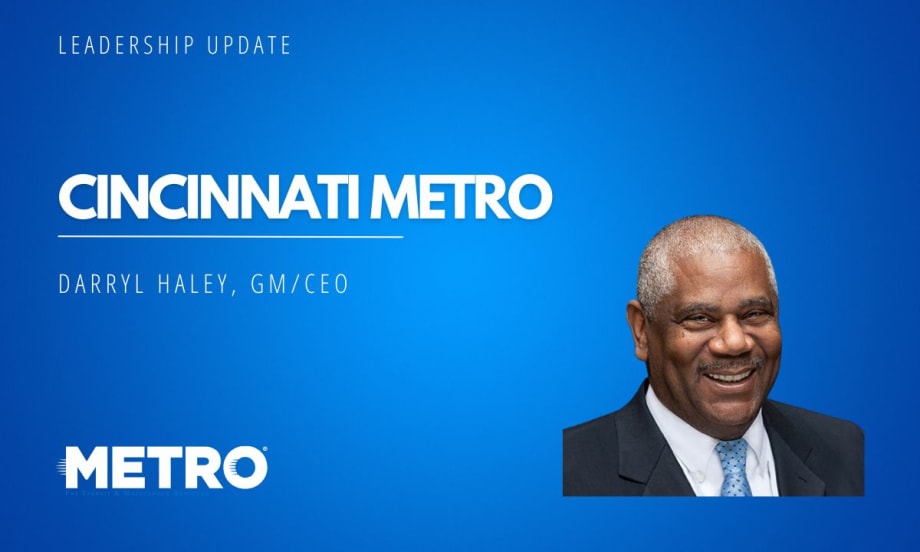
Darryl Haley began his career at Metro as the customer relations manager, focusing on enhancing the customers’ experience.
Photo: Metro
After 19 years of dedicated service to Cincinnati’s Metro, including the last five years as CEO/GM, Darryl Haley plans to retire on June 1.
During his tenure, Haley has played a pivotal role in transforming Metro into a world-class transit system and a key economic driver for the Greater Cincinnati region.
“Darryl has been a remarkable leader and change maker for transit, not only in our region, but on a national level as well,” said Blake Ethridge, chairman of Metro’s board. “We applaud his leadership, dedication, and innovation in transforming Metro into the transit system this region deserves and needs.”
Haley’s Career
Haley began his career at Metro as the customer relations manager, focusing on enhancing the customers’ experience.
He’s since held progressive leadership roles, including serving as executive director, development; executive VP; COO; and deputy GM, before becoming CEO.
“Together with an amazing staff and public support, we’ve been able to achieve extraordinary milestones that have positioned us as a national leader in public transportation,” said Haley. “We secured the first countywide sales tax levy dedicated to transportation. We contributed to the improvement of infrastructure projects throughout the county. We revolutionized transit in our region with innovative new services and improvements that now connect more people to better-paying jobs, quality healthcare and education. In short: We have demonstrated what’s possible for our region when we invest in public transit.”
Impact at Cincinnati’s Metro
Under Haley’s leadership, Metro has achieved several historic milestones, including:
Testifying before Congress on behalf of the transit industry in support of the historic and largest ever federal investment in public transportation through the bipartisan Infrastructure Investment and Jobs Act.
Investing more than $317 million to improve roads, sidewalks, bridges, and other transit-related infrastructure through the Metro Transit Infrastructure Fund for 100-plus projects in Hamilton County.
Signing a labor agreement to provide historic wage and benefit increases to support quality-of-life improvements for Metro’s operators and maintenance workers.
Implementing 24-hour service for the first time in the agency’s history.
Launching the new MetroNow! on-demand service in two zones.
Laying the framework for the development of bus rapid transit (BRT) to enhance mobility and economic development.
Creating the Regional Paratransit Collaboration with seven counties to improve service connectivity for riders with disabilities.
Maintaining full service and avoiding job losses with a focus on public safety while navigating the challenges of the COVID-19 pandemic.
Leading the nation in post-pandemic ridership recovery.
“These accomplishments are a testament to the incredible team at Metro,” said Haley. “Every employee, whether they work behind the wheel, turn a wrench, or in the office, plays a vital role in delivering exceptional service to our community. It has been an honor to work alongside such dedicated professionals.”
What’s Next for Metro?
A search for Haley’s successor will be announced in the coming months.
In the meantime, Haley remains committed to guiding Metro through a seamless transition and ensuring the organization is well-positioned for future success, while it remains focused on continuing to deliver on its promises of expanding access to safe, reliable, and innovative transit solutions.
More Management

METRO Opens Submissions for 2026 Motorcoach Awards
Nominations are now being accepted for METRO Magazine’s Operator of the Year and Innovative Operator of the Year awards.
Read More →
New York MTA Advances Final Contract for Second Avenue Subway Expansion
Contract Four is the largest in the Second Avenue Subway Phase 2 project and includes construction of station infrastructure, tracks, and signals for the subway expansion, MTA officials said. Work on Contract Four will begin in 2027.
Read More →
Transit Agencies Highlight Safety Gains at National Summit
Leaders from 15 major transit systems shared crime-reduction results and safety initiatives while discussing the role of continued federal support.
Read More →

NITA Names New Leadership, Expands Reduced-Fare Program at First Board Meeting
The new regional transit authority appointed its first board chair and interim executive director while extending reduced fares across CTA, Metra, and Pace for eligible riders.
Read More →
Beyond the Checklist: A Structured Approach to Transit Maintenance
Reliability-Centered Maintenance helps transit agencies move beyond routine checklists to focus limited resources on the assets and failures that have the greatest impact on safety, reliability, and service.
Read More →
APTA 2026 Nominating Committee Selects Leadership Slate, Names Chair and Vice Chair Nominees
Leadership changes will help shape the association’s priorities and its representation of the transportation industry during the 2026–2027 term.
Read More →
DART Launches Major Security, Fare Enforcement Initiative
The 90-day demonstration will deploy coordinated security teams at five light rail stations while testing controlled access and gathering data to guide future investments.
Read More →
Advancing Fare Collection Through Technology and Innovation
Learn about delivering 1300 gates at 91 stations while managing fare evasion. Explore the large scale deployment, solution customization and real-world results that affect the region. Prepare for deployment in your region now.
Read More →
Game Day in Motion: Moving Millions During the 2026 World Cup
Between packed transit stations and team motorcoaches, see how agencies and operators across North America tackled the transportation demands of the 2026 FIFA World Cup.
Read More →
Surface Transportation Extension Averts Shutdown, Leaves Transit Funding Gap
The stopgap keeps federal transportation programs moving, but missing advance funding could complicate the transit and rail projects agencies are planning next.
Read More →