



Inside the EPA's Diesel Exhaust Fluid Fix and Its Impact on the Motorcoach Industry
Starting with model year 2027, EPA requirements state that all new diesel on-road trucks and motorcoaches must be engineered to avoid sudden and severe power loss after running out of DEF. Find out more about what led to the EPA's decision and how it will benefit operators.


When DEF runs out or a system sensor fails, current systems can force a vehicle to reduce speed or become inoperable drastically.
Photo: METRO
Alongside U.S. Small Business Administrator Kelly Loeffler at the Iowa State Fair, U.S. Environmental Protection Agency (EPA) Administrator Lee Zeldin issued clear guidance urging diesel engine and equipment manufacturers to revise diesel exhaust fluid (DEF) system software in existing vehicles and equipment, including motorcoaches, to prevent sudden speed and power losses caused by DEF systems, giving operators more time to repair faults without impacting productivity or safety.
“We have heard loud and clear from small businesses across the United States that the current DEF system is unacceptable,” said Zeldin. “We are responding to those concerns by calling on manufacturers to take action to update their software and eliminate the unnecessary sudden loss of power and frustrating shutdowns that too many Americans have experienced.”
What’s Changing With DEF: EPA Rules Starting in 2027
Starting with model year 2027, EPA requirements state that all new diesel on-road trucks and motorcoaches must be engineered to avoid sudden and severe power loss after running out of DEF.
To fix the problem for vehicles already in use, EPA’s new guidance, developed in collaboration with manufacturers, will work to ensure that the necessary software changes can be made on the existing fleet.
In addition to providing certainty to manufacturers about how EPA wants this issue resolved, the agency is not requiring separate approvals beyond those provided in EPA’s guidance, ensuring that there are no hurdles to delay manufacturers’ ability to put solutions into the field, according to officials.
EPA added that it remains committed to protecting air quality and public health while ensuring that engine operators can depend on the equipment they need, and that it will continue to work with all stakeholders to “ensure practical, durable solutions that simultaneously support emissions reductions and reliable operations.”
EPA released no exact timetable for the derating changes.
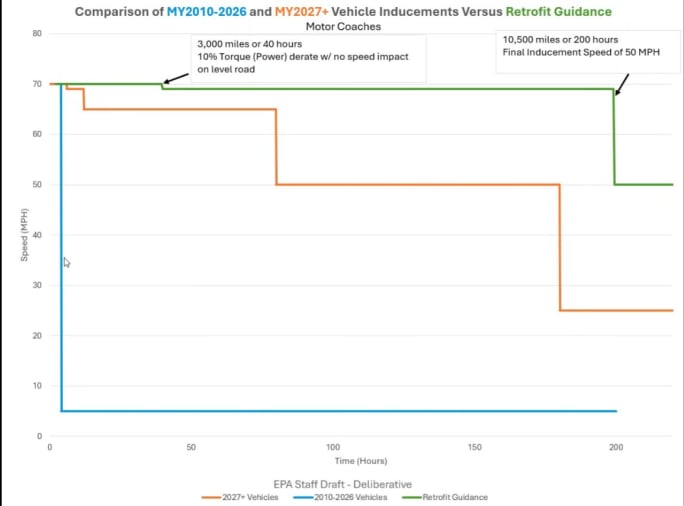
Under the new guidance, EPA has agreed to give operators 40 hours before a derate, which will be a 10% torque derate.
Photo: EPA
Remedying What Has Become an Ongoing Issue
When DEF runs out or a system sensor fails, current systems can force a vehicle to reduce speed or become inoperable drastically.
In many cases, vehicles are limited to as little as five miles per hour within hours of a DEF-related fault, causing significant disruptions.
Although this derate strategy was intended to ensure compliance with EPA’s Tier 4 Emissions Standards, it has caused frustration, operational delays, and real economic hardship for countless equipment operators.
Under the new guidance, EPA has agreed to give operators 40 hours before a derate, which will be a 10% torque derate.
“We will not have a speed derate until 200 hours of engine time, which will drop us to 50 miles per hour,” explained Phil Streif, co-owner and VP at Caseyville, Illinois’ Vandalia Bus Lines. “This gives us plenty of time to get the people to their destination or origin safely, along with us being able to get the bus back home to make the needed repairs.”
Since 2010, most on-road diesel trucks and many types of non-road equipment have used selective catalytic reduction (SCR) systems that inject DEF into exhaust streams to reduce nitrous oxide (NOx) emissions.
Streif said the announced EPA guidance is a literal game changer because derating not only impacted the motorcoach industry’s ability to provide services effectively but also the safety of the passengers it moved daily.
“We’re moving the most precious cargo there is, people, and derating created a profound safety risk for our driver and passengers,” said Streif. “To make things worse, it was difficult to find shops to repair a bus, since this issue occurred in the middle of nowhere and at all times of the day/night. I think I can speak for most operators, our stress level will now be way down.”
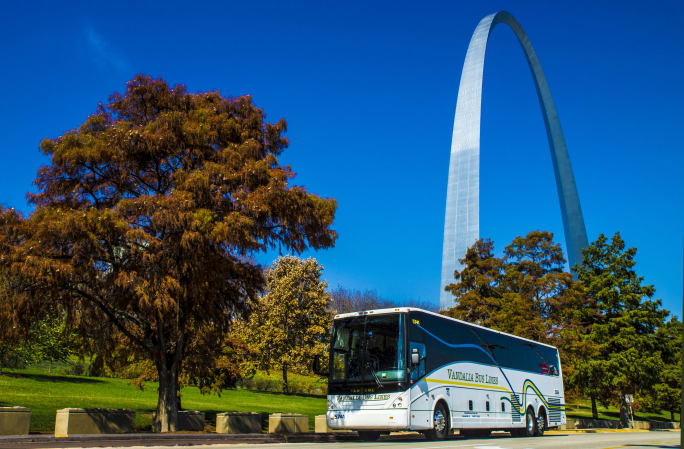
Vandalia Bus Lines' Phil Streif said that while he took the lead originally on behalf of the industry, the ABA, UMA, and IMG were big supporters for derating changes from the outset.
Photo: Vandalia Bus Lines
A Long Time in the Making
Streif explained that he has spearheaded the outreach to help change derating schedules for about five years because a four-hour window was not realistic for motorcoach operators to get something repaired.
“Luckily, the timing of my outreach was perfect, because EPA had been working on the 2027 heavy-duty NOx ruling and they were looking for input from the different industries that this would impact,” he said. “After countless meetings with EPA and CARB, we finally got relief for 2027 and beyond with a much more practical timeframe; however, the question remained on what could be done on existing fleets, and anything back to 2010 could still have these issues.”
After the NOx ruling went public, Streif said there was pushback from the engine manufacturers, forcing Streif and industry leaders from the American Bus Association (ABA), United Motorcoach Association (UMA), and International Motorcoach Group (IMG) to go back to the drawing board with approaching the EPA and CARB again to modify the parameters for vehicles on the road today.
Streif added that while he took the lead originally on behalf of the industry, the ABA, UMA, and IMG were big supporters from the outset.
“With their help and many of the members' feedback, we were able to collect hard data and surveys that helped us in providing factual statistics on the impact derates have,” he said. “Without the strength of these great organizations, we probably wouldn’t have had the results we were able to achieve.”
Streif said that when he initially reached out to EPA about adjusting the derating schedules for motorcoaches, they responded that they “didn’t even consider buses.”
In the future, he is optimistic that this positive step will go a long way in improving the industry’s stature on Capitol Hill.
“It has been stated before that our industry has been left out in the past, but I think that’s going to change going forward,” Streif said. “We were loud and clear, got our message across, and ended up with a great resolution. Now that we have the door open, we need to expand on the relationship we built, stay involved, and be vocal.”
More Technology

ENC Lands MATA Contract and More in Biz Briefs
In this edition of Biz Briefs, we spotlight the latest developments shaping the future of mobility.
Read More →
Strada360’s Steve Lassey on Turning Transit Data Into Better Decisions
From breaking down data silos to preparing for AI, Strada360 CEO Steve Lassey discusses how transit agencies can use technology to improve operations, customer information, and long-term decision-making.
Read More →
Almaviva Looks to Open Architecture to Advance Transit Technology
Eric Reese discusses how interoperability, open architecture, and modular design can help transit agencies control costs, reduce vendor lock-in, and upgrade technology without starting over.
Read More →

Driving Smarter Paratransit
John Hanlon shares how AlphaRoute is leveraging AI-powered technology to help paratransit providers optimize operations, support frontline staff, and enhance the rider experience.
Read More →
From Hardware to Digital Partner: Luminator Charts Its Next Chapter
CEO Magnus Friberg discusses Luminator’s shift toward becoming a digital partner, the growing importance of software and interoperability, and how AI can help agencies improve operations and passenger experience.
Read More →
Beyond the Checklist: A Structured Approach to Transit Maintenance
Reliability-Centered Maintenance helps transit agencies move beyond routine checklists to focus limited resources on the assets and failures that have the greatest impact on safety, reliability, and service.
Read More →
NJ TRANSIT Advances Bus Technology Upgrades Across Statewide Fleet
More than 1,500 buses now feature upgraded technology designed to improve arrival predictions and provide free Wi-Fi, with deployment expected to reach nearly 2,000 buses by the end of 2026.
Read More →
Building a Flexible Path to Transit Electrification
John Hroncich discusses BAE Systems’ modular and scalable approach, lessons learned from decades of real-world operations, and how agencies can identify electrification strategies that fit their fleets.
Read More →
Biz Briefs: Alstom Lands Canadian Contract, LYT to Supply California TSP, and More
In METRO's latest installment, we take a look at recent news from Complete Coach Works, Beep, FlixBus, and more partnerships making headlines across the transportation sector.
Read More →
From Legacy Silos to Conversational Intelligence
What if transit leaders could ask any operational question and get a trusted answer in seconds? Conversational AI is transforming how agencies use their data.
Read More →