



Designing Transit for an Aging America: A Conversation with SilverRide’s Jeff Maltz
SilverRide recently published a blog by its CEO/Founder, Jeff Maltz, “The Crucial Link of Aging in Place: Transportation That Works,” which explored how accessible, reliable mobility can make all the difference in helping seniors maintain independence.

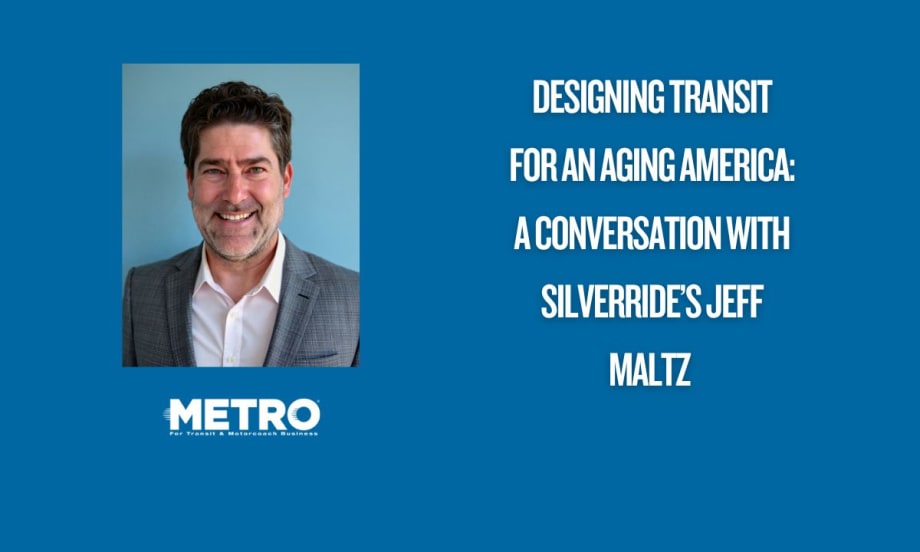
METRO’s Executive Editor Alex Roman spoke with SilverRide's CEO/Founder Jeff Maltz about addressing the most urgent gaps in current mobility systems, how effective mobility options can help reduce overall healthcare spending, and much more.
Photo: SilverRide/METRO
- Jeff Maltz discusses the importance of effective transportation in allowing seniors to age in place with independence.
- The blog by SilverRide's CEO highlights the role of accessible and reliable mobility solutions for elderly individuals.
- Ensuring suitable transportation options is crucial for supporting the autonomy and quality of life for aging populations.
*Summarized by AI
For older adults, the ability to age in place often depends on something as simple — and as essential — as getting where they need to go.
SilverRide, a company dedicated to providing safe, personalized transportation for older adults and individuals with mobility challenges, recently published a blog by its CEO/Founder, Jeff Maltz, “The Crucial Link of Aging in Place: Transportation That Works,” which explored how accessible, reliable mobility can make all the difference in helping seniors maintain independence and connection.
To dive deeper into this topic, METRO’s Executive Editor Alex Roman spoke with Maltz about addressing the most urgent gaps in current mobility systems, how effective mobility options can help reduce overall healthcare spending, and much more.
Gaps in Mobility and Finding a Balance
What do you see as the most urgent gaps in current mobility systems that need to be addressed first?
The Americans with Disabilities Act (ADA) is now 35 years old, and while we’ve made real progress in accessible transportation, it’s not enough. Considering that nearly 20% of Americans will be over age 65 by 2030, there is still a degree of mismatch between what older adults need and what is being provided in public transit and healthcare.
The biggest issue isn't just getting someone from point A to point B — it's those critical first and last 50 feet. Someone who can't safely walk to the curb, who needs guidance navigating uneven surfaces, or who requires assistance getting to a waiting room safely before their driver departs — these are real-world needs that curb-to-curb service doesn't address. This is why SilverRide is so focused on those first and last 50 feet with its passengers.
We're also seeing a complete disconnect between transportation and healthcare systems. When 3.6 million Americans miss care annually due to transportation barriers, we're not just talking about missed appointments — we're talking about preventable hospitalizations, medication non-compliance, and social isolation that accelerates decline. These systems need to talk to each other.
The other critical gap is cultural responsiveness. Transportation isn't one-size-fits-all. In our San Gabriel Valley partnerships, we primarily serve seniors who speak Cantonese and Mandarin. Having drivers who speak their language isn't a nice-to-have — it's essential for safety and independence.
How should public transit agencies think about the balance between fixed-route services, paratransit, and more flexible assisted mobility options as the population ages?
Transit agencies need to stop thinking about these as competing services and start thinking about them as an integrated mobility ecosystem. Fixed-route will always be the backbone, but paratransit and assisted mobility aren't afterthoughts — they're essential components serving a growing market.
Here's the reality: traditional paratransit is often the most expensive service transit agencies provide, and it's not meeting the actual needs of aging riders. We're seeing agencies partner with providers like SilverRide because we can deliver better outcomes at comparable or lower costs while improving rider satisfaction.
The key is understanding that different populations need different solutions. A 72-year-old with mild cognitive challenges needs something very different from a 55-year-old with mobility issues. Flexible assisted mobility fills gaps that rigid paratransit definitions can't address.
Smart agencies are looking at this demographic shift as an opportunity, not a burden. They're utilizing Section 5310 (Enhanced Mobility of Seniors and Individuals with Disabilities) funding creatively, building partnerships that expand their reach, and recognizing that serving aging populations effectively actually strengthens their entire system's value proposition to the community.
The agencies that succeed are those that measure success not just by cost per ride, but also by appointment adherence, rider satisfaction, and community impact — and that’s where we can really excel as a partner to transit agencies and their operators.

Fixed-route will always be the backbone, but paratransit and assisted mobility aren't afterthoughts — they're essential components serving a growing market, says SilverRide's Jeff Maltz.
Photo: SilverRide
Assisted Mobility and Lowering Healthcare Costs through Stronger Mobility
Assisted mobility is more intensive than traditional curb-to-curb service. What practical challenges — such as staffing, training, or funding — need to be solved for these models to scale?
In my honest opinion, the biggest challenge is mindset. Many people assume that assisted transportation services automatically mean unsustainable costs. That's not true if you design the system correctly — and actually, with our model of shared trips, it can even be more cost-efficient.
In terms of staffing and vetting, we've proven that this can scale. Our drivers undergo extensive credentialing, including background checks, safety modules, and specialized training on working with older adults and individuals with disabilities. The key is building systems that support drivers, with real-time support and clear protocols. This enables the service to be scalable while maintaining quality and safety.
Funding is actually less of a barrier than people think. PACE (Program of All-Inclusive Care for the Elderly) programs, Medicaid waivers, and healthcare partnerships offer sustainable funding models, as assisted mobility prevents much more costly acute care episodes. We're saving the system money, not just spending it.
For example, when it comes to paratransit, we often support transit agency operators as subcontractors — and at a lower cost — so everyone benefits: the agency, the operator, and the rider.
How strong is the evidence that investing in better transportation for older adults can reduce overall healthcare spending?
The evidence is overwhelming, and frankly, it's basic math. When someone misses a dialysis appointment because they can't get there safely, they end up in the Emergency Room (ER).
When someone can't get to their cardiologist for routine monitoring, they have a preventable heart attack. These aren't hypothetical scenarios — they're happening every day, yet they shouldn’t happen at all.
The data shows that accessible transportation prevents an estimated $537 million in costlier acute care episodes annually. But that's just the direct medical costs. It doesn't capture the human costs — the loss of independence, family stress, and the accelerated decline that occurs when people become isolated.
In our PACE partnerships, we see the evidence directly. Better transportation leads to improved appointment adherence, which in turn results in better health outcomes and lower overall costs. It's not just correlation — we can trace the causal chain.
The challenge is that transportation costs are listed in one budget line, while the savings are listed in another. Transit agencies pay for the ride, but healthcare systems see the benefit. That's why integrated models, such as the PACE, work so well — they align the incentives properly. What excites me is that we're starting to see value-based care arrangements that recognize transportation as a social determinant of health. When healthcare systems assume risk for population health outcomes, they become particularly interested in ensuring their patients can actually access care.
Filling All Necessary Needs, How Tech Can Help
What strategies are most effective in ensuring transportation services are culturally responsive and accessible to people with different languages, abilities, and community contexts?
You have to start with the community, not with the technology or the service model. In our San Gabriel Valley work, we didn't just hire Cantonese and Mandarin-speaking drivers — we built relationships with community leaders, understood cultural preferences around family involvement in care decisions, and adapted our scheduling to align with artistic practices.
Cultural responsiveness isn't just about language, though that's critical. It's about understanding that different communities have different relationships with authority, varying comfort levels with technology, different preferences for same-gender drivers, and diverse family dynamics surrounding caregiving.
The most effective strategy is hiring from the communities you serve. Our driver, Christian, in East Boston, doesn't just speak Spanish — he understands the community. He knows which clients prefer certain types of interactions, recognizes when someone might be struggling with something beyond transportation, and builds trust in a way that creates better outcomes.
We also often see drivers referring friends, family members, and former coworkers to join the SilverRide network, because they find their work so meaningful and they genuinely enjoy it. On SilverRide’s social media, we often feature driver stories, which are genuinely touching.
On the practical side, we design our systems to be flexible and adaptable. Some communities prefer phone booking, others want family members involved in scheduling, and some need specific cultural or dietary accommodations during longer trips. You can't serve everyone the same way and expect it to work. The key insight is that cultural responsiveness actually improves service for everyone. When you design for the most complex needs, you create better systems overall.
Digital tools play a growing role in transportation. How can agencies strike a balance between innovation and accessibility for older adults who may not use smartphones or prefer more traditional booking methods?
This is where many companies go wrong. They assume you have to choose between innovation and accessibility. The answer isn't to avoid technology – it's to design technology that serves everyone.
With new software platforms like Spare, Via, and RideCo being implemented across the country, featuring easy-to-use APIs, there is an opportunity to bring in more innovative service providers, such as SilverRide. Our platform is set up to integrate with theirs when needed, allowing transit agencies to schedule our unique service alongside all other services. This enables the agency to gain both the efficiency of scheduling at scale and our unique offering simultaneously. In other words, we’re part of the transit system’s holistic service — and at all times, they can see our drivers/vehicles, and make scheduling changes if needed, that help the whole system. It immediately boosts their on-time performance (OTP).
Agencies typically have multiple booking channels, including phone, online, through care coordinators, and through family members. We do the same for our medical services; we run the booking process. Our software backend is highly automated, and the frontend enables users to access the platform in the easiest and most accessible manner possible. For example, a rider might call in to book a ride, and then, as the ride progresses, their care coordinator receives automated updates. Additionally, family members can track the ride online.
I also believe the industry underestimates the technology adoption of older adults. Many of our riders do use smartphones — they want options and backup systems, which is understandable. We can’t assume someone who's 75 is unable to use an app, and at the same time, we also cannot believe they want to be forced to use the app. Perhaps their condition has changed, and even though they can use an app, they prefer to speak with a person to update them on their condition and how it may impact their ride.

Through partnerships and personalized care, SilverRide bridges the gap between transportation and healthcare access for seniors.
Photo: SilverRide
Pushing Accessibility for All Forward
If policymakers were to act today, what two or three changes would most accelerate progress toward transportation systems that truly support aging in place?
First, we need procurement reform that values consistent safety standards and rider outcomes over the lowest cost.
Too many transportation contracts are still awarded based on price rather than adherence to appointment schedules, rider satisfaction, or health outcomes. Furthermore, there remain inconsistent safety standards when it comes to the provision of public transit (for example, the FTA’s taxicab exemption). When services are publicly funded, they should meet baseline public safety expectations, regardless of the vehicle or dispatch system used.
Second, we need better coordination between transportation funding streams and healthcare funding. Currently, Department of Transportation (DOT) funds and Department of Health and Human Services (HHS) funds often can't be effectively blended, even when it makes perfect sense from a patient outcome perspective. Allow Medicaid waivers, PACE programs, and transportation grants to work together more seamlessly. This is obviously much easier said than done.
Third — and this might be the most important — we need to expand the definition of medical necessity to include transportation that prevents isolation and decline. Currently, we'll pay $50,000 for someone's hospital stay, but not $50 for the transportation that could have prevented it. That's not just bad policy, it's bad math.
If I could add a fourth, it would be creating incentives for aging in place and enabling independent living. Every person who successfully ages in their community saves the system
enormous costs while preserving their independence and autonomy. Transportation is fundamental to making that work, but we need policies that recognize and reward that connection.
And fifth, when it comes to public transit agencies, I would suggest that when writing RFPs, they include options for non-traditional approaches, like including a portion of their service for supplemental service providers like SilverRide. We are ideal for low-density areas, after-hours service, high-need riders, subscription trips, and more unique scenarios to boost overall service quality for riders and cost efficiencies for agencies and their operators.
The good news is that these aren't radical changes — they're common-sense reforms that align costs with outcomes. The opportunity is there for leaders who are ready to think beyond traditional silos.
Quick Answers
The blog focuses on how accessible and reliable transportation is essential for seniors to maintain their independence and age in place effectively.
*Summarized by AI
More Paratransit

Biz Briefs: RIPTA Unveils New Frontrunners, Clevland RTA Adds New Siemens, and More
In METRO's latest installment, we take a look at recent news from Siemens, Prevost, Dodge, and more partnerships making headlines across the transportation sector.
Read More →
King County Metro Makes ADA Paratransit Easier to Navigate
METRO's Innovative Solutions Award winner replaces complex service-area descriptions with an accessible, interactive map that puts paratransit information directly in customers’ hands.
Read More →
Jacksonville’s NAVI Project Charts a New Course for Autonomous Public Transportation
Through its NAVI program, JTA is showing how autonomous vehicles, intelligent infrastructure, and coordinated operations can work together to deliver everyday public transportation.
Read More →
Driving Smarter Paratransit
John Hanlon shares how AlphaRoute is leveraging AI-powered technology to help paratransit providers optimize operations, support frontline staff, and enhance the rider experience.
Read More →
METRO Magazine Announces 2026 Innovative Solutions Awards Winners
Projects Recognized for Advancing Mobility Through Technology, Accessibility, Workforce Innovation, and Operational Excellence
Read More →
Biz Briefs: STV teams with Amtrak, Motorcoach Operators Boost Fleet and Land Contracts, and More
From manufacturers and suppliers to transit agencies and motorcoach operators, these updates offer a snapshot of the projects, partnerships and business moves driving the industry forward.
Read More →
Biz Briefs: Masabi Teams with St. Louis Metro and More
In METRO's latest installment, we take a look at recent news from Transdev, Hitachi, and more partnerships making headlines across the transportation sector.
Read More →
New York MTA Leverages Zoning Program to Advance Station Accessibility
Accessibility enhancements at Nevins St Station will be financed through a development agreement tied to the MTA's Zoning for Accessibility initiative.
Read More →
Reinventing Fleet Maintenance with Real-time Visibility and AI
Transit leaders need to know what needs fixing, where to look, who is responsible, when work is completed, and what it costs without having to chase information across disconnected systems.
Read More →
SamTrans Sets Priorities for Potential Connect Bay Area Revenue
The board-approved framework allocates future funding to maintaining service, rider improvements, equity initiatives, and infrastructure repairs.
Read More →