METRO Magazine Logo
MenuMENU
SearchSEARCH

Report: Traffic problems rising as economy rebounds

Key findings include a continued rise in congestion and commuter costs, and that public transportation saved travelers 785 million hours of delay, 640 million more gallons of fuel and $19 billion in congestion costs. APTA and T4 America leaders respond.

January 20, 2011
Report: Traffic problems rising as economy rebounds

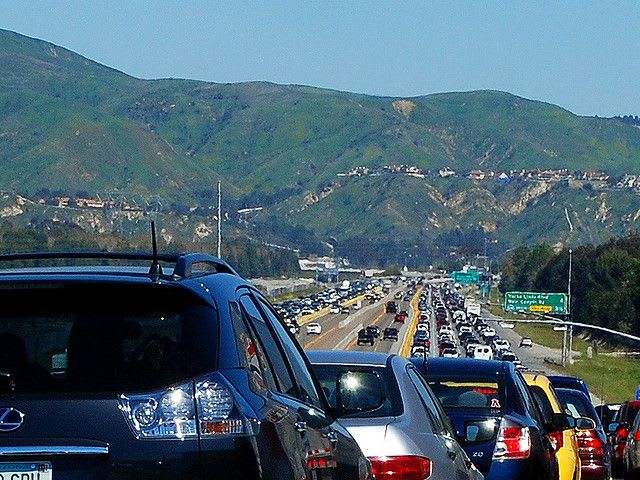
Photo by danorth1 via flickr.

5 min to read


[IMAGE]Traffic-danorth1-4434409336-7500ccf12f-z-2.jpg[/IMAGE]After two years of slight declines in overall traffic congestion — attributable to the economic downturn and high fuel prices — leading indicators suggest that as the economy rebounds, traffic problems are doing the same, according to a new report from the Texas Transportation Institute (TTI).

While 2008 was the best year for commuters in at least a decade, the problem again began to grow in 2009.

Ad Loading...

The 2010 Urban Mobility Report, published by TTI at Texas A&M University, provides a snapshot of traffic congestion in the 439 U.S. urban areas. The current report offers a greatly enhanced picture of congestion on a city-by-city basis, using the wealth of speed data provided by INRIX, a private-sector provider of travel time information.

Highlights from the research illustrate the effects of the nation's traffic problems:

  •     Congestion costs continue to rise: measured in constant 2009 dollars, the cost of congestion has risen from $24 billion in 1982 to $115 billion in 2009.

  •     The total amount of wasted fuel in 2009 topped 3.9 billion gallons – equal to 130 days of flow in the Alaska Pipeline.

  •     Cost to the average commuter: $808 in 2009, compared to an inflation-adjusted $351 in 1982.

  •     Yearly peak delay for the average commuter was 34 hours in 2009, up from 14 hours in 1982.

Ad Loading...

The methodology used to calculate congestion has been improved more than a dozen times since the Urban Mobility Report was first published in 1984, but the changes made possible by access to hour-by-hour speed data are the most significant improvement yet, researchers say.

As a result of the new data, a revised congestion trend has been constructed for each urban region from 1982 to 2009. Eleven new urban regions have been added, including San Juan, Puerto Rico. Finally, three new measures of congestion are calculated for the 2010 report: delay per auto commuter, delay per non-peak traveler, and a Commuter Stress Index (CSI), which is calculated for the worst direction in each peak period to show the time penalty to those who travel in the peak direction.

The congestion reduction benefits of two significant solutions are discussed — public transportation and roadway operations. Without public transportation services, travelers would have suffered an additional 785 million hours of delay and consumed 640 million more gallons of fuel — a savings of $19 billion in congestion costs. Roadway operational treatments save travelers 320 million hours of delay and 265 million gallons of fuel for a congestion cost savings of $8 billion.

Researchers recommend a balanced and diversified approach to reducing traffic congestion – one that focuses on more of everything. Their strategies include:

  •     Get as much use as possible out of the transportation system we have.

  •     Add roadway and public transportation capacity in the places where it is needed most.

  •     Change our patterns, employing ideas like ridesharing and flexible work times to avoid traditional "rush hours."

  •     Provide more choices, such as alternate routes, telecommuting and toll lanes for faster and more reliable trips.

Ad Loading...
  •     Diversify land development patterns, to make walking, biking and mass transit more practical.

  •     Adopt realistic expectations, recognizing for instance that large urban areas are going to be congested, but they don't have to stay that way all day long.


American Public Transportation Association (APTA) President William Millar responded to the report: “There is no doubt that expanding public transportation use is key to reducing traffic congestion,” he said. “Clearly, even if you don’t ride public transportation, it is still in your best interest to support investment in public transit.  Better public transportation in your community means less congestion on the roads.”

Pointing out that the surface transportation authorization legislation has not yet been enacted by Congress, Millar added, “This report offers compelling evidence of the importance of investing in public transportation…Now is the time for Congress to pass a long-term authorization bill that will help reduce the problem of urban road congestion through a greater investment in public transportation…Each passing day means a delay in addressing congestion problems which impact individuals and undermine business productivity.”

Meanwhile, Transportation 4 America’s Director, James Corless, issued the following statement:

“The Urban Mobility Report is an important reminder that too many Americans are stuck without good options for efficient, safe and affordable travel in our cities and towns. It is especially timely as Congress prepares to reset priorities for investing our transportation trust fund. However, we must note that flaws in the UMR's analysis could lead to faulty conclusions about what the report indicates.

It assumes, for example, that everyone should be able to speed as rapidly down the highway during rush hour as they could in the middle of the night. American taxpayers will never stand for being asked to turn over their wallets and their neighborhoods in order to build that kind of highway capacity.

They would much rather see Congress make more efficient use of their money by fixing crumbling roads and bridges; investing in technology to manage existing freeway traffic better; providing rail and rapid bus service in congested corridors; and linking transportation funding to smarter planning and development.

The economist Joe Cortright showed in a study for CEOs for Cities that the UMR obscures the fact that people who live in cities with transportation options and less urban sprawl generally have shorter commutes. That means a lower proportion of the population is subjected to highway congestion than is true in places where long automobile commutes are the predominant option.

In the upcoming transportation authorization, Congress can fix the system that has left too many with no alternative but to sit in traffic, by giving communities the tools they need to provide more and better choices in living locations and travel options.”


More Paratransit

A Heliox charger on KC Metro property

King County Test Heliox Chargers, Keolis Lands California Contract Top Biz Briefs

Stay informed with these quick takes on the projects and companies driving progress across the transportation landscape.

Read More →
Spare logo for Fixed Route Platform
Technologyby StaffMay 19, 2026

Spare Expands AI-Native Operations Platform With Fixed-Route Capabilities

The launch marks a major milestone in Spare’s vision for unified transit operations.

Read More →
Trinity Metro On Demand Vehicle
Technologyby StaffMay 19, 2026

Via Announces Scheduling and Supply Studio

The Scheduling and Supply Studio provides the world’s first fully integrated platform for optimizing vehicle and driver availability to rider demand, said company officials.

Read More →
Ad Loading...
MBTA Green Line Construction
Railby StaffMay 18, 2026

Boston's MBTA Completes Latest Green Line Work

The work took place during 12 consecutive days of shuttle bus service replacement between Kenmore and Cleveland Circle. 

Read More →
Community Transit's Bluebell bus celebrating the agency's 50-year milestone.
Busby StaffMay 15, 2026

Washington's Community Transit Celebrates 50-Year Milestone

The milestone highlights both the agency’s history and its evolving role in meeting the region’s growing mobility needs.

Read More →
Cover for Part 2 with AC Transit's Cecil Blandon
ManagementMay 8, 2026

Bus Tech Talk: Part 2 with AC Transit's Cecil Blandon

In Part 2 of a two-part conversation, AC Transit’s director of maintenance joins co-hosts Alex Roman and Mark Hollenbeck to discuss his maintenance team’s work with various types of vehicle, training, augmented reality, and more.

Read More →
Ad Loading...
transit tracker connectpoint
Sponsoredby Alex RomanMay 1, 2026

Connectpoint Expands Digital Signage Strategy with LED Push

Connectpoint is enhancing its digital signage strategy by integrating LED technology into its services.

Read More →
frontrunner bus
SponsoredMay 1, 2026

ADA Compliant Transit: Easier, More Dignified Travel for Every Passenger

Today’s riders—and the communities you serve—expect more from public transit. While ADA compliance is required, leading transit agencies know that true accessibility also means delivering dignity, efficiency, and a better rider experience. This whitepaper reveals why forward thinking agencies nationwide choose the Low Floor Frontrunner as their first choice for ADA compliant vehicles—setting a new standard with passenger first design, faster boarding, improved safety, and unmatched operational performance.

Read More →
AMF Bruns' new headquarters and parking lot.
Paratransitby StaffApril 28, 2026

Inside AMF Bruns of America’s New Ohio Production Hub [Photos]

Step inside AMF Bruns of America’s 41,000-square-foot facility in Stow, Ohio, where expanded manufacturing capacity, modernized operations, and a focus on next-generation mobility solutions are shaping the company’s growth in accessible transportation.

Read More →
Ad Loading...
Exterior image of AMF Bruns' new facility in Ohio.
Paratransitby StaffApril 22, 2026

AMF Bruns Opens New Ohio Headquarters, Expands U.S. Manufacturing Footprint

With expanded production space, local investment, and a growing workforce, AMF Bruns is scaling its U.S. presence. Here’s an exclusive look inside the new Stow, Ohio, HQ.

Read More →