



2012 Women In Transportation: Margaret O'Meara
VP, Client Services and Business Development, Northeast Region Parsons Brinckerhoff Boston
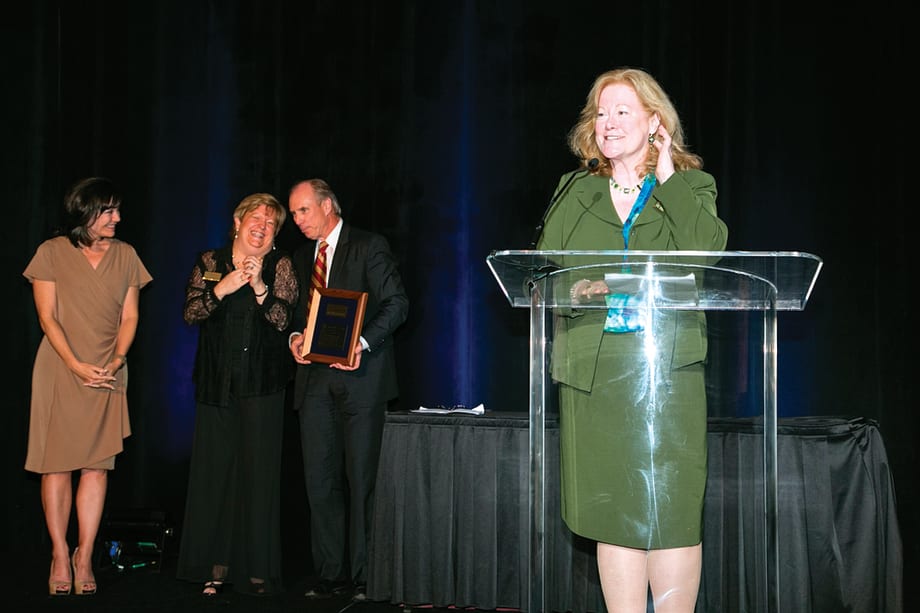
Margaret O’Meara fell in love with transit at the start of her career and never looked back. Graduating from Northeastern University with a bachelor’s degree in business administration, she originally thought she wanted to study law. However, after taking a position at the Massachusetts Bay Transportation Authority (MBTA), O’Meara realized she had already found her career path.
“I was born and raised in Boston and observed and valued how much transit impacts each of us every day,” says O’Meara. “I learned the value and the importance of transportation as an economic engine and a critical element of our country’s quality of life. I liked being a part of making a difference.”
O’Meara worked for more than 20 years for MBTA, first as an office engineer, then as project analyst and project manager. She gained a great deal of field and management experience during this time, but she says the most important lessons she learned — and brought to every job thereafter — were partnering skills, communication and leadership. “Being able to communicate, being a leader that trusts and empowers others, are traits that breed success,” she says.
During her career, O’Meara has worked on many large infrastructure projects that have transformed communities. As assistant area construction manager for the Central Artery/Tunnel (CA/T) at MassHighway, O’Meara provided guidance and direction for the management and coordination of multiple contracts related to the CA/T project at Logan International Airport. She also served as MassHighway’s District 3 highway director, where she was responsible for meeting the transportation needs of 77 towns and cities. Later, she became assistant commissioner, where she chaired an advisory task force for the Route 3 North Project, Massachusetts’ first horizontal design-build project.
Following her public sector career, O’Meara began working in the private sector, first as VP for a Boston-based engineering consulting firm, where she was responsible for office operations, and now as VP, client services and business development, Northeast Region, at Parsons Brinckerhoff, where she is responsible for client services, strategic planning and business development within the New England region.
She’s currently Parsons Brinckerhoff’s principal-in-charge on the Whittier Bridge/I-95 Improvement Project, which will replace the bridge over the Merrimack River between Newburyport and Amesbury, Mass., and add two lanes to a section of I-95 in the Newburyport-Salisbury area. She’s also Parsons Brinckerhoff’s principal for the ConRAC project to expand car rental facilities at Logan International Airport.
“I’m taking the larger snapshot and providing influence for the bigger picture,” says O’Meara. “I can work with the project team to resolve issues before they become problems, in anticipation of meeting the client’s goals.”
O’Meara recognizes the importance of giving voice to the transportation industry in the public policy realm. As well, she promotes the advancement of women in transportation through her active leadership with Women’s Transportation Seminar International (WTS). She currently serves on the WTS International Advisory Board and chairs the appointments committee. She previously served as president of WTS Boston and is active in MassGAP, a non-partisan collaboration of women’s groups that work to increase the number of female cabinet positions in Massachusetts. She was recently named WTS’ Woman of the Year for 2012.
Both inside and outside of her office, O’Meara mentors younger employees to help them achieve professional develop-ment.
“It’s important to my company and it’s important to me personally,” says O’Meara. “As a senior person for Parsons Brinckerhoff, I take that on as an important role.”
More Rail

New York MTA Advances Final Contract for Second Avenue Subway Expansion
Contract Four is the largest in the Second Avenue Subway Phase 2 project and includes construction of station infrastructure, tracks, and signals for the subway expansion, MTA officials said. Work on Contract Four will begin in 2027.
Read More →
San Diego MTS Breaks Monthly Trolley Ridership Record
Agency officials said July’s ridership indicates MTS’s continued recovery from the pandemic.
Read More →
Report Examines NJ TRANSIT Reliability, Funding Challenges
The Garden State Initiative analysis examines the roles of Amtrak infrastructure, fleet management, and agency operations while recommending a more performance-based approach to improving reliability.
Read More →
Stadler, CapMetro Sign Long-Term Rail Fleet Support Agreement
Beginning in 2027, Stadler will provide on-site technical expertise, spare parts support, training, and obsolescence management to help extend the reliability and longevity of CapMetro’s GTW fleet.
Read More →
Biz Briefs: Alstom Lands Canadian Contract, LYT to Supply California TSP, and More
In METRO's latest installment, we take a look at recent news from Complete Coach Works, Beep, FlixBus, and more partnerships making headlines across the transportation sector.
Read More →
CATS Gold Line Marks 5 Years of Service, 2.8M Passenger Trips
With a six-mile expansion planned, the Charlotte streetcar is positioned to connect more neighborhoods and major transit hubs across the region.
Read More →
Why Simulating Pedestrian Movement Has Become Essential for Modern Rail Stations
Pedestrian microsimulation is helping rail planners identify bottlenecks, test station designs, and prepare complex transit hubs for growing passenger volumes.
Read More →
Amtrak Begins Major Construction at New York’s Sunnyside Yard
The new maintenance facility will support Amtrak’s Airo trainsets while improving maintenance efficiency and turnaround times in New York.
Read More →
Chicago Leaders Unveil Plans for O’Hare Airport Express Train
The privately developed project would offer a 15-minute trip between downtown and O’Hare’s Terminal 2, with trains operating every 15 minutes on a dedicated track. The service would use battery-electric trains and three existing freight rail rights-of-way.
Read More →
OCTA Maps Out 30-Year Strategy to Protect Coastal Rail Corridor
The draft feasibility report identifies strategies to protect the coastal rail line for decades as the agency continues near-term stabilization and sand placement efforts.
Read More →