



2014 Top Rail Projects Survey
With a reported $16.5 billion in projects, New York City Transit again tops the list, with the amount of streetcar projects in North America continuing to grow. Total project purse grows nearly 50% over 10 years.

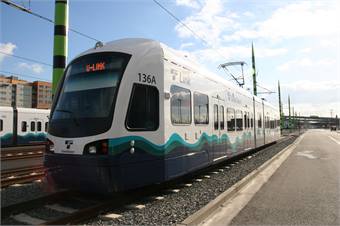
With a reported $16.5 billion in projects, the Metropolitan Transportation Authority’s (MTA) New York City Transit sits at the top spot in METRO’s Top Rail Projects survey, which has a $99 billion total project purse for 2014.
When including MTA’s Long Island Rail Road (No. 25) and the Metro-North Railroad (No. 26), the overall total for projects taking place in the state of New York total more than $18.6 billion. Canadian projects continue to make a splash with a total of $21 billion appearing in this year’s list, while five streetcar systems appearing at the bottom of the list come in at $674 million.
Rounding out METRO’s top five are the Toronto Transit Commission with $13.2 billion; Seattle’s Sound Transit with $9 billion; Boston’s Massachusetts Bay Transportation Authority with $6.2 billion; and the City & County of Honolulu DOT Services’ Rapid Transit Division with $5.1 billion.
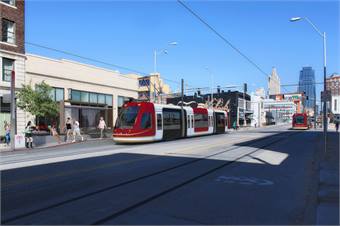
Streetcar projects listed in the survey, including Kansas City’s, (rendering shown) totaled a reported $674 million.
Streetcars
Streetcars are becoming a greater presence, with $674 million in projects appearing in this year’s Top Rail Projects list.
In Tucson, Ariz., Sun Link’s $196 million streetcar project (No. 38) is part of the $2.1 billion Regional Transportation Plan, approved by Pima County voters in May 2006. The project, which is funded by the Regional Transportation Authority, is scheduled to open July 25.
With an aggressive build schedule, the project added seven streetcars as of press time and moved from the construction and production phase to testing and training over the course of the past year.
The City of Cincinnati is in the first phase of its 3.6-mile streetcar system (No. 39), with project costs coming in at a reported $147 million.
In May, the Southwest Ohio Regional Transit Authority’s Metro, which the City requested assume responsibility for streetcar marketing and community education, issued a Request for Proposals (RFP) for the creation of a brand identity and branding system of the Cincinnati Streetcar. The RFP includes a logo and guidelines related to its use that will be needed for everything related to streetcar operations, including vehicles, signs, operators’ uniforms, website and printed materials.
Detroit’s 3.3-mile M-1 Rail streetcar project (No. 40), which is set to open by late 2016, was approved in March for a $10 million loan from the state.
The vision for a rail line along the Woodward Corridor has been in existence since 2007, and it has gone through a number of iterations — in technology and actual cars and total distance. The project is set to officially break ground later this summer.
Meanwhile, the two additional projects in this year’s survey include Kansas City’s Downtown KC Streetcar (No. 42) and the Atlanta Streetcar (See METRO April 2014) at No. 43.
In May, the City of Atlanta and the Metropolitan Atlanta Rapid Transit Authority announced they will jointly manage the 2.7-mile line that will run along an east-west route with 12 stops/stations using streetcars powered by overhead wire technology.
In Kansas City, the two-mile Downtown streetcar starter line was set to break ground in May. The system will include 16 stops spaced approximately every two blocks and serve the city’s Central Business District; the Crossroads Art District; the Power and Light District; and numerous other businesses, restaurants, art galleries, educational facilities and residential neighborhoods.
The completion of the Downtown KC Streetcar starter line project is anticipated in summer of 2015 followed by a period of testing. It is expected that by the end of 2015 the first streetcar rides will occur through Downtown Kansas City in over a half a century.
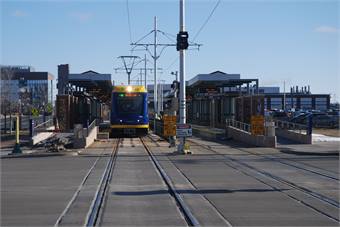
Minneapolis’ Metro Transit was set to open its $957 million Green Line in June.
Ready for launch
As of press time, Minneapolis/St. Paul-based Metro Transit (No. 16) was in final testing of its $957 million METRO Green Line and set to begin revenue service on June 14.
The Green Line is an 11-mile light-rail line connecting downtown Minneapolis, the University of Minnesota and downtown St. Paul. The METRO Green Line includes 18 new light rail stations. The Green Line will also serve five downtown Minneapolis stations that are shared with the METRO Blue Line, which travels south from Minneapolis to the Minneapolis-St. Paul International Airport and the Mall of America in Bloomington.
Metro Transit is also in preliminary engineering on its Green Line Extension, which includes an additional 16 miles of double track as well as 16 new stations. It will be part of an integrated system of transitways, including connections to the Blue Line, the Northstar Commuter Rail line and Metro Transit bus routes.
In August, No. 23, the Dallas Area Rapid Transit (DART) will begin service on its 4.7-mile Orange Line extension from Belt Line Station to the newly rebuilt Dallas/Fort Worth International Airport station.
The extension is part of DART’s 14-mile Orange Line and brings the nation’s longest light rail system to 90 miles. When the station opens, riders will only need to walk approximately 300 feet from the station to the terminal.
At a Glance
Further analysis of this year’s numbers show that respondents have approximately 3,300 new railcars on order, with a majority of those vehicles expected to be heavy railcars.
In METRO’s list 10 years ago, NYC Transit topped the list with $12 billion in projects and a total of 6,589 vehicles. In fact, when comparing the numbers from 2004 and 2014, not a whole lot has changed, except for the total project purse, which hit $66.3 billion in 2004, has grown by 49%.
If you know an agency with plans for the future, but were omitted from this year’s survey, please let us know so that we can include it next year.
METRO would also like to send a special thanks to all the agencies for taking the time to fill out our surveys and continuing to participate in this annual feature.
To view the story as it ran in print, click here.
More Management

METRO Opens Submissions for 2026 Motorcoach Awards
Nominations are now being accepted for METRO Magazine’s Operator of the Year and Innovative Operator of the Year awards.
Read More →
New York MTA Advances Final Contract for Second Avenue Subway Expansion
Contract Four is the largest in the Second Avenue Subway Phase 2 project and includes construction of station infrastructure, tracks, and signals for the subway expansion, MTA officials said. Work on Contract Four will begin in 2027.
Read More →
Transit Agencies Highlight Safety Gains at National Summit
Leaders from 15 major transit systems shared crime-reduction results and safety initiatives while discussing the role of continued federal support.
Read More →

NITA Names New Leadership, Expands Reduced-Fare Program at First Board Meeting
The new regional transit authority appointed its first board chair and interim executive director while extending reduced fares across CTA, Metra, and Pace for eligible riders.
Read More →
Beyond the Checklist: A Structured Approach to Transit Maintenance
Reliability-Centered Maintenance helps transit agencies move beyond routine checklists to focus limited resources on the assets and failures that have the greatest impact on safety, reliability, and service.
Read More →
APTA 2026 Nominating Committee Selects Leadership Slate, Names Chair and Vice Chair Nominees
Leadership changes will help shape the association’s priorities and its representation of the transportation industry during the 2026–2027 term.
Read More →
DART Launches Major Security, Fare Enforcement Initiative
The 90-day demonstration will deploy coordinated security teams at five light rail stations while testing controlled access and gathering data to guide future investments.
Read More →
Advancing Fare Collection Through Technology and Innovation
Learn about delivering 1300 gates at 91 stations while managing fare evasion. Explore the large scale deployment, solution customization and real-world results that affect the region. Prepare for deployment in your region now.
Read More →
Game Day in Motion: Moving Millions During the 2026 World Cup
Between packed transit stations and team motorcoaches, see how agencies and operators across North America tackled the transportation demands of the 2026 FIFA World Cup.
Read More →
Surface Transportation Extension Averts Shutdown, Leaves Transit Funding Gap
The stopgap keeps federal transportation programs moving, but missing advance funding could complicate the transit and rail projects agencies are planning next.
Read More →