



A Favorable Outlook for Chicago’s Intercity Rail Traffic, But Seat Shortages Loom
A new study, Growth Spurt: The Outlook for Chicago’s Intercity Rail Traffic through 2030, highlights an upswing in travel on state-supported Amtrak trains serving the Windy City, exemplified by many sold-out trains during Labor Day weekend.
Amtrak hopes to double Midwest train ridership by 2040, an effort being facilitated by the USDOT’s Corridor ID program, which jump-starts planning for state-led rail expansion.
Photo: METRO
- A study predicts an increase in usage of state-supported Amtrak trains in Chicago by 2030.
- The rise in train travel is confirmed by the numerous sold-out trains over the Labor Day weekend.
- Despite growth, the study warns of potential seat shortages on these popular routes.
*Summarized by AI
A new study, Growth Spurt: The Outlook for Chicago’s Intercity Rail Traffic through 2030, highlights an upswing in travel on state-supported Amtrak trains serving the Windy City, exemplified by many sold-out trains during Labor Day weekend.
Driven by strong demand for regional travel, ongoing improvements to Chicago Union Station, and the introduction of a new Twin Cities train, the report shows that the Chicago Hub is outperforming other regions with clusters of state-supported routes serving major metropolitan areas.
However, the study cautions that worsening capacity shortages could soon dampen growth.
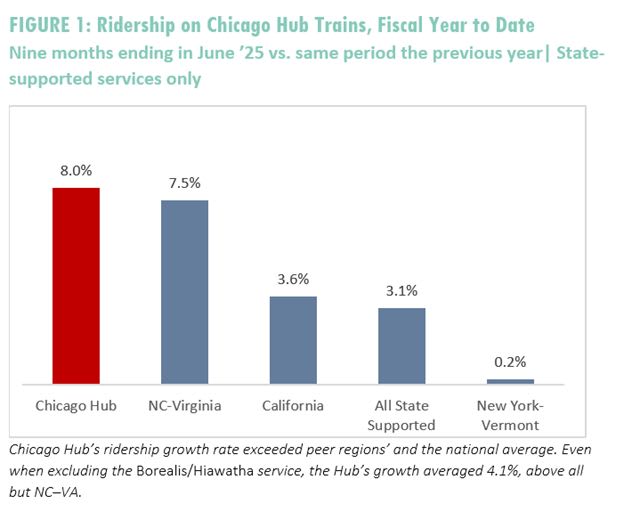
During the first nine months of Amtrak’s fiscal year, which ended in June 2025, ridership on Amtrak trains to Chicago, operated with state finance support, including routes to Detroit, St. Louis, and the Twin Cities, rose by 8% compared to the same nine-month period the previous year.
This outpaces the North Carolina and Virginia networks (NC-VA), which together grew by 7.5%, and California and New York–Vermont (NY–VT), which grew by 3.6% and 0.2%, respectively.
Traffic in California and New York-Vermont faced extenuating factors that interrupted service, which are expected to be only temporary.
Five states — Illinois, Indiana, Michigan, Minnesota, and Wisconsin — that provide significant operating assistance for Amtrak trains to Chicago, coordinate their work through the Midwest Interstate Rail Passenger Commission.
“We’re impressed that all seven Chicago Hub routes had passenger gains of 2.7% or more since October, noted Joseph Schwieterman, a DePaul University professor who is the study’s author, who added that “the increase is comfortably above Illinois’s 1.1% real GDP growth” in 2024.
The Windy City’s Recovery
The DePaul study attributes recent gains to the Borealis (a second Chicago–Saint Paul, MN train), the gradual rollout of 110-mile-per-hour service on the St. Louis line, and the Windy City’s appeal as a business and leisure destination. New Venture passenger coaches purchased by states, manufactured by Siemens, and upgraded stations are helping meet demand.
“We expect ridership to exceed 2019 levels by late 2026 consistently,” said Schwieterman.
The Chicago Hub's ridership recovery still lags that of NC–VA and NY–VT, which have risen to 163% and 115.2% of their 2019 levels, respectively, partly due to their more extensive service expansion over the past seven years.
However, the study predicts that Chicago Hub ridership will increase by another 10% over the next 24 months, despite its capacity shortages and a national domestic travel slowdown that has prompted some airlines to cut flights. It expects Chicago’s growth to be fueled by a new twice-daily Metra-operated service to Rockford, Illinois, projected to start in 2026.
An additional Chicago–Milwaukee round-trip, facilitated by ongoing trackwork in Wisconsin, is expected to launch in 2026 or 2027.
Sustaining brisk traffic growth between 2028 and 2030 will be a “heavier lift,” Schwieterman cautioned, due to the need for additional coaches and the likely absence of substantial new service additions during this period.
Load factors (the percentage of seats filled) in the Chicago Hub are now higher than in other regions and far above the national average. DePaul's review of the Labor Day holiday found that many trains were sold out days in advance.
“We were surprised to find more than 50 trains sold out well before the Thursday–Monday holiday period,” said DePaul’s Samantha Rouzan. Rouzan added that many St. Louis–Chicago trains haven't had seats for days.
The study predicts that Chicago Hub ridership will increase by another 10% over the next 24 months, despite its capacity shortages and a national domestic travel slowdown that has prompted some airlines to cut flights.
Photo: DePaul University
Continued Focus on Midwest Growth
Amtrak hopes to double Midwest train ridership by 2040, an effort being facilitated by the USDOT’s Corridor ID program, which jump-starts planning for state-led rail expansion. Many of the payoffs from the ID program for travelers will likely be realized well after 2030.
Focusing on the short term, Schwieterman called for state governments to “prioritize capacity expansion on existing trains, including adding coaches on a relatively ambitious timetable.”
Wisconsin’s trains are expected to have increased seat capacity once the state receives nine new Venture cars, reportedly scheduled to arrive in 2026. The study urges other states to follow suit, placing orders and joining the queue for new deliveries.
Older equipment could also be found. Suppose Amtrak’s Horizon cars, which have been sidelined due to corrosion, are brought back into service, or decades-old Amfleet cars from other regions are freed up. In that case, Schwieterman believes that states should “push to have a significant number of them allocated to the Chicago Hub.”
Another priority is developing intercity bus services to supplement Amtrak trains, a strategy that Oregon, Washington, and Vermont have implemented, even listing buses alongside trains on Amtrak.com.
The study recommends filling schedule gaps on routes from Chicago to Champaign, Illinois, and to Indianapolis and Grand Rapids, Michigan.
“First and foremost, state agencies should prioritize activities that alleviate the shortage of seats,” said Schwieterman.
Although technical factors may prevent new routes, such as proposed service expansion to Columbus, Ohio; Green Bay, Wisconsin; the Quad Cities, Illinois; and central Iowa, from being launched until well after 2030, he calls for avoiding stretching out the implementation timelines any further than they are.
“The recent traffic growth shows that the demand for rail passenger travel in the Chicago Hub is robust,” said Schwieterman.
The report, “Growth Spurt: The Outlook for Chicago’s Intercity Rail Traffic through 2030,” from DePaul University’s Chaddick Institute for Metropolitan Development, is available here.
Quick Answers
The study indicates an upswing in travel on state-supported Amtrak trains serving Chicago, with many trains selling out during peak times like Labor Day weekend.
*Summarized by AI
More Rail

New York MTA Advances Final Contract for Second Avenue Subway Expansion
Contract Four is the largest in the Second Avenue Subway Phase 2 project and includes construction of station infrastructure, tracks, and signals for the subway expansion, MTA officials said. Work on Contract Four will begin in 2027.
Read More →
San Diego MTS Breaks Monthly Trolley Ridership Record
Agency officials said July’s ridership indicates MTS’s continued recovery from the pandemic.
Read More →
Report Examines NJ TRANSIT Reliability, Funding Challenges
The Garden State Initiative analysis examines the roles of Amtrak infrastructure, fleet management, and agency operations while recommending a more performance-based approach to improving reliability.
Read More →
Stadler, CapMetro Sign Long-Term Rail Fleet Support Agreement
Beginning in 2027, Stadler will provide on-site technical expertise, spare parts support, training, and obsolescence management to help extend the reliability and longevity of CapMetro’s GTW fleet.
Read More →
Biz Briefs: Alstom Lands Canadian Contract, LYT to Supply California TSP, and More
In METRO's latest installment, we take a look at recent news from Complete Coach Works, Beep, FlixBus, and more partnerships making headlines across the transportation sector.
Read More →
CATS Gold Line Marks 5 Years of Service, 2.8M Passenger Trips
With a six-mile expansion planned, the Charlotte streetcar is positioned to connect more neighborhoods and major transit hubs across the region.
Read More →
Why Simulating Pedestrian Movement Has Become Essential for Modern Rail Stations
Pedestrian microsimulation is helping rail planners identify bottlenecks, test station designs, and prepare complex transit hubs for growing passenger volumes.
Read More →
Amtrak Begins Major Construction at New York’s Sunnyside Yard
The new maintenance facility will support Amtrak’s Airo trainsets while improving maintenance efficiency and turnaround times in New York.
Read More →
Chicago Leaders Unveil Plans for O’Hare Airport Express Train
The privately developed project would offer a 15-minute trip between downtown and O’Hare’s Terminal 2, with trains operating every 15 minutes on a dedicated track. The service would use battery-electric trains and three existing freight rail rights-of-way.
Read More →
OCTA Maps Out 30-Year Strategy to Protect Coastal Rail Corridor
The draft feasibility report identifies strategies to protect the coastal rail line for decades as the agency continues near-term stabilization and sand placement efforts.
Read More →