



Alstom Reaches its High-Speed Destiny with New Train
The company's new AGV train, which recently completed testing in the Czech Republic, can reach speeds up to 225 mph.
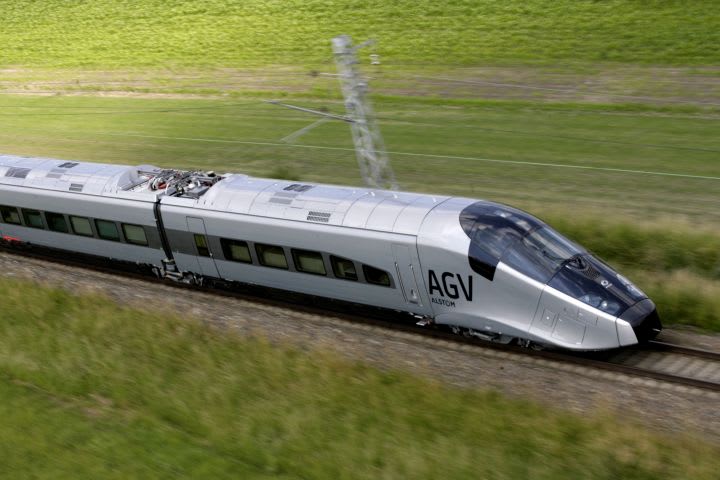
[IMAGE]MET9alstomagv-.jpg[/IMAGE] With air travel becoming increasingly more expensive and inconvenient, other transportation options are becoming more attractive. This has presented an opportunity for the rail industry to capitalize on. Alstom Transport has answered this call with its newest high-speed train offering — the AGV (Automotrice àGrande Vitesse). Touted as “the fastest train in the world,” according to Francois Lacôte, Alstom’s technical VP — the vehicle reaches speeds up to 225 mph. The AGV is the fourth generation of very high-speed train designed and delivered by the company.
With this new generation of high-speed trains, the idea is to capture market share of the airlines, the mode’s competitor, according to Eric Marie, VP, high speed for Alstom. “A trip from Paris to Toulouse would take two hours and 30 minutes compared to five,” he says. “We want to help customers capture that market.”
Aerodynamic design
The AGV train is specially designed to reach its maximum
speed, by incorporating cutting-edge technologies and design to optimize its
drag coefficient. “One of the main challenges that needed to be met was to
clearly define the visual language of high speed,” says Xavier Allard, Alstom’s
VP, design and styling. “This project gave Alstom the opportunity to create a
very strong brand,” he says. “It’s very easy to recognize an Alstom.”
The aerodynamic design of the front canopy of the vehicle, inspired by the cockpit of a fighter aircraft, features a nosecone cast in one piece from the top of the windshield. The vehicle’s exterior design allows for ease of customization by customers for co-branding, says Allard. The modular interior can be outfitted to customer specifications including seating, luggage racks and trim.
Technological
advances
In addition to its high-tech visual appeal, the AGV
incorporates the extremely successful articulated trainset design used on all
TGVs which are made up of interdependent cars linked by a bogie (truck). Where
traditionally on the TGV, electronic power components were concentrated in the
lead and rear-power cars taking up valuable space, the AGV has made a step
forward, combining articulated architecture and distributed power (with
electronic power components installed under passengers coaches), making all the
space along the train available for passengers. “The new design distributes the
power system throughout the entire trainset, freeing up 20 percent extra floor
space for increased passenger capacity, as well as making power bogies more
readily accessible”, says Laurent Baron, AGV platform director.
On a traditional, non-articulated trainset, cars sit on two bogies and are linked by couplings. A traditional 200 m train (six passenger cars and two power cars) would feature 16 bogies, while the AGV is made up of 11 interdependent cars linked by a bogie featuring 12 bogies total — 25 percent less. The reduced number of bogies also allows for enhanced aerodynamics, as well as reduced maintenance costs, Lacôte says. Safety is also a key advantage of the articulated design, which provides rigidity to the trainset allowing it to remain in formation in most derailment events. In other words, the trainset is unlikely to break-up with the risk that cars could pile up.
“An advantage of the articulated architecture is the comfort for passengers,” says Lacôte. Because the bogies are a source of noise and vibration, the new design places bogies far from passenger seating areas.
Other technological advancements featured on the AGV include the use of permanent magnet synchronous motors. These permanent magnet motors are more compact and energy efficient than previous generations of design. These magnets, which create the magnetic field necessary for the motor to function, help eliminate a big part of energy losses of traditional electric motors. Its more compact design occupies one-third less space than asynchronous motors.
The power electronic components are based on the latest technology of IGBTs, that are more compact and energy efficient, and allow the train to operate under four types of voltage: (European) 1500, 3000 and 15000, as well as 25000 volts, which is more widely used in other parts of the world.
The vehicle’s braking system combines a rheostatic brake with a regenerative braking system, which allows for unused power to be sent to the national grid.
[PAGEBREAK]Environmental
consideration
When developing the AGV, Alstom wanted to go further in
terms of environmental considerations. The vehicle produces reduced greenhouse
gas emissions, when compared to its first generation high-speed train. As an
example, the AGV using Californian electricity would emit 15 to 20g/km/passenger of CO², which is five
times less than a bus or an airplane (90 to 100 grams) and ten time less than
an individual car (180 grams).
Reduced noise is another element that was involved in the design. “For the AGV, we are using the same philosophy we have for the previous generations [TGV]. We have increased the speed, but at the same time, we have increased the comfort for the passenger and we have better insulation from noise and improved suspension,” Lacôte says. Eco-friendly aims for the new train included reducing energy consumption by 10 percent to 15 percent from its direct competitors, improving recyclability of vehicle materials by up to 98 percent, and reducing the decibel level produced.
Velim test center
In June, the AGV prototype underwent its first round of
dynamic testing, which took place at the Velim Rail Test Centre in the Czech Republic,
30 minutes outside of Prague.
The center features two tracks: the large ring, which was used for the AGV
testing, is eight miles in length allowing for maximum speeds of 130 mph.
During the testing, 15 engineers from various Alstom Transport manufacturing sites performed numerous tests on the prototype, which was outfitted with more than 2,000 sensors. The seven-car train featured two cars fitted with seats and five others equipped solely for the purpose of testing. These included work stations, space for a generator powering the testing equipment and storage.
Some of the testing involved analyzing the wheel-rail dynamics, where engineers checked the vibration levels as they would be perceived by the passengers. In addition, testing was performed on the pantograph-catenary pairing, which is installed on the first passageway between cars, to determine its ability to collect the current during various speeds.
Although the train traveled at lower-than-maximum speeds during the testing, the environment provided an accurate picture of the train and its components, according to Alstom officials. With the Velim testing nearly complete, the train is set to proceed to France for additional analysis at higher speeds (225 mph). Once this phase is complete, the train will proceed to the plant in La Rochelle for any necessary modifications.
First delivery
New Italian railway operator, Nuovo Trasporto Viaggiatori
(NTV), will be the first customer to take delivery of Alstom’s new AGV
high-speed trains. In early February 2008, NTV unveiled the new red livery
featuring a narrow golden stripe along the carriages of the AGV fleet it will
be using on the Italian rail network beginning in 2011.
The contract signed with NTV in January 2008 covers the
provision of 25 AGV trains for $967.1 million (€650 million). It also includes
maintenance of these trains for a 30-year period — not included in the above
amount. An option for an additional 10 trains is also included. Designed in La Rochelle, France,
in Alstom Transport’s center dedicated to high speed trains, NTV’s units will
be assembled on this site (14) and in the Savigliano factory in
Italy (11). A
depot for train maintenance will be built in Nola, close to
Naples.
More Management

LIT Marks 10-Year Milestone at Annual Summit
Hosted by the COTA from September 10 to 13, the Summit carried the theme “Celebrating 10 Years of Excellence, Leadership, and Impact,” with every part of the program honoring the people, agencies, and partners who built LIT over its first decade.
Read More →
People Movement: Dan Dipert Coaches Adds Third-Generation Leader, Keolis Names New Valley Metro VP/GM, and More
In this edition, we also cover recent appointments and announcements at the Wabtec, SilverRide, HNTB, and more, showcasing the individuals helping to shape the future of transportation.
Read More →
METRO Opens Submissions for 2026 Motorcoach Awards
Nominations are now being accepted for METRO Magazine’s Operator of the Year and Innovative Operator of the Year awards.
Read More →

New York MTA Advances Final Contract for Second Avenue Subway Expansion
Contract Four is the largest in the Second Avenue Subway Phase 2 project and includes construction of station infrastructure, tracks, and signals for the subway expansion, MTA officials said. Work on Contract Four will begin in 2027.
Read More →
Transit Agencies Highlight Safety Gains at National Summit
Leaders from 15 major transit systems shared crime-reduction results and safety initiatives while discussing the role of continued federal support.
Read More →
NITA Names New Leadership, Expands Reduced-Fare Program at First Board Meeting
The new regional transit authority appointed its first board chair and interim executive director while extending reduced fares across CTA, Metra, and Pace for eligible riders.
Read More →
Beyond the Checklist: A Structured Approach to Transit Maintenance
Reliability-Centered Maintenance helps transit agencies move beyond routine checklists to focus limited resources on the assets and failures that have the greatest impact on safety, reliability, and service.
Read More →
APTA 2026 Nominating Committee Selects Leadership Slate, Names Chair and Vice Chair Nominees
Leadership changes will help shape the association’s priorities and its representation of the transportation industry during the 2026–2027 term.
Read More →
DART Launches Major Security, Fare Enforcement Initiative
The 90-day demonstration will deploy coordinated security teams at five light rail stations while testing controlled access and gathering data to guide future investments.
Read More →
Advancing Fare Collection Through Technology and Innovation
Learn about delivering 1300 gates at 91 stations while managing fare evasion. Explore the large scale deployment, solution customization and real-world results that affect the region. Prepare for deployment in your region now.
Read More →