




Looking Back: Agencies Celebrate 2025 Transit Equity Day
Free Rides, Civil Rights, and the Legacy of Rosa Parks in 2026
Transit agencies across the U.S. commemorated Transit Equity Day with zero fares and a renewed focus on access and equity.
February 5, 2026

Together, agencies nationwide are using the annual observance to honor Rosa Parks’ legacy while reinforcing the message that equitable access to transportation remains a fundamental civil right.
Credit:
Metrolink
3 min to read
- Transit agencies nationwide observed Transit Equity Day by offering free rides.
- The initiative aimed to highlight and improve access and equity in public transportation.
- The day served as a reminder of Rosa Parks' pivotal role in the civil rights movement.
*Summarized by AI
Transit agencies across the United States celebrated Transit Equity Day on Feb. 4 by offering free rides, highlighting public transportation as a civil right, and honoring the legacy of civil rights pioneer Rosa Parks.
The annual observance was recognized by agencies nationwide, including Metrolink in Southern California, North County Transit District in San Diego, LA Metro in Los Angeles, C-Tran in Vancouver, Washington, Denver’s Regional Transportation District, the Charlotte Area Transit System in North Carolina, Chatham Area Transit Authority in Georgia, and others.
In Southern California, Metrolink, the region’s six-county passenger rail provider, offered free systemwide rides in observance of Transit Equity Day. Riders were able to board without a ticket at any of Metrolink’s 67 stations and travel across the system, including on the Arrow service.
“Transit Equity Day honors Rosa Parks’ legacy and the principle that everyone deserves access to reliable public transportation,” Metrolink Board Chair Doug Chaffee said. “Free-fare days open the door for more Southern Californians to experience Metrolink firsthand and see how regional rail can connect them to new opportunities by expanding their options and reducing barriers that limit mobility.”
Metrolink data shows free-ride days drive strong engagement, with more than 75% of riders returning after participating. In 2025, the agency recorded more than 27,000 boardings on Transit Equity Day, 22% above the average Tuesday ridership for that month.
Other agencies, like the Montgomery County Department of Transportation in Maryland, displayed internal placards and reserved a seat on each agency bus in honor of Rosa Parks and her lasting influence in establishing transportation equity as a fundamental civil right.
“Transit Equity Day is part of a larger recognition of the contributions of Black Americans and the role of Black history in the pursuit of racial justice and equality, which is celebrated during February, Black History Month,” the agency stated in MCDOT's Go Montgomery! newsletter.
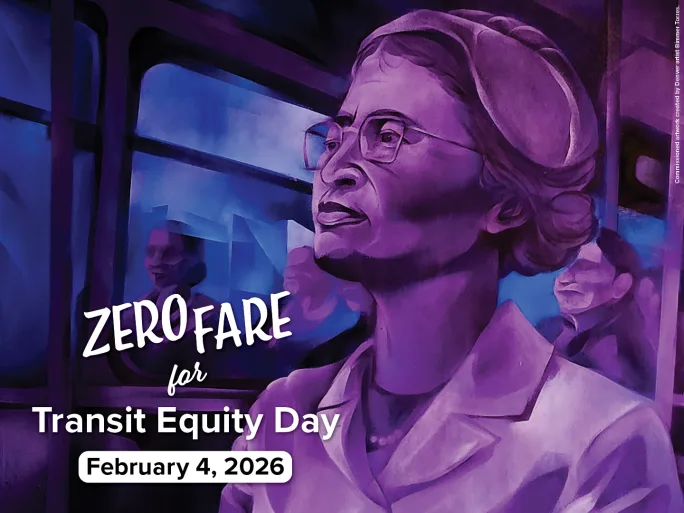
RTD’s Board of Directors authorized zero-fare service for Transit Equity Day as a permanent annual initiative in December 2024.
Credit:
Regional Transportation District, Commissioned artwork created by Denver artist Bimmer Torres
Recognizing Transit as a Pathway to Equity
Transit Equity Day is observed annually on Parks’ birthday and recognizes public transit as a critical pathway to opportunity. Parks’ arrest on Dec. 1, 1955, after refusing to give up her seat on a segregated bus in Montgomery, Alabama, helped spark the Montgomery Bus Boycott and became a defining moment in the Civil Rights Movement. The boycott led to a 1956 U.S. Supreme Court ruling declaring segregation on public buses unconstitutional.
In Colorado, Denver’s Regional Transportation District offered zero-fare service systemwide on Feb. 4, allowing customers to ride buses, rail, FlexRide, Access-a-Ride, and Access on Demand services at no cost.
“Public transportation stands as a cornerstone of equity, connecting individuals to the resources and opportunities that shape their futures,” said Debra A. Johnson, RTD general manager and CEO. “Transit is more than infrastructure — it is a pathway to education, employment, health care, and community engagement that holds room for all.”
RTD’s Board of Directors authorized zero-fare service for Transit Equity Day as a permanent annual initiative in December 2024, reinforcing the agency’s long-term commitment to advancing equity. The observance also aligns with national efforts led by the U.S. Department of Transportation, which first formally recognized Transit Equity Day in 2021.
Celebrating Transit Equity Leaders Beyond Rosa Parks
The New Orleans Regional Transit Authority (RTA) will also waive transit fares in honor of Transit Equity Day, offering free rides on all RTA buses, streetcars, and ferries. Alongside Parks, RTA is recognizing other civil rights champions who have advanced equity in public transit, including Martha White, who played a pivotal role in the Baton Rouge bus boycott.
According to the agency, White, a 31-year-old Baton Rouge housekeeper, often walked miles in the heat to reach her bus stop for work. On June 15, 1953, when only white-designated seats were available, White sat just behind the driver, refused to give up her seat when ordered, and another Black woman sat beside her in solidarity.
Together, agencies nationwide are using the annual observance to honor these legacies while reinforcing the message that equitable access to transportation remains a fundamental civil right.
Quick Answers
Transit Equity Day is an annual event where transit agencies across the U.S. focus on promoting access and equity in public transportation by celebrating the civil rights legacy of Rosa Parks.
*Summarized by AI
More Management

METRO Opens Submissions for 2026 Motorcoach Awards
Nominations are now being accepted for METRO Magazine’s Operator of the Year and Innovative Operator of the Year awards.
Read More →
New York MTA Advances Final Contract for Second Avenue Subway Expansion
Contract Four is the largest in the Second Avenue Subway Phase 2 project and includes construction of station infrastructure, tracks, and signals for the subway expansion, MTA officials said. Work on Contract Four will begin in 2027.
Read More →
Transit Agencies Highlight Safety Gains at National Summit
Leaders from 15 major transit systems shared crime-reduction results and safety initiatives while discussing the role of continued federal support.
Read More →

NITA Names New Leadership, Expands Reduced-Fare Program at First Board Meeting
The new regional transit authority appointed its first board chair and interim executive director while extending reduced fares across CTA, Metra, and Pace for eligible riders.
Read More →
Beyond the Checklist: A Structured Approach to Transit Maintenance
Reliability-Centered Maintenance helps transit agencies move beyond routine checklists to focus limited resources on the assets and failures that have the greatest impact on safety, reliability, and service.
Read More →
APTA 2026 Nominating Committee Selects Leadership Slate, Names Chair and Vice Chair Nominees
Leadership changes will help shape the association’s priorities and its representation of the transportation industry during the 2026–2027 term.
Read More →
DART Launches Major Security, Fare Enforcement Initiative
The 90-day demonstration will deploy coordinated security teams at five light rail stations while testing controlled access and gathering data to guide future investments.
Read More →
Sponsored•September 9, 2026
Advancing Fare Collection Through Technology and Innovation
Learn about delivering 1300 gates at 91 stations while managing fare evasion. Explore the large scale deployment, solution customization and real-world results that affect the region. Prepare for deployment in your region now.
Read More →
Game Day in Motion: Moving Millions During the 2026 World Cup
Between packed transit stations and team motorcoaches, see how agencies and operators across North America tackled the transportation demands of the 2026 FIFA World Cup.
Read More →
Surface Transportation Extension Averts Shutdown, Leaves Transit Funding Gap
The stopgap keeps federal transportation programs moving, but missing advance funding could complicate the transit and rail projects agencies are planning next.
Read More →