



APTA EXPO 2014: Wealth of Public Transit Tech,Tools and Talk in Texas
The triennial event featured more than 750 global exhibitors, 60-plus buses and two mockup railcars, as well as more than 80 educational sessions.
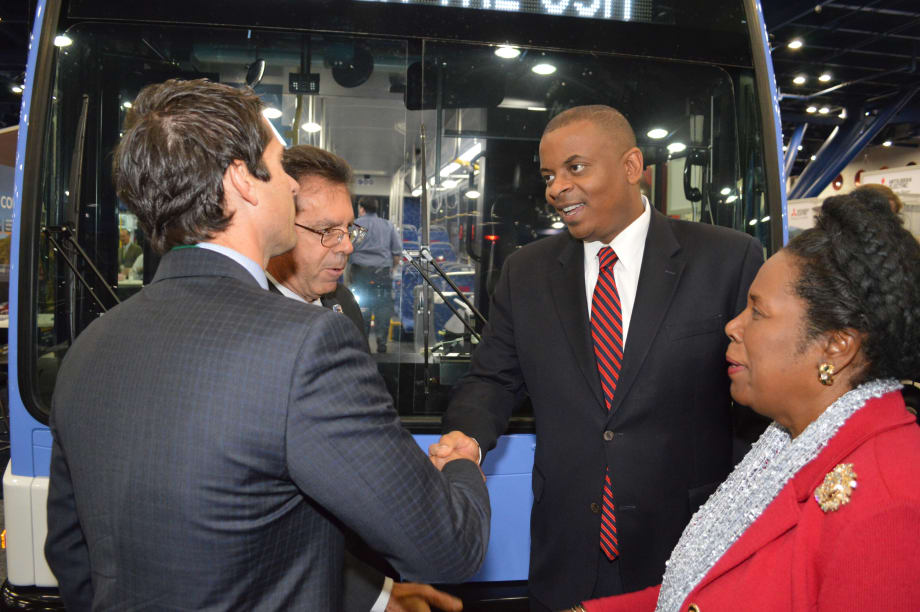
Secretary Foxx visited five suppliers on the show floor, including Alstom, Gillig (pictured), Mobility Ventures LLC, Route Match and Wabtec.
Secretary Foxx visited five suppliers on the show floor, including Alstom, Gillig (pictured), Mobility Ventures LLC, Route Match and Wabtec.
The American Public Transportation Association (APTA) welcomed thousands of attendees to Houston for EXPO 2014 at the George R. Brown Convention Center. This year’s EXPO featured more than 750 global exhibitors displaying the latest products, services and technologies, and offered attendees a peek at more than 60 buses and two mockup railcars.
Additional highlights included 80-plus educational sessions as well as forums, tours and networking events.
In addition to new “Learning Zones” highlighting product innovations and best practices, APTA also launched a new space called “Mobility Management for Livable and Sustainable Communities,” which featured a special plaza focusing on livable and sustainable communities, complete streets and transit oriented development.
The APTA Expo General Session featured the “passing of the gavel” from outgoing APTA Chair Peter Varga, CEO, The Rapid, to incoming chair Phil Washington, GM, Denver Regional Transportation District. Washington discussed his intent to increase emphasis on safety and security; funding; shifting workforce demographics; changing customer lifestyles and demographics; and accelerated technological innovations.
“This country has been on an infrastructure vacation,” he said, and vowed APTA would be able to change that.
Foxx Talks Future
Presentation highlights included a speech by Secretary of Transportation Anthony Foxx, who spoke about the importance of public transportation in his life and to America’s future.
Foxx discussed how growing up in Charlotte, N.C., he would travel with his grandmother to the center city on weekends, where she taught him to pay a fare, request a transfer and read bus schedules.
Foxx used his life experience to remind the crowd of the importance of the work they do for millions of people around the nation.
“Behind what you are doing, undergirding it is the American Dream,” he said. “I am working for and fighting for a transportation system that is as good as the American people are.”
To that end, Foxx discussed how there has not been the passage of a six-year transportation authorization bill in 10 years, which poses a challenge for transportation agencies and local governments to plan for the future.
He also discussed the $86 billion backlog in transit repairs and the need to address that backlog in anticipation of the 100 million more people expected to be living in the U.S. by 2050.
“Just imagine what kind of congestion we’re setting ourselves up for. Imagine what types of quality of life challenges we’re setting ourselves up for. This is an entirely avoidable problem,” he said.
Foxx also touted the four-year, $302 billion GROW America Act proposed by President Barack Obama and his Administration, which he called “the most forward-leaning vision for transportation the country has seen in some time,” and his disappointment in Congress for extending MAP-21 another 10 months instead of taking up the proposal.
He urged the crowd to make their voices heard, both locally and nationally, and stressed the importance that all the stakeholders involved work together rather than continue to fight for their own specific issues of interest.
Following his speech, Foxx visited five suppliers on the show floor — Alstom, Gillig, Mobility Ventures LLC, Route Match and Wabtec — to learn what they do and how they help the public transportation industry move forward more efficiently.
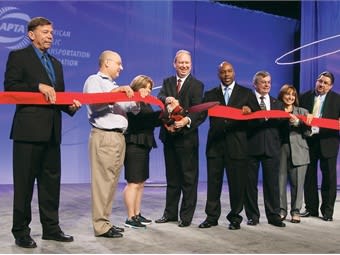
APTA President/CEO Michael Melaniphy (center) joined other officials for the ceremonial opening of the 2014 APTA EXPO in Houston.
Finding a funding source
With surface transportation reauthorization facing several hurdles, most notably funding, key congressional staff engaged in overseeing public transportation programs shared their views and outlook for the legislative process during the “Congress & the Federal Transportation Agenda” session, one of many featured during the EXPO.
While acknowledging the importance of reauthorizing the surface transportation bill, one key takeaway from the informative session was that both the proposed GROW America Act and the funding recommended by APTA will be difficult for Congress to come up with.
In fact, it may very well be impossible unless a funding source is found, said Andrew Brady, majority professional staff member, Subcommittee on Highways and Transit and Committee on Transportation and Infrastructure. He also added it is already a challenge to maintain enough funding to meet the current levels set in MAP-21.
Brady said that Congressional members are open to hearing creative ideas from the industry, as well as feedback on which programs are most important and which programs or initiatives that may not be worth moving forward on. Basically, he said, any comments or suggestions are welcomed absent of asking for more federal funds for public transportation.
Both Brady and Homer Carlisle, professional staff member, Committee on Banking, Housing and Urban Affairs, said Congress is exploring ideas to come up with funding for the bill, but it is still a difficult nut to crack, with the politically unpopular idea of simply raising the gas tax beginning to look like it wouldn’t be enough as many Americans continue to drive less and the fuel efficiency of automobiles continues to increase.
On a brighter note, Brady did add that as soon as a funding source is identified, Congress is ready to move on bill, with that package ideally being ready around the time the current MAP-21 extension ends this spring. However, citing the successful passage of two bills during the 2008 election year, the possibility was not ruled out by the panel that something could get done in either the so-called lame duck Congress or at the beginning of the new Congressional session in early 2015.
U.S. Mayors Roundtable
During the Roundtable Discussion with American Mayors, moderated by Mayor Chris Coleman of Saint Paul, Minn., Mayors Annise Parker of Houston; Chris Koos of Normal, Ill.; and Frank Jackson of Cleveland discussed infrastructure renewal, urban growth and development, gentrification, complete streets, sustainability, transportation rebalancing, and the interrelationship between federal, local and regional government aspects of public transportation.
All of them highlighted the importance of public transit to economic development, maintaining a good quality of life and reducing a city’s carbon footprint.
Responding to whether they had issues with getting locals to buy into the transportation vision, even if they have already seen success with other expansions, Mayor Parker explained that for Houston, there is certainly a demand for public transportation.
“People want choices,” Parker said. Mayor Jackson agreed that transit is about creating a viable choice — one that has to be efficient, quick, state of the art and not that expensive. “People are perfectly willing to let other people drive, but they won’t settle for just anything,” Jackson explained.
When asked if they felt their cities were doing a sufficient job accommodating all ages and socio-economic ranges with transit, Mayor Parker said that it used to be about riders only having one option of transit, now it’s providing the best of several. Mayor Koos agreed and said that as each city’s infrastructure continues to improve, people consider the new transit options more frequently. The three emphasized that it’s not about background, anymore. People want choices, no matter where they come from.
Finally, Mayor Coleman broached the idea of funding. Mayors Parker, Koos and Jackson explained that they would like to see, in addition to more stable long-term funding from Congress, is certainty about where the dollars should be invested between the choice of community development and simply rail transit. They stated it would be nice to know that there is enough transit and community development funding rather than having to decide which is more important. Mayor Coleman also delved into the perception that government funding for freeway expansion projects are expected but transit building costs must be justified and recovered.
There was agreement that a mix of funding sources is ideal, with more local control over those sources.
The group finished by pointing out the cities they’ve observed with transit systems they found to be exceptional, which included Heidelberg, Germany; Sao Paulo, Brazil; Prague and stateside, systems in Portland, Ore. and Salt Lake City.
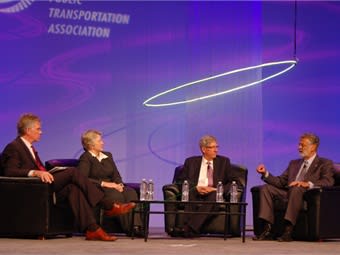
(From left) Mayors Chris Coleman of Saint Paul, Minn., Annise Parker of Houston, Chris Koos of Normal, Ill., and Frank Jackson of Cleveland discuss their roles in public transportation and their efforts to improve.
Tech management, integration
New for this year’s EXPO were seven “Learning Zones,” which highlighted the latest product innovations as well as international presentations with lessons learned from a global perspective.
During the “Management and Integration of New Technologies” Learning Zone, panelists discussed technology tools and resources as key enablers to the business processes and operations and of virtually all transit agencies.
Clair Fiet, chief technology officer, Utah Transit Authority, delved into how necessary technology has become to the success of transit agencies. “IT is not just a service anymore, we’re a contributor to the strategy of our organization,” he explained.
Fiet also noted that as technology progresses, there are going to be more demands from millennials for accuracy and reliability, which means there is great opportunity. However, as more and more systems become technologically focused, integrating them into one another has become more difficult. With the numerous different applications requiring integration on a bus, for example, there is a bigger need for a centralized system.
Michael C. Hubbell, VP, maintenance, Dallas Area Rapid Transit agreed with Fiat that new technology really needs to be confirmed as reliable and sustainable. He discussed how necessary it is for each component of a technological system, as it is updated, to initially and continually integrate and function well with the other components and not just independently. He also mentioned how important it is for someone within the organization to take ownership of any new technology the company acquires, and have an outlined budget for it, because putting in into vehicles and maintaining them is a huge investment.
William Tsuei, senior manager, information technology, for El Monte, Calif.-based Access Services, reiterated what Hubbell and Fiat touched upon about how each new technological system can’t be siloed but must be expected to work with other existing programs.
Roberto Treviño, VP, engineering and capital projects, Houston METRO, talked about the difficulties with initially selecting the technologies rather than the backend of managing them. He gave an example of a center lane transit system Houston installed that had a steep learning curve for riders and led to an increase in accidents. The solution was to add static LED alerts about upcoming vehicles that were so popular the applications were requested in the expansions as well. But the county realized quickly that they were too costly to maintain, so they had to find a more cost-effective solution while still providing the service. His emphasis was that agencies shouldn’t go with technology that hasn’t been proven in their personal environments.
To view METRO's APTA gallery of show floor highlights, click here.
More Management

METRO Opens Submissions for 2026 Motorcoach Awards
Nominations are now being accepted for METRO Magazine’s Operator of the Year and Innovative Operator of the Year awards.
Read More →
New York MTA Advances Final Contract for Second Avenue Subway Expansion
Contract Four is the largest in the Second Avenue Subway Phase 2 project and includes construction of station infrastructure, tracks, and signals for the subway expansion, MTA officials said. Work on Contract Four will begin in 2027.
Read More →
Transit Agencies Highlight Safety Gains at National Summit
Leaders from 15 major transit systems shared crime-reduction results and safety initiatives while discussing the role of continued federal support.
Read More →

NITA Names New Leadership, Expands Reduced-Fare Program at First Board Meeting
The new regional transit authority appointed its first board chair and interim executive director while extending reduced fares across CTA, Metra, and Pace for eligible riders.
Read More →
Beyond the Checklist: A Structured Approach to Transit Maintenance
Reliability-Centered Maintenance helps transit agencies move beyond routine checklists to focus limited resources on the assets and failures that have the greatest impact on safety, reliability, and service.
Read More →
APTA 2026 Nominating Committee Selects Leadership Slate, Names Chair and Vice Chair Nominees
Leadership changes will help shape the association’s priorities and its representation of the transportation industry during the 2026–2027 term.
Read More →
DART Launches Major Security, Fare Enforcement Initiative
The 90-day demonstration will deploy coordinated security teams at five light rail stations while testing controlled access and gathering data to guide future investments.
Read More →
Advancing Fare Collection Through Technology and Innovation
Learn about delivering 1300 gates at 91 stations while managing fare evasion. Explore the large scale deployment, solution customization and real-world results that affect the region. Prepare for deployment in your region now.
Read More →
Game Day in Motion: Moving Millions During the 2026 World Cup
Between packed transit stations and team motorcoaches, see how agencies and operators across North America tackled the transportation demands of the 2026 FIFA World Cup.
Read More →
Surface Transportation Extension Averts Shutdown, Leaves Transit Funding Gap
The stopgap keeps federal transportation programs moving, but missing advance funding could complicate the transit and rail projects agencies are planning next.
Read More →