



APTA Rail Kicks Off in Cleveland
The show got started with President/CEO Paul Skoutelas touting transit's successes and resiliency.

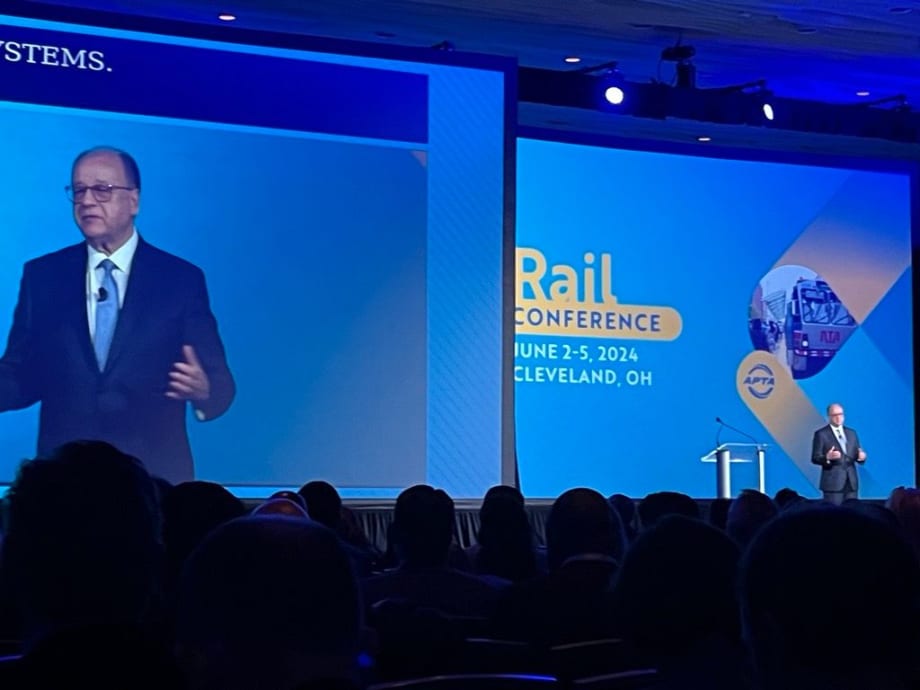
Kicking off the program, APTA President/CEO Paul P. Skoutelas highlighted Cleveland’s long history as a major railroad hub and how it became the first in the nation to establish direct rail service from downtown to the area’s major airport way back in 1968.
Photo: METRO Magazine
The American Public Transportation Association (APTA) kicked off its Rail Conference in Cleveland, which runs from June 2 through June 5.
The opening day featured remarks by Grammy Award-winning Hip Hop artist Speech Thomas, Federal Transit Administration (FTA) Acting Administrator Veronica Vanderpool, APTA President/CEO Paul P. Skoutelas, and APTA Board Chair Michele Wong Krause.
The conference also includes sessions and workshops to address the critical priorities and challenges facing all rail modes — urban, commuter, high-speed, and intercity – including ridership recovery; decarbonization; approaches to personal safety and public security; strategies to combat fare evasion; high school and community college training programs; and innovative technologies to accelerate capital rail projects.
Additionally, manufacturers, suppliers and technology developers will be on hand to discuss the latest trends and technology in rail transit at the Products & Services Showcase.
Highlights From The Opening Session
Kicking off the program, Skoutelas highlighted Cleveland’s long history as a major railroad hub and how it became the first in the nation to establish direct rail service from downtown to the area’s major airport way back in 1968.
He also discussed the unprecedented opportunity facing public transit thanks to historic Bipartisan Infrastructure Law funding.
“Think about where we were just four years ago. There was great uncertainty when the pandemic shut down the economy and mobility. Think about what our federal funding levels were the year before the pandemic,” said Skoutelas. “Back then, no one — not even our most ardent supporters — could have foreseen more than $200 Billion over years for public transit and rail. Yet today, we are in the midst of the biggest federal investment in public transportation in American history.”
Skoutelas pointed out that the Federal Transit Administration (FTA) has already awarded $65 Billion across thousands of projects, while the Federal Railroad Administration (FRA) has awarded almost $25 Billion for 35 passenger rail projects in the Northeast Corridor and across the country.
He added that more good news is on the way after Congress recently approved the Fiscal 2024 appropriations for transportation programs, and specifically for public transportation, which translates into:
$21 Billion for public transit.
$16.3 Billion for rail.
$3.8 Billion for capital investment grants.
Jobs for thousands of American rail and transit workers and for business members designing and constructing these new projects.
Looking Ahead
Finally, Skoutelas touted public transit’s role in getting people to jobs, medical appointments, and community events, while pointing out there are still challenges facing the industry, including public safety issues, workforce shortages, ridership, and project delivery.
Despite the challenges, he pointed out ridership is continuing to rebound and address some of these challenges head on, while reinforcing that the industry must continue to innovate on a daily basis.
“To address the concerns about transit safety, some agencies are adopting a layered approach, using ‘transit ambassadors,’ mental health professionals, public awareness campaigns, and more law enforcement personnel,” said Skoutelas. “We are introducing new approaches and solutions every day to improving transit, but we must also advocate strongly for public transportation in ways that resonate with the public, the media, and lawmakers.”
More Rail
Amtrak, CN Reach Agreements to Strengthen Passenger Rail Service, Safety
The agreement resolves a more than decade-long proceeding before the Surface Transportation Board concerning the terms and conditions for Amtrak services, such as the City of New Orleans, Illini/Saluki, and Wolverine.
Read More →
New York MTA Advances Final Contract for Second Avenue Subway Expansion
Contract Four is the largest in the Second Avenue Subway Phase 2 project and includes construction of station infrastructure, tracks, and signals for the subway expansion, MTA officials said. Work on Contract Four will begin in 2027.
Read More →
San Diego MTS Breaks Monthly Trolley Ridership Record
Agency officials said July’s ridership indicates MTS’s continued recovery from the pandemic.
Read More →
Report Examines NJ TRANSIT Reliability, Funding Challenges
The Garden State Initiative analysis examines the roles of Amtrak infrastructure, fleet management, and agency operations while recommending a more performance-based approach to improving reliability.
Read More →
Stadler, CapMetro Sign Long-Term Rail Fleet Support Agreement
Beginning in 2027, Stadler will provide on-site technical expertise, spare parts support, training, and obsolescence management to help extend the reliability and longevity of CapMetro’s GTW fleet.
Read More →
Biz Briefs: Alstom Lands Canadian Contract, LYT to Supply California TSP, and More
In METRO's latest installment, we take a look at recent news from Complete Coach Works, Beep, FlixBus, and more partnerships making headlines across the transportation sector.
Read More →
CATS Gold Line Marks 5 Years of Service, 2.8M Passenger Trips
With a six-mile expansion planned, the Charlotte streetcar is positioned to connect more neighborhoods and major transit hubs across the region.
Read More →
Why Simulating Pedestrian Movement Has Become Essential for Modern Rail Stations
Pedestrian microsimulation is helping rail planners identify bottlenecks, test station designs, and prepare complex transit hubs for growing passenger volumes.
Read More →
Amtrak Begins Major Construction at New York’s Sunnyside Yard
The new maintenance facility will support Amtrak’s Airo trainsets while improving maintenance efficiency and turnaround times in New York.
Read More →
Chicago Leaders Unveil Plans for O’Hare Airport Express Train
The privately developed project would offer a 15-minute trip between downtown and O’Hare’s Terminal 2, with trains operating every 15 minutes on a dedicated track. The service would use battery-electric trains and three existing freight rail rights-of-way.
Read More →