




Related: Capital Metro Board Approves Largest Electric Vehicle Procurement
Capital Metro, Clever Devices Win Innovative Solutions Award for Trip Planning
Austin, Texas’ Capital Metro is implementing an onboard digital display system integrated with a real-time data feed versus the traditional integration with on-vehicle schedule information, across a subset of its fleet.
November 8, 2021
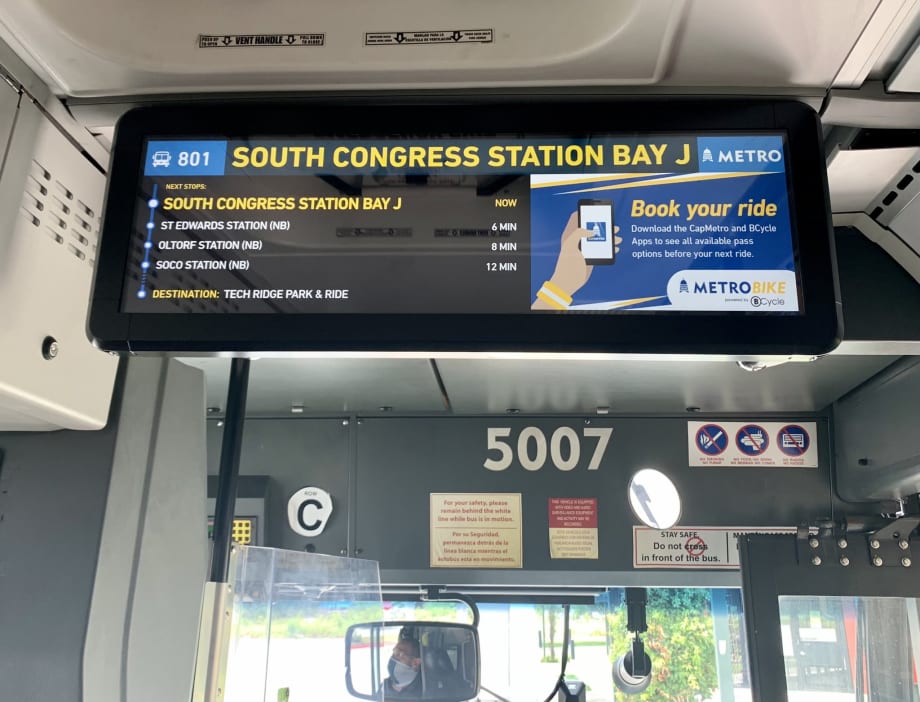
The innovative solution will allow this feature to be used by transit agencies that don’t have a complete Intelligent Transportation System (ITS) onboard.
Credit:
Capital Metro
3 min to read
Now in its seventh year, the Innovative Solutions Awards honors bus operations and their supplier partners who have implemented initiatives that helped them save money, run more efficiently, streamline operations, increase safety, improve customer satisfaction, increase ridership, and more.
METRO’s staff would like to thank everyone who applied, and congratulations again goes to all our winners.
Austin, Texas’ Capital Metro is implementing an onboard digital display system integrated with a real-time data feed versus the traditional integration with on-vehicle schedule information, across a subset of its fleet. The innovative solution will allow this feature to be used by transit agencies that don’t have a complete Intelligent Transportation System (ITS) onboard. Based on General Transit Feed Specification architecture (GTFS-RT), the real-time information informs customers of next-stop arrival times, detours, and delays. The displays also provide safety alerts, system-wide updates to better inform riders choices, and can provide an avenue for revenue generating advertisements.
The partnership stems from a competitive solicitation by Capital Metro, which brought in proposals from several vendors.
“Clever was awarded a contract based on their past performance on other projects of a similar scope, the qualifications of their firm and project team, the strength of their technical proposal, and the value they could bring to Capital Metro,” says Capital Metro CIO Jane Schroter. “We are currently piloting seven vehicles with 12 displays. An additional 60 vehicles with 92 displays will be installed before the end of the year, bringing the total numbers to 104 displays on 67 vehicles. They will be adopted as a standard in many of our vehicles going forward.”
Capital Metro sought a new solution as its current Sunrise Systems LED displays are limited to scrolling text for stop requests, date, time, operator ID, and next stop information, while the digital displays dynamically provide information versus a static feed, and have greater visual accessibility with high resolution images, text, and video.
“This innovation positively impacted our operation by improving customer satisfaction, running operations more efficiently,” explains Schroter.
Since the system is unique and being implemented for the first time, there are challenges for integration into Capital Metro’s system.
“The safety of our customers is our top priority, so it takes time to consider and work through the design to ensure the safe and proper placement of the displays,” Schroter says about the implementation process. “We then progress through installation adjustments, as well as test efforts to assess performance and reliability. It’s a challenging but thorough process with Clever and manufacturers, which is being met to deliver the technology to our customers.”
Previously, the real-time data was only available through Capital Metro’s website and app. With these displays, customers without smartphones can benefit from this information and are better able to make ride decisions, adds Schroter.
The displays are also an example of the agency’s commitment to sustainability, as an environmentally friendly option to present a great amount of information digitally rather than through traditional printed materials. The displays also have an ambient light sensor that allows them to adjust brightness and conserve battery energy while still providing visual display clarity to customers.
On the horizon, Capital Metro plans on implementing revenue-generating advertisements to the system.
“The system provides the ability for us to deploy content that is specific to the time of day, the route, or the geolocation,” Schroter explains. “We are looking forward to implementing this in the future and being able to support local businesses through the ads.”
Subscribe to Our Newsletter
More Technology

From Hardware to Digital Partner: Luminator Charts Its Next Chapter
CEO Magnus Friberg discusses Luminator’s shift toward becoming a digital partner, the growing importance of software and interoperability, and how AI can help agencies improve operations and passenger experience.
Read More →
Beyond the Checklist: A Structured Approach to Transit Maintenance
Reliability-Centered Maintenance helps transit agencies move beyond routine checklists to focus limited resources on the assets and failures that have the greatest impact on safety, reliability, and service.
Read More →
NJ TRANSIT Advances Bus Technology Upgrades Across Statewide Fleet
More than 1,500 buses now feature upgraded technology designed to improve arrival predictions and provide free Wi-Fi, with deployment expected to reach nearly 2,000 buses by the end of 2026.
Read More →

Building a Flexible Path to Transit Electrification
John Hroncich discusses BAE Systems’ modular and scalable approach, lessons learned from decades of real-world operations, and how agencies can identify electrification strategies that fit their fleets.
Read More →
Biz Briefs: Alstom Lands Canadian Contract, LYT to Supply California TSP, and More
In METRO's latest installment, we take a look at recent news from Complete Coach Works, Beep, FlixBus, and more partnerships making headlines across the transportation sector.
Read More →
Sponsored•September 8, 2026
From Legacy Silos to Conversational Intelligence
What if transit leaders could ask any operational question and get a trusted answer in seconds? Conversational AI is transforming how agencies use their data.
Read More →
USDOT Announces Rail Vehicle Replacement Grants, Chattanooga AV Shuttle Funding
More than $191 million in federal funding will help three transit agencies replace aging rail vehicles and support a new autonomous shuttle service in Chattanooga.
Read More →
Bus Tech Talk: Keeping Transit Technicians Ahead of the Technology Curve
LA Metro’s Obed Mejia discusses technician training, evolving maintenance technology, fleet replacement, and strategies for getting the most out of today’s transit fleets.
Read More →
Biz Briefs: RIPTA Unveils New Frontrunners, Clevland RTA Adds New Siemens, and More
In METRO's latest installment, we take a look at recent news from Siemens, Prevost, Dodge, and more partnerships making headlines across the transportation sector.
Read More →
Why Simulating Pedestrian Movement Has Become Essential for Modern Rail Stations
Pedestrian microsimulation is helping rail planners identify bottlenecks, test station designs, and prepare complex transit hubs for growing passenger volumes.
Read More →