



'Connected' Vehicle Testing Aims to Bolster Bus Safety
The U.S. Department of Transportation is testing nearly 3,000 vehicles, including transit buses, equipped with wireless communication devices that transmit a safety message indicating their position, speed and other data.
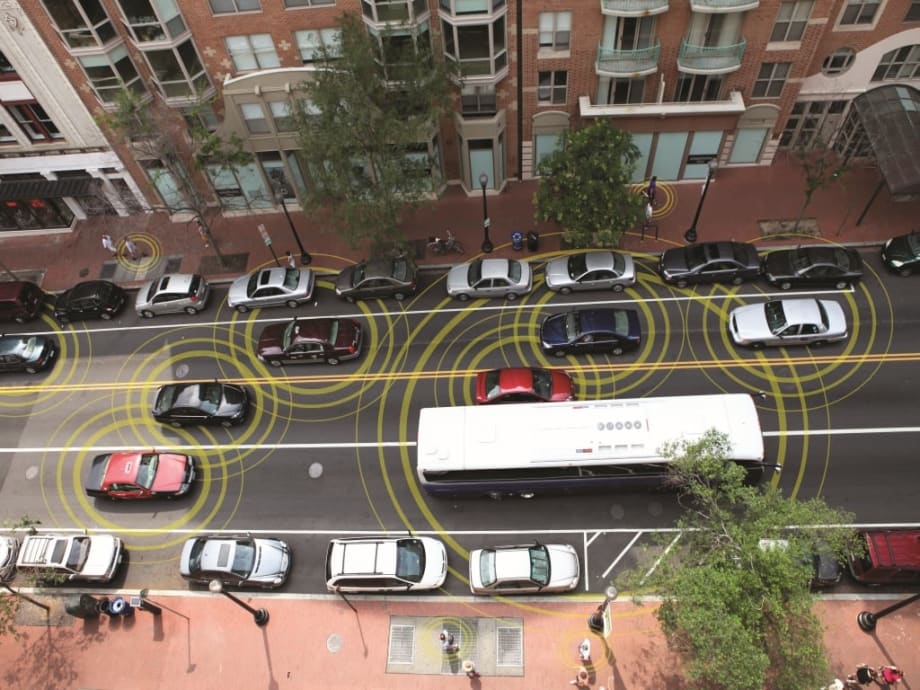
Starting in August 2012, the United States Department of Transportation (U.S. DOT) began the “Connected Vehicle Safety Pilot Model Deployment,” of nearly 3,000 cars, trucks and transit vehicles equipped with wireless communication devices to improve safety.
The vehicles, which are operating on public streets in Ann Arbor, Mich., transmit a basic safety message (BSM), indicating their position, speed, heading and other information, via dedicated short-range communications (DSRC), a technology similar to Wi-Fi. A subset of vehicles, including three transit buses, are also equipped with safety applications that warn drivers of imminent crashes.
The Connected Vehicle Safety Pilot Model Deployment is a part of the U.S. DOT’s research program focused on the development of crash warning and avoidance systems based on vehicle-to-vehicle (V2V) and vehicle-to-infrastructure (V2I) technologies that communicated via DSRC.
The U.S. DOT agencies involved in the Model Deployment include the Research and Innovative Technologies Administration’s (RITA) Intelligent Transportation Systems Joint Program Office, National Highway Traffic Safety Administration (NHTSA), Federal Highway Administration, Federal Motor Carriers Safety Administration and Federal Transit Administration.
The U.S. DOT’s Volpe Center is conducting an independent evaluation. The Model Deployment provides a real-world driving environment for testing connected vehicle safety applications as well as the necessary information for an agency decision by NHTSA in February to enable V2V technology for light vehicles.
A safer way to share roads
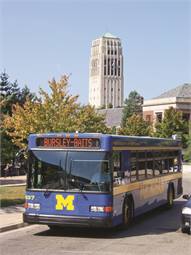
An Android tablet inside each bus serves as the driver-vehicle interface that displays customized warning images and emits customized warning sounds.
There were more than 3,200 transit bus crashes reported in 2010, resulting in more than 80 fatalities and 14,000 injuries, according to National Transit Database statistics. Even so, transit is one of the safest modes for travel, and connected vehicle technologies could further empower transit drivers with the tools they need to anticipate potential accident situations and significantly reduce the number of crashes, injuries and lives lost each year.
The Transit Safety Retrofit Project, which is a part of the Model Deployment, developed and demonstrated V2V and V2I safety applications on three retrofitted University of Michigan transit buses. It is hoped the buses will determine the effectiveness of the safety applications at reducing crashes and to show how real-world drivers will respond to these safety applications in their vehicles.
In February 2013, the three retrofitted buses began providing warnings to drivers as well as transmitting and receiving the BSM. An Android tablet inside each bus serves as the driver-vehicle interface (DVI). The tablet displays customized warning images and emits customized warning sounds to alert bus drivers of potential crashes.
A combination of university students and full-time, professional drivers are operating the buses along commuter routes in the Ann Arbor area. These routes are key to testing the applications as they meet the required transit crash scenario criteria the best — e.g., high-frequency bus service, near-side bus stops, high-volume pedestrian traffic and high-volume vehicular traffic.
Providing warnings to drivers
Transit bus crashes include collisions with pedestrians, rear-end collisions and collisions with motor vehicles making a right-hand turn in front of buses at near-side bus stops. The three retrofitted buses have five safety applications that provide crash-imminent warnings to drivers to reduce collisions such as these. Three of the applications are also on the other cars and heavy trucks that are part of the Model Deployment, but were modified for the transit bus environment. These include:
Forward Collision Warning: This V2V application warns a bus driver if there is a risk of a rear-end collision with an equipped vehicle in front of the bus.
Emergency Electronic Brake Lights: This V2V application warns a bus driver when there is a hard-braking event ahead of the bus, from an equipped vehicle in the lane ahead of the bus or in an adjacent lane. The vehicle initiating the hard braking may be several vehicles in front of the bus. This application addresses chain-reaction collisions.
Curve Speed Warning: This V2I application warns a bus driver if the bus is approaching a curve too quickly for safe navigation. The application relies on roadside equipment, and therefore, is only available at designated locations.
The other two safety applications are specific to transit bus driving scenarios. These include:
Vehicle Turning Right in Front of Bus Warning: This V2V application warns a bus driver of the presence of vehicles attempting to go around the bus to make a right turn as the bus departs from a bus stop. The application includes two levels of warning to the driver — a cautionary indicator if an equipped vehicle has moved from behind to beside the bus and an imminent warning if the equipped vehicle shows intent to turn in front of the bus.
Pedestrian in Signalized Crosswalk Warning: This V2I application warns a bus driver if pedestrians are in the intended path of the bus when the bus is making a right or left turn. This application incorporates two methods of detecting pedestrians — activation of the crosswalk button by a pedestrian and a microwave motion sensor that detects the presence of pedestrians in the crosswalk. The predicted path of the bus is determined by stored route data. The application provides two levels of warning to the driver — a cautionary indicator if the crosswalk button is activated and an imminent warning if a pedestrian is actually detected in the crosswalk.
All of the safety applications described above provide two levels of warnings to drivers — a “yellow” caution warning and a “red” imminent warning. Each yellow or red warning includes a visual image and an audible signal.
What are potential benefits?
The Volpe Center is serving as the independent evaluator for the Transit Safety Retrofit Project and will conduct an evaluation of the data collected during the Model Deployment. The data will include numeric objective data and multimedia data. The evaluation will also include feedback from bus drivers based on questionnaires and a focus group.
Questionnaires were handed out to approximately 60 drivers — those who consented to participate in the Model Deployment and drive the retrofitted buses; a subset of the drivers will be included in the focus group. The goals of the independent evaluation are to:
Measure and understand the safety impact of each of the transit safety applications regarding potential safety benefits and the potential for unintended consequences. This goal focuses on the applications’ effects on drivers’ response to warnings and driver attention.
Assess driver acceptance of the transit safety applications. The assessment considers the compatibility between driver expectations and the performance of the safety applications, as well as the degree to which drivers express interest in having V2V and V2I safety applications in their vehicles.
Test the performance of the transit safety applications. This goal looks at performance elements such as application accuracy, DVI efficiency and application availability.
Results from the Transit Safety Retrofit Project evaluation will be available in summer 2014.
Robert Sheehan is ITS multimodal program manager for RITA’s Intelligent Transportation Systems Joint Program Office. Steve Mortensen is sr. ITS engineer for the FTA.
More New Mobility

From Hardware to Digital Partner: Luminator Charts Its Next Chapter
CEO Magnus Friberg discusses Luminator’s shift toward becoming a digital partner, the growing importance of software and interoperability, and how AI can help agencies improve operations and passenger experience.
Read More →
Biz Briefs: Alstom Lands Canadian Contract, LYT to Supply California TSP, and More
In METRO's latest installment, we take a look at recent news from Complete Coach Works, Beep, FlixBus, and more partnerships making headlines across the transportation sector.
Read More →
CharterUP’s Armir Harris on Technology, AI, and the Future of Group Mobility
In a recent episode of METROspectives, CharterUP Founder/CEO Armir Harris discussed the company’s evolution from an online charter bus marketplace into a technology platform supporting public- and private-sector mobility and much more.
Read More →
Jacksonville’s NAVI Project Charts a New Course for Autonomous Public Transportation
Through its NAVI program, JTA is showing how autonomous vehicles, intelligent infrastructure, and coordinated operations can work together to deliver everyday public transportation.
Read More →
Biz Briefs: Luminator Marks Milestone and More
From manufacturers and suppliers to transit agencies and motorcoach operators, these updates offer a snapshot of the projects, partnerships and business moves driving the industry forward.
Read More →
New Tricks for Old Bureaucracies: Joshua Schank on Making Transit Innovation Stick
Former LA Metro Chief Innovation Officer Joshua Schank discusses why good ideas aren't enough, how transit agencies can overcome resistance to change, and why today's challenges demand more innovation.
Read More →
How DART's GoPass Is Redefining Regional Mobility
Serving 14 transit agencies, GoPass simplifies multimodal travel by allowing riders to plan, pay for, and manage an entire trip through one app.
Read More →
Biz Briefs: OCTA Taps Clean Energy for Hydrogen Station, Stadler to Supply Via Rail Vehicles, and More
From manufacturers and suppliers to transit agencies and motorcoach operators, these updates offer a snapshot of the projects, partnerships and business moves driving the industry forward.
Read More →CharterUP Expands Into New Mobility and Autonomous Transportation
Vice President of New Mobility Stephen Joos discusses how CharterUP is leveraging its nationwide transportation network, technology platform, and autonomous vehicle partnerships to expand into workforce mobility, campus shuttles, and transit solutions.
Read More →
METRO Magazine Announces 2026 Innovative Solutions Awards Winners
Projects Recognized for Advancing Mobility Through Technology, Accessibility, Workforce Innovation, and Operational Excellence
Read More →