



Cummins Engines Ready to Meet 2010 Standards
The company has updated and customized its engines to meet the EPA's near-zero-emissions standards -- without losing fuel efficiency or performance -- by integrating subsystems.

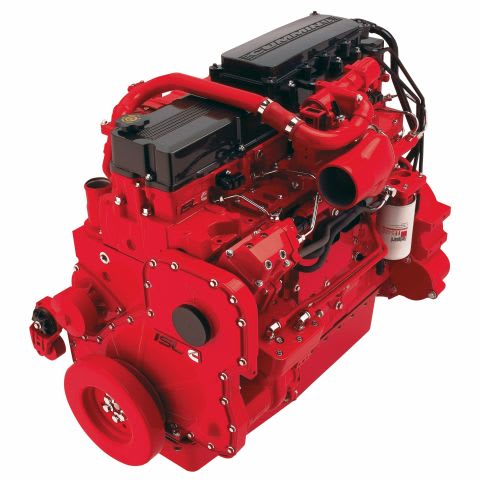
[IMAGE]MET11Cummins-ISL.jpg[/IMAGE] Starting January, 2010, the U.S. Environmental Protection Agency (EPA) will require all engine manufacturers to produce engines that meet the 2010 near-zero emissions criteria, which includes emissions of no more than .2 grams nitrogen oxide (NOx) and .01 grams particulate matter. Columbus, Ind.-based Cummins Inc. has updated and customized its engines to meet these new standards — without losing fuel efficiency or performance — by integrating subsystems.
Cummins displayed these newly tailored ISB Hybrid and ISL Diesel engines as well as its ISL G gas product at the APTA EXPO in San Diego. Cummins’ Tom Hodek, general manager, worldwide bus business, says that the company has made some reliability and efficiency improvements to the engines — mostly internal — without any architectural changes. “It’s the 2007 system plus a Selective Catalytic Reduction (SCR) system. It’s not a big tear-up and redesign. We’re taking the reliability from 2007 and improving upon it for 2010, and [will continue to] improve upon it from there.”
Substantial reductions
In order to adjust to the 2010 near-zero-emission standard criteria, engine manufacturers have had to change from allowing about four grams of nitrous oxide (NOx) and .1 gram particulate matter in emissions in 1998, down to .2 grams of NOx and .01 grams of particulate matter in 2010.
“The emissions reductions are substantial. We’ve had to meet these hurdles about every three years now. So, the investment in the technology, the effort we’ve had to put forth, the development curve we’ve been on is very steep. We’ve been able to manage to retain that advantage primarily due to the integration of all the subsystems,” Hodek says.
Engine efficiency improved
The ISB Hybrid engine, used with hybrid technologies in the BAE- and Allison-equipped buses on display, was part of technology that allows the hybrid system to recover braking energy, which can be used to drive the bus. The ISB Hybrid is a diesel engine, just like the ISL diesel, and they both operate like diesel engines. However, the ISB Hybrid engine has been tailored in its calibration and electronic controls to work more efficiently with a hybrid system, as opposed to a standard automatic or manual transmission. “We work with hybrid manufacturers, including BAE, Allison and Eaton, and have adapted our engines to work efficiently with their systems,” Hodek says.
The ISL, a diesel product, is Cummins’ highest-volume product right now for transit buses. It will be available in 2010 with its current horsepower and some hybrid ratings. Hodek describes it as “a building block emissions change for us, in that we made a lot of changes in 2007 to the engine, and added aftertreatment. In 2010, the engine changes are focused on reliability and efficiency improvements.” The ISL G, a natural gas product, is in production today, and currently meets the 2010 emissions standards. “It’s ahead of its time, so to speak,” he says.
While the EPA may not be taking certifications yet for 2010, if the product could be certified at present, it would meet the standard. The gas product has been well-received in the marketplace and is a much-improved product, according to Hodek, and may be an optimal product for a municipality that has the appropriate infrastructure.
On the SCR system in the new engines, there is an injector that sends diesel exhaust fluid (DEF) into the exhaust stream to clean it and, on that line, will be a filter that the DEF passes through prior to injection. The filter needs to be changed — similar to an oil filter — approximately every 200,000 miles. The hour translation, Hodek estimates, would be about every 5,000 hours of operation. “Given the changing of the system, and the amount of emissions reduction we’re gaining, that maintenance change is negligible,” says Hodek.
[PAGEBREAK] Systems, subsystems impacted
Cummins also manufactures fuel systems, air-handling systems, filtration for oil and fuel, and aftertreatment systems, and these products, in addition to the engines, are all impacted by the near-zero-emission standard. All these subsystems are critical to engine performance. “We’ve managed to integrate and include our subsystems into our overall product, so it’s a win-win for everybody,” Hodek says.
All Cummins engines and aftertreatment systems shipped effective Jan. 1, 2010, will meet the near-zero-emissions standard. “Just by virtue of purchasing a bus that’s a 2010 product, you’ll automatically meet the standard,” says Hodek of end-users looking to upgrade their fleets to meet the new requirement.
Performance maintained
In terms of benefits to the end-user, there should be no change in engine performance or fuel efficiency as a result of the changes made to meet the 2010 standard. All maintenance intervals currently available will be the same through 2010, and there will be no additional maintenance requirements. “We don’t expect to see any decrease in fuel economy… in 2002 and in 2007, we saw fuel economy reduction, but in 2010, we’re not going to see that. So, from an operating perspective, there’s no change from 2007 fuel economy,” says Hodek.
The engines will continue to have the same operations capabilities as in 2007, including power, torque, and rated speeds. However, since OEMs are adding more electricity on board, and require bigger alternators and more parasitic load on the engine, Cummins moved to accommodate these changes with more horsepower. “The ISB Hybrid today has a 260-horsepower rating, and in 2010 it will have a 280-horsepower rating, by popular demand,” Hodek adds.
More Motorcoach

METRO Opens Submissions for 2026 Motorcoach Awards
Nominations are now being accepted for METRO Magazine’s Operator of the Year and Innovative Operator of the Year awards.
Read More →
Biz Briefs: Alstom Lands Canadian Contract, LYT to Supply California TSP, and More
In METRO's latest installment, we take a look at recent news from Complete Coach Works, Beep, FlixBus, and more partnerships making headlines across the transportation sector.
Read More →
Biz Briefs: RIPTA Unveils New Frontrunners, Clevland RTA Adds New Siemens, and More
In METRO's latest installment, we take a look at recent news from Siemens, Prevost, Dodge, and more partnerships making headlines across the transportation sector.
Read More →
People Movement: Holly Arnold Joins Transdev and More
In this edition, we also cover recent appointments and announcements at Pace, CamTran, MCI, and more, showcasing the individuals helping to shape the future of transportation.
Read More →
ABA Report: Motorcoach Travel Generates $161.6B Economic Impact
The 2025 analysis finds motorcoach travel supported nearly 900,000 jobs and generated $28 billion in federal, state, and local taxes.
Read More →
CharterUP’s Armir Harris on Technology, AI, and the Future of Group Mobility
In a recent episode of METROspectives, CharterUP Founder/CEO Armir Harris discussed the company’s evolution from an online charter bus marketplace into a technology platform supporting public- and private-sector mobility and much more.
Read More →
People Movement: ABC Names John Walsh as Chief Commercial Officer
In this edition, METRO also covers recent appointments and announcements at the DART, STV, and more, showcasing the individuals helping to shape the future of transportation.
Read More →
From Surviving to Thriving: Building Stronger Transportation Organizations
Bus Business Consultants founder Brian Dickson shares lessons on leadership, organizational health, and creating options for long-term success in a changing transportation industry.
Read More →
Biz Briefs: Luminator Marks Milestone and More
From manufacturers and suppliers to transit agencies and motorcoach operators, these updates offer a snapshot of the projects, partnerships and business moves driving the industry forward.
Read More →
ABAF Study Reveals Growing Insurance Crisis for Motorcoach Operators
Preliminary findings show 98% of operators faced premium increases over the past five years, while shrinking insurer participation is putting added pressure on businesses and customers.
Read More →