



Express Bus Service Drives New Rider Trends
Service reflects changes in rider choices for transportation to both work and recreational activities. Younger riders are drawn to the value in price and the ability to remain connected during the ride.

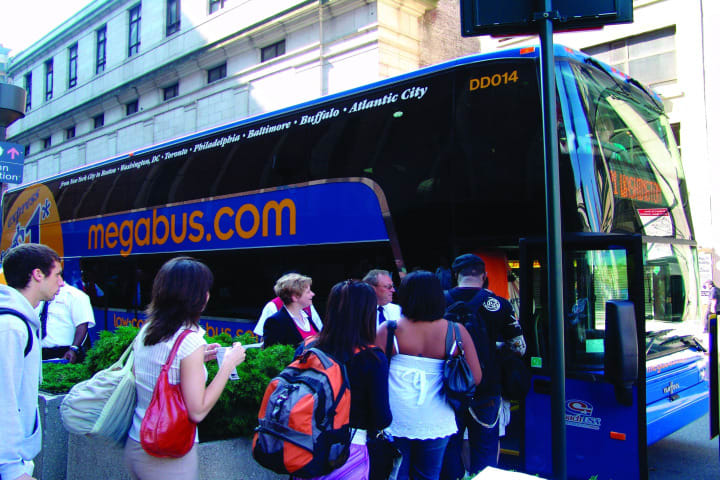
MegaBus, a subsidiary of Coach USA, began operations in 2006, and was the first company to bring express service with the yield price product to the market.
[IMAGE]Special.jpg[/IMAGE]Express bus services are reaping the benefits of an increase in passengers, particularly those in their twenties and thirties, opting for bus travel instead of other forms of transportation, such as rail, discount airlines or their own car.
Part of what is driving the ridership spike is that the perception of buses is changing. A drastic difference from the so-called "Chinatown buses," transportation companies, including MegaBus and BoltBus, are also redefining business travel with new technology, such as free Wi-Fi and 110-volt plug-ins for electronic devices. In addition, they are marketing to budget-conscious travelers, with a yield pricing model for seats, allowing customers to purchase a ticket for as cheaply as $1, depending on market demand, offering a more appealing experience.
Tapping the tech-savvy
MegaBus, a subsidiary of Coach USA, began operations in 2006, and was the first company to bring express service with the yield price product to the market. In just slightly more than four years MegaBus' ridership has reached 5.3 million. "It's been a very robust growth and there continues to be a very significant growth in demand," says Dale Moser, president and COO, Coach USA.
Parent company Stagecoach Group, based in the U.K., had started this same initiative a year and a half earlier, first in Scotland and then England. "It was quite successful, so [they] decided we would roll it out in North America," Moser says.
Fifty-five percent of MegaBus' passenger demographic is made up of 18 to 34 year olds, whom they categorize as "young professionals."
This group tends to watch their spending on travel and is looking for value, convenience and amenities such as free Wi-Fi plug-ins for cell phones and other electronic devices; they want all those features that currently they can't always get on other modes of transportation, Moser says.
At 60 percent, the majority of the customers who use MegaBus tell the operator they would have otherwise taken their car for their trip. "We're getting what we believe to be a modal shift, getting people out of their automobiles. With fuel prices, the cost of driving your car, parking in these cities, wear and tear on your car, and just the hassle of driving in some of these cities has [caused] people to look for alternatives," Moser says. He adds that these amenities allow riders to keep their connectivity with the rest of the world while traveling economically when going from one city to another.
In April 2006 MegaBus operated in seven cities in the Midwest. Since then, the carrier has grown its operation to 40 cities in the Midwest and the Northeast. After a recent expansion, travelers in the Northeast can now go to Pittsburgh and State College, Pa., and travelers in the Midwest can now go to Des Moines, Iowa and Iowa City, Iowa.
Moser attributes growth of the service to the additional city pairs, but adds that demand for existing services has also been growing.
BoltBus, a division of Greyhound Lines and affiliated with Peter Pan Bus Lines, began operations in March 2008. The first scheduled routes ran between New York and Washington, D.C. Soon after the launch, the carrier had to implement new schedules including from New York to Boston, Philadelphia and Baltimore, due to a surge in demand.
In 2009, BoltBus transferred more than 1.4 million passengers. Timothy Stokes, company spokesperson, says the company has seen year over year growth in passenger numbers. "The majority of our riders are in the 18 to 34 age range. They're technology-savvy. Most have a college degree or are pursuing one," Stokes says.
BoltBus attracts a high number of college students and young professionals with free Wi-Fi, power outlets, and extra legroom. The majority of their passengers tend to carry a laptop or a data-enabled phone. To further accommodate their tech-savvy riders, the carrier launched BoltBus mobile, allowing them to buy a ticket from their mobile phone. "We have seen a sizable increase in sales [since], further proving that our customers tend to be technologically savvy," Stokes says. Tickets start at $1 plus a booking fee, and prices increase on market demand.
The carrier also simplifies operations with their boarding process. Riders can order tickets online, and then print out and bring the form or show the ticket confirmation on their phone.
In addition, the transportation provider rewards customer loyalty with their "Bolt Rewards" plan. After taking eight trips on BoltBus, a rider receives one free one-way ticket. "Our customers are looking for value and a good deal. The experience on the bus is important to them. I believe our pricing is something that attracts our customers," Stokes says.
[PAGEBREAK]Changes in the travel-sphere
Due to popular demand, many charter bus companies are moving quickly to put Wi-Fi on their coaches. "A good 60 percent of our travelers on the charter and tours side are younger travelers. They want to be in touch all the time. Many times their travel purpose is educational in focus, and they do research using a laptop or other electronic devices. It's the next level of amenity that they have in their daily lives," says Peter Pantuso, president, American Bus Association.
If coach operators are not providing Wi-Fi, they are offering individual radio stations, XM satellite or Sirius radio.
Wi-Fi and power outlets are bringing more customers aboard because riders now want a more independent experience than they did in the past, Pantuso notes. "A number of years ago, maybe people wanted to watch a movie. Now, everybody wants to do their own thing, and not only [with] travel; almost every experience is about individuality. It's not, 'Let's go as a group and listen to music,' it's, 'I want to hear my iPod, I want to hear my tunes that I care about.'" Taking that into the travel-sphere, you see people watching movies, doing work in their own space, behaving how they want to in their own world. "Not everybody wants to watch the same movie or hear the same song, so having the ability to individualize your trip in terms of technology is something that's attractive to a brand new audience of people that you wouldn't have seen before," Pantuso adds.
However, it's not only younger passengers craving this experience. Pantuso remarks that the other demographic change he has seen over the last four years when taking the bus from Washington, D.C. to New York has been that the average age is getting older. "It's still a lot of college-age, but that age creep is moving in my direction; [with] more professionals and families, there's a broader mix of the passenger base. Five years ago, you didn't see that mix of traveler; it was predominantly college-age."
Connecting city pairs
When people are traveling in a corridor, typically there is more traffic between city pairs, such as Los Angeles and San Francisco, or Milwaukee and Chicago, more so than people going from Los Angeles to New York, Pantuso notes.
"If you start looking across the country — and that's something that many of our members have talked about for many years — looking at city pairs and where people travel is an element of the motorcoach industry that a lot of operators are beginning to focus on. I think there's certainly an opportunity in the industry for that segment to grow," he adds.
The model is almost identical to Southwest Airlines, Pantuso points out. The airline got away from moving people from hub to hub and then moving them again to their destination, and instead looked at city pairs where people are traveling and began moving them between those pairs.
As the curbside market sprung up five to seven years ago, a groundswell of younger travelers moved to the express bus mode because they found that they could travel very cheaply between city pairs. "They were traveling on a regular basis from Washington, D.C. to New York, or from Boston to New York. They could have taken Amtrak or their cars, and paid $20 or $30 in tolls each way. Then, they found they could take a curbside bus for $20 or less. From that, you saw the mainstream companies in what was a curbside market, a band of carriers that came together, very large professional international companies in that arena."
Pantuso says that even some smaller motorcoach carriers are targeting city pairs for express service. "We've seen it in different ethnic markets, as different ethnic groups have moved for work or to visit families. We're seeing carriers run from the Southwest region between Texas and Minnesota to work, or Texas and Chicago or between other mega-sized cities or even smaller cities to larger cities. That's certainly a trend that I think we'll see continue to grow over the years to come," he says.
More Motorcoach

METRO Opens Submissions for 2026 Motorcoach Awards
Nominations are now being accepted for METRO Magazine’s Operator of the Year and Innovative Operator of the Year awards.
Read More →
Biz Briefs: Alstom Lands Canadian Contract, LYT to Supply California TSP, and More
In METRO's latest installment, we take a look at recent news from Complete Coach Works, Beep, FlixBus, and more partnerships making headlines across the transportation sector.
Read More →
Biz Briefs: RIPTA Unveils New Frontrunners, Clevland RTA Adds New Siemens, and More
In METRO's latest installment, we take a look at recent news from Siemens, Prevost, Dodge, and more partnerships making headlines across the transportation sector.
Read More →
People Movement: Holly Arnold Joins Transdev and More
In this edition, we also cover recent appointments and announcements at Pace, CamTran, MCI, and more, showcasing the individuals helping to shape the future of transportation.
Read More →
ABA Report: Motorcoach Travel Generates $161.6B Economic Impact
The 2025 analysis finds motorcoach travel supported nearly 900,000 jobs and generated $28 billion in federal, state, and local taxes.
Read More →
CharterUP’s Armir Harris on Technology, AI, and the Future of Group Mobility
In a recent episode of METROspectives, CharterUP Founder/CEO Armir Harris discussed the company’s evolution from an online charter bus marketplace into a technology platform supporting public- and private-sector mobility and much more.
Read More →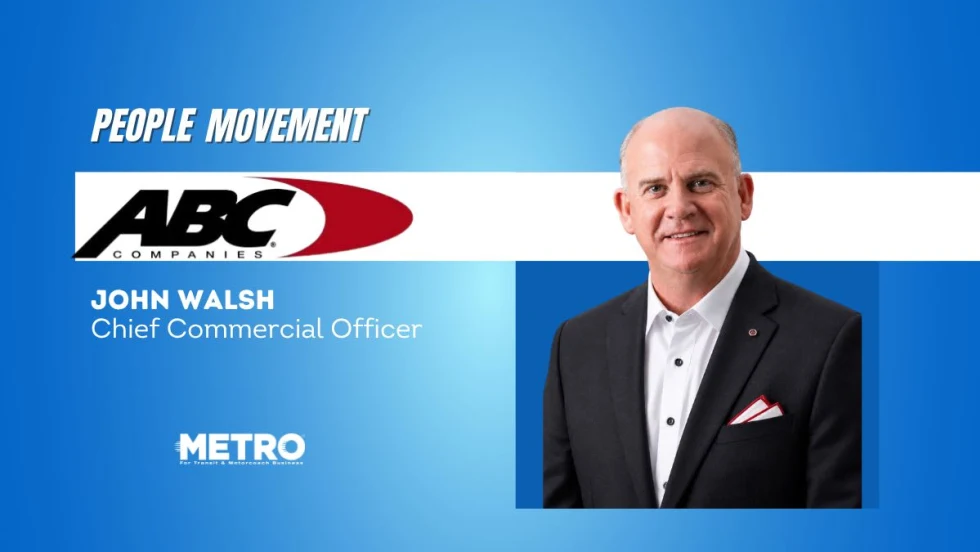
People Movement: ABC Names John Walsh as Chief Commercial Officer
In this edition, METRO also covers recent appointments and announcements at the DART, STV, and more, showcasing the individuals helping to shape the future of transportation.
Read More →
From Surviving to Thriving: Building Stronger Transportation Organizations
Bus Business Consultants founder Brian Dickson shares lessons on leadership, organizational health, and creating options for long-term success in a changing transportation industry.
Read More →
Biz Briefs: Luminator Marks Milestone and More
From manufacturers and suppliers to transit agencies and motorcoach operators, these updates offer a snapshot of the projects, partnerships and business moves driving the industry forward.
Read More →
ABAF Study Reveals Growing Insurance Crisis for Motorcoach Operators
Preliminary findings show 98% of operators faced premium increases over the past five years, while shrinking insurer participation is putting added pressure on businesses and customers.
Read More →