



How Coach USA Is Using AI to Prevent Bus Accidents
As motorcoaches navigate increasingly congested urban corridors filled with pedestrians, cyclists, scooters, and distracted drivers, safety leaders across the industry are confronting a growing challenge: visibility.

Coach USA implemented Samsara’s AI Dash Cams and AI Multicam, which uses multiple high-resolution cameras positioned around the vehicle to create a complete view of the bus’s surroundings.
Coach USA/Samsara
- Coach USA is implementing Artificial Intelligence (AI) technology to enhance the safety of their motorcoaches in busy urban areas.
- The AI system helps to address the visibility issues caused by increasing urban congestion, including pedestrians and various types of vehicles.
- Safety leaders in the industry are focused on overcoming the challenges posed by distracted drivers and other visibility-related risks.
*Summarized by AI
Large passenger coaches inherently have blind spots along their sides, rear, and interior areas where pedestrians or cyclists can easily go unseen during turns or lane changes. In dense urban environments where traffic conditions shift constantly, those blind spots create significant risk.
For Coach USA, one of North America’s largest motorcoach operators, addressing that challenge became a central focus of its safety strategy.
“Safety is first at Coach USA,” said Derrick Waters, CEO at Coach USA. “We want to make sure that every person is safe around us, and that our drivers are aware of all sides of their bus.”
By deploying Samsara’s AI Multicam and AI Dash Cams to monitor the entire vehicle environment, Coach USA has dramatically improved visibility for its operators, with the results proving significant.
In fact, since implementing the technology, the company reports a 92% reduction in preventable incidents involving pedestrians, bicyclists, and motorcyclists, along with a 75% reduction in claim costs.
But the transformation required more than installing cameras. It involved a shift in how the company thinks about safety, driver coaching, and risk management.
A Changing Risk Environment
Motorcoach operators today face increasingly complex operating environments.
Urban traffic density continues to increase, while options such as e-bikes and scooters are adding new variables to city streets. At the same time, national safety data shows pedestrian fatalities rising dramatically over the past decade.
For fleets operating large passenger vehicles, those trends create new operational challenges.
“Coach USA’s decision to adopt a more proactive approach to pedestrian and roadway risk was driven by several converging safety trends and operational realities,” Waters explained. “Our operating environment has become increasingly complex. Higher traffic density, distracted driving among the general public, expanded micromobility use, and more congested urban corridors have significantly elevated pedestrian exposure and roadway risk. These factors demand heightened situational awareness and a stronger proactive safety strategy.”
Historically, many safety programs relied heavily on reactive indicators, which review incidents after they occurred.
But that approach provided limited insight into near misses or emerging risk patterns.
“Industry data and internal trend analysis reinforced the need to shift from reactive response to leading-indicator management,” Waters said. “We recognized that traditional lagging metrics alone were not sufficient to drive meaningful risk reduction.”
Instead, Coach USA began focusing on identifying risky behaviors before its accident rate escalated.
Coach USA/Samsara
Tackling Key Issues
One of the most persistent challenges for motorcoach operators is the vehicle itself.
Large passenger vehicles have significant blind zones that even highly trained operators cannot always fully monitor.
“Before adopting Samsara, blind spots and limited visibility presented persistent challenges in fully assessing and managing roadway risk, particularly in dense urban environments and high-pedestrian areas,” Waters said. “Large commercial passenger vehicles inherently have substantial blind zones to the sides and rear. While our operators are highly trained in mirror usage and defensive driving techniques, visibility gaps can still limit real-time awareness of pedestrians, cyclists, and vehicles approaching from adjacent lanes or converging at intersections.”
Traditional safety monitoring also had limitations.
“Safety monitoring relied heavily on self-reporting, post-incident review, or third-party claims,” Waters said. “Without comprehensive video and telematics data, identifying near-miss events or subtle behavioral trends was more difficult, and that limited our ability to intervene early and coach proactively.”
Those limitations prompted Coach USA to seek a technology solution that could expand visibility around the entire vehicle.
Coach USA ultimately implemented Samsara’s AI Dash Cams and AI Multicam, which uses multiple high-resolution cameras positioned around the vehicle to create a complete view of the bus’s surroundings.
The system monitors blind spots in real time and alerts drivers to potential hazards.
“Large passenger vehicles are blind-spot machines. The risks are impossible for a human to track, and traditional mirrors don’t cut it,” said Johan Land, SVP of Product at Samsara. “Passenger vehicles are continually surrounded by vulnerable pedestrians, for whom they owe a high duty of care. Data shows that pedestrian deaths surged by 80% from 2009 to 2023, illustrating the dire need for more robust pedestrian safety capabilities.”
The system continuously analyzes the environment around the vehicle and surfaces potential risks on a monitor in the driver’s cab.
“Samsara’s AI Multicam and AI Dash Cams understand the environment in real time, looking everywhere at once and surfacing what’s happening on an intuitive monitor in the cab,” Land said. “Real-time notifications via audio and in-app alerts allow AI to instantly notify a driver when it spots a cyclist or pedestrian in a blind spot. This unprecedented visibility and proactive prevention make blind spots a thing of the past.”
For Coach USA’s safety team, the impact was immediate.
“Our ‘aha moment’ with AI Multicam was when we saw what was happening on the roadway,” said Jason Louis, VP, safety, at Coach USA. “We didn’t know what we didn’t know until we had the video.”
Preventing Collisions, Providing Coaching Opportunities
One of the most important features of the system is Pedestrian Collision Warning, which alerts drivers when vulnerable road users enter the vehicle’s path.
Land compares the system to an early-warning device.
“It’s like a smoke detector for the road,” he said. “The alert runs on a high-speed observe-and-alert loop. When a driver activates a turn signal or shifts into reverse, the AI Multicam scans the drivable area for pedestrians, cyclists, and scooter users. When the AI detects someone in that area, it immediately triggers an in-cab audio alert and highlights that camera feed on the driver’s monitor.”
Because the AI processes data directly on the device in the vehicle, better known as edge processing, the alerts occur within milliseconds.
“Processing detections on the edge shaves milliseconds off response times,” Land said. “That ensures drivers can react quickly enough to prevent incidents. It’s particularly powerful at night or in heavy rain when human eyes struggle.”
The system essentially acts as an additional set of eyes for the driver, added Land.
“With 360-degree visibility, drivers can manage complex maneuvers like navigating a crowded depot or changing lanes knowing AI has their back,” he said. “That gives drivers a major confidence boost.”
While improved visibility has helped drivers avoid hazards, the technology has also transformed how the operation manages safety internally.
Instead of reviewing incidents only after accidents occur, safety managers now analyze data trends to identify patterns in driver behavior.
“Operationally, we moved from a reactive model to a leading-indicator approach,” Waters said. “Instead of focusing solely on post-incident review, we began actively monitoring behavioral trends — things like intersection approach speed, stop-line compliance, close following distance, and distracted-driving indicators. Real-time telematics and AI-enabled video review allow us to intervene early, often before a minor risk escalates into a reportable event.”
Waters added that access to video evidence has also made coaching conversations more objective.
“Video provides clear, contextual evidence of what occurred, both inside and outside the vehicle,” he explained. “This removes ambiguity and reduces defensiveness. Coaching discussions are no longer based on perception or third-party accounts; they’re grounded in observable behaviors.”
That shift has made coaching more consistent and constructive, said Waters.
“Managers follow a defined coaching framework to ensure fairness and consistency in how behaviors are addressed,” he said. “It allows us to focus on what happened and how to improve, rather than debating fault.”
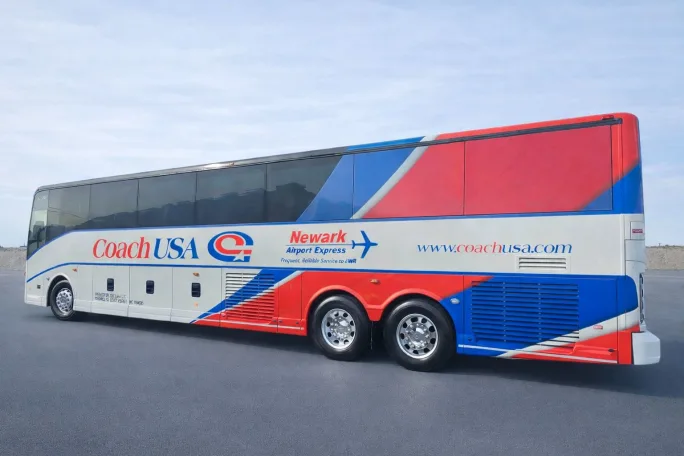
Coach USA leaders emphasize that the Samsara technology alone does not create safety improvement. But that cultural change is equally important.
Coach USA
Significant Safety Improvements
The combination of improved visibility, real-time alerts, and data-driven coaching has produced measurable results across Coach USA’s fleet, with the company reporting:
- A 92% decrease in preventable incidents involving pedestrians, bicyclists, and motorcyclists.
- A 50% reduction in following-distance events.
- A 35% decrease in speeding events within one year.
Beyond accident reduction, the technology has also strengthened claims management, with Coach USA reporting a 50% reduction in auto and bodily injury claims and a 75% reduction in total claim costs.
Video documentation has also helped protect drivers.
“Professional drivers often operate in high-risk, high-traffic environments where they may be unfairly blamed,” Waters said. “Having objective evidence allows us to exonerate drivers when they acted responsibly, reinforcing trust and confidence in the organization.”
Building a New Safety Culture
Coach USA leaders emphasize that technology alone does not create safety improvement. But that cultural change is equally important.
Operators initially approached the cameras cautiously, but attitudes shifted as drivers saw the system’s benefits, said Waters.
“Operators began to see safety technology as a support tool rather than surveillance,” he explained.
Recognition programs also played a role in Coach USA’s safety improvements.
“Video is not used solely for corrective action,” Waters said. “We actively use footage to highlight exemplary defensive driving and pedestrian awareness, reinforcing desired behaviors and promoting peer learning.”
As AI technology continues to evolve, industry leaders believe it will increasingly function as a proactive safety partner for drivers.
“Samsara processes over 25 trillion data points a year,” Land said. “That allows us to understand the full picture of risk, such as driver tenure, road conditions, coaching history, and time of day, analyzing over 45 risk factors.”
Ultimately, Land believes AI systems will function like real-time safety coaches.
“Imagine an AI safety expert that understands your route, your history, traffic patterns, and coaches you through your shift like a world-class sports coach,” he said.
For fleets transporting passengers, that added intelligence could prove critical.
“In the motorcoach world, you’re not just moving cargo, you’re moving the most precious cargo: people,” Land said. “AI-powered safety technology is helping transit operators understand risk in real time and act on it before incidents occur. That’s how we make transportation safer for everyone.”
Quick Answers
Visibility is a concern because urban areas are often congested with pedestrians, cyclists, scooters, and distracted drivers, making it challenging for motorcoaches to navigate safely.
*Summarized by AI
More Technology

ENC Lands MATA Contract and More in Biz Briefs
In this edition of Biz Briefs, we spotlight the latest developments shaping the future of mobility.
Read More →
Strada360’s Steve Lassey on Turning Transit Data Into Better Decisions
From breaking down data silos to preparing for AI, Strada360 CEO Steve Lassey discusses how transit agencies can use technology to improve operations, customer information, and long-term decision-making.
Read More →
Almaviva Looks to Open Architecture to Advance Transit Technology
Eric Reese discusses how interoperability, open architecture, and modular design can help transit agencies control costs, reduce vendor lock-in, and upgrade technology without starting over.
Read More →

Driving Smarter Paratransit
John Hanlon shares how AlphaRoute is leveraging AI-powered technology to help paratransit providers optimize operations, support frontline staff, and enhance the rider experience.
Read More →
From Hardware to Digital Partner: Luminator Charts Its Next Chapter
CEO Magnus Friberg discusses Luminator’s shift toward becoming a digital partner, the growing importance of software and interoperability, and how AI can help agencies improve operations and passenger experience.
Read More →
Beyond the Checklist: A Structured Approach to Transit Maintenance
Reliability-Centered Maintenance helps transit agencies move beyond routine checklists to focus limited resources on the assets and failures that have the greatest impact on safety, reliability, and service.
Read More →
NJ TRANSIT Advances Bus Technology Upgrades Across Statewide Fleet
More than 1,500 buses now feature upgraded technology designed to improve arrival predictions and provide free Wi-Fi, with deployment expected to reach nearly 2,000 buses by the end of 2026.
Read More →
Building a Flexible Path to Transit Electrification
John Hroncich discusses BAE Systems’ modular and scalable approach, lessons learned from decades of real-world operations, and how agencies can identify electrification strategies that fit their fleets.
Read More →
Biz Briefs: Alstom Lands Canadian Contract, LYT to Supply California TSP, and More
In METRO's latest installment, we take a look at recent news from Complete Coach Works, Beep, FlixBus, and more partnerships making headlines across the transportation sector.
Read More →
From Legacy Silos to Conversational Intelligence
What if transit leaders could ask any operational question and get a trusted answer in seconds? Conversational AI is transforming how agencies use their data.
Read More →