



Forcing a square peg into a round hole
Read why the motorcoach industry is not happy with the state of Illinois.
The motorcoach industry is not happy with the state of Illinois, specifically with lawmakers who approved a law that will require coach drivers who transport children on school-sponsored trips to obtain the same credentials as a school bus driver. The law takes effect Jan. 1, 2003.
Their indignation is understandable. The requirements to become a school bus driver are quite different from those for motorcoach operators. More to the point, the school bus driver requirements are generally unnecessary for transporting children in motorcoaches. But let's first look at the main differences.
Differences are many
• The CDL requirements are different. School bus drivers must pass a skills test in a school bus (makes sense to me). That means, however, that a motorcoach operator would have to do the same, requiring the company or individual to rent or lease a school bus for training and testing.
What makes this scenario particularly frustrating is that the coach driver will not be driving a school bus. He or she will be driving a motorcoach, a very different type of vehicle. An apt comparison might be to require a physician to obtain a veterinary degree. While it's true that humans are animals, a physician will only be treating humans.
• Pre-service training requirements are different. Motorcoach operators will be required to undergo that same state-mandated classroom and behind-the-wheel training as school bus drivers. This means that the coach drivers will learn such things as child-friendly loading and unloading procedures, traffic control using red flashing lights and side-mounted stop signs and behavior management — none of which is relevant to motorcoach operation.
At first blush, it might seem reasonable to expect motorcoach operators to understand the basic elements of managing the behavior of children and teens, but remember that coaches, teachers or parents are almost always on the bus during any school-sponsored trip that would require the services of a motorcoach. These chaperones, not the driver, are responsible for ensuring that misbehavior does not run rampant on the bus.
• Nearly all states mandate that school bus drivers undergo criminal background checks, state, federal or both. Motorcoach operators in Illinois who want to do school trips will have to do the same. This requirement makes more sense than the two previously mentioned, and motorcoach companies would be wise to embrace this precaution with all of its drivers. If a company is sued because one of its drivers assaulted a passenger, wouldn't it be comforting to know that the driver had a clean record when he was hired? Or, put another way, wouldn't it be scary to discover that the driver had been convicted of rape and armed robbery only after a passenger was assaulted and a lawsuit filed?
The problem facing motorcoach operators in Illinois who want to drive school-sponsored trips is that it can take more than a month to receive the results of a federal criminal background check, which is done by submitting fingerprint samples to the FBI.
Just more cost, aggravation
The end result of this aggravating red tape is that costs for motorcoach companies that want to continue providing school charters will go higher — during one of the worst slumps in several years. Those additional costs should be passed on to the customer, but remember that schools have been equally hard hit by the seemingly endless economic slump. The Illinois legislation will place unnecessary burdens on the transportation providers and the customer, which just isn't good lawmaking.
Let's hope other states don't follow the lead of Illinois. The training and certification of coach operators is perfectly adequate, for all customers. The government should leave well enough alone.
More Management
People Movement: Connectpoint Expands Leadership Team, Stadler Names New Group CEO, and More
In this edition, we also spotlight recent personnel moves at Burns, UZURV, and more, highlighting the people taking on new roles across the transportation industry.
Read More →
More Than a Summer Job: Building the Next Generation of Transit Talent
The Delaware River Port Authority and PATCO have transformed their internship program into a hands-on professional development experience that introduces students to the breadth of transportation careers — and creates a pipeline for future employees.
Read More →
LA Metro Board Awards 220 Battery-Electric Bus Contract to ENC
The contract, which is the largest base award of battery-electric buses by a U.S. transit agency, will be built in Southern California, sustaining good jobs as LA prepares to welcome the world in 2028
Read More →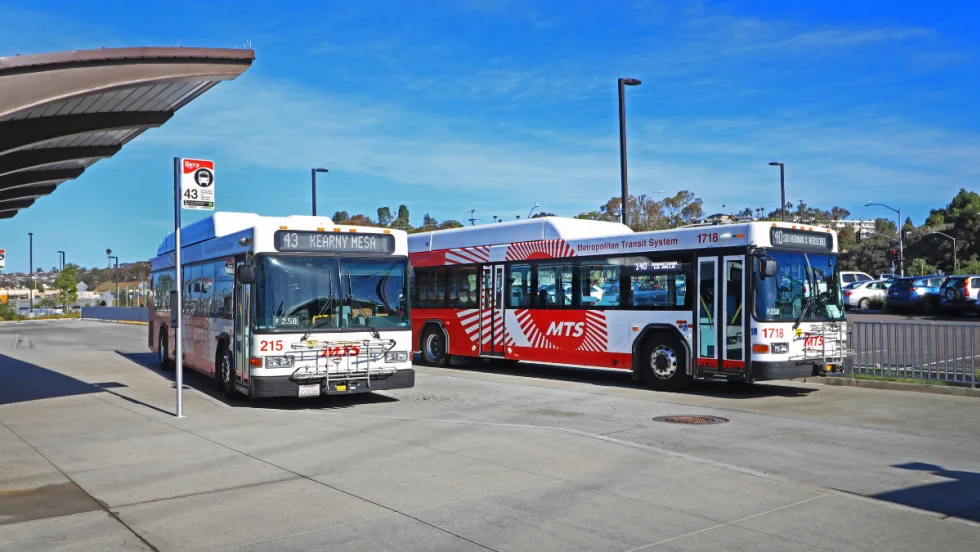
What’s Behind San Diego MTS’s Award-Winning Transit Strategy
Named one of APTA’s 2026 Outstanding Public Transportation Systems with 50 million or more annual passenger trips, California’s San Diego Metropolitan Transit System points to gains in ridership, safety, technology, and reliability as foundations of its success.
Read More →
Public Transit Conference Returning to GFX in 2027, Call for Papers Now Open
The Call for Papers is now open, allowing transit agency professionals and industry experts to help shape the PTC educational program by submitting session ideas for consideration.
Read More →
Indian River Transit’s Community-Focused Approach Earns National Recognition
Named APTA’s 2026 Outstanding Public Transportation System in its size category, Florida’s Indian River County transit system continues to grow ridership through fare-free service and a focus on evolving community needs.
Read More →
ENC Lands MATA Contract and More in Biz Briefs
In this edition of Biz Briefs, we spotlight the latest developments shaping the future of mobility.
Read More →
From Surviving to Thriving: Building Stronger Transportation Organizations
Bus Business Consultants founder Brian Dickson shares lessons on leadership, organizational health, and creating options for long-term success in a changing transportation industry.
Read More →
Everett Transit, Community Transit Outline Consolidation Agreement
The proposed agreement calls for a 50% increase in bus service in Everett, a new microtransit zone, continued paratransit service, and the transfer of Everett Transit operations to Community Transit.
Read More →
Strada360’s Steve Lassey on Turning Transit Data Into Better Decisions
From breaking down data silos to preparing for AI, Strada360 CEO Steve Lassey discusses how transit agencies can use technology to improve operations, customer information, and long-term decision-making.
Read More →