



C-TRAN Sees Fourth Consecutive Year of Ridership Growth
The total ridership includes all fixed-route bus service, C-VAN paratransit service, The Current, Vanpool, and special event service. Almost all individual routes saw year-over-year increases from 2024 to 2025.

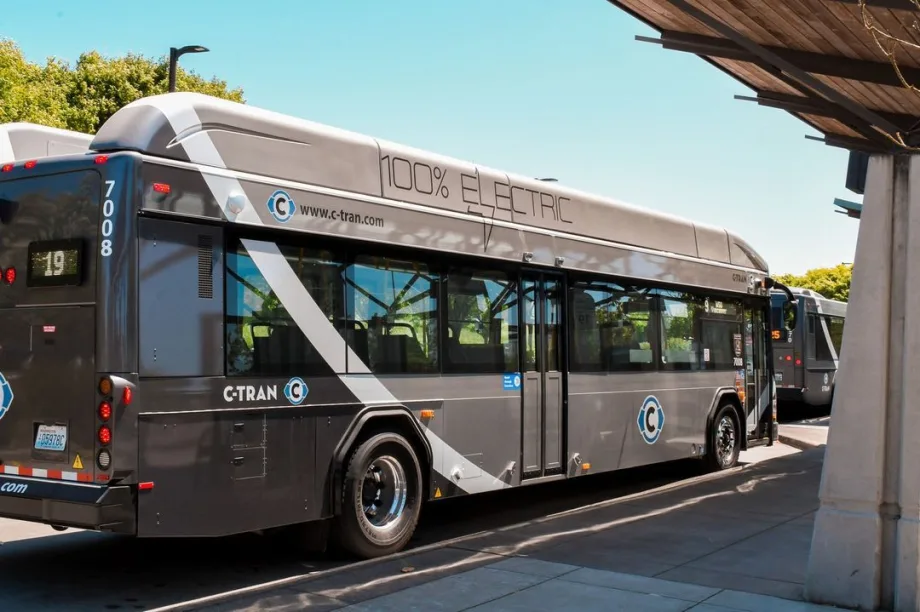
C-TRAN’s total ridership exceeded five million in 2025 for the first time since 2019, bolstered by new and returning riders in Clark County.
C-TRAN
- C-TRAN in Vancouver, Washington, achieved over five million rides in 2025, marking its fourth consecutive year of ridership growth with a 6.3% increase from the previous year.
- The total ridership in 2025 encompasses fixed-route bus service, C-VAN paratransit, The Current, Vanpool, and special event services, with nearly all routes experiencing year-over-year growth.
- CEO Leann Caver emphasized the importance of evolving transit services to meet changing regional travel patterns as the community continues to grow.
*Summarized by AI
Vancouver, Washington’s C-TRAN saw its total ridership surpass five million in 2025, trending upward for the fourth year in a row, reported agency officials, who added that the preliminary total of 5,280,313 trips was a 6.3% increase over 2024.
The total ridership includes all fixed-route bus service, C-VAN paratransit service, The Current, Vanpool, and special event service. Almost all individual routes saw year-over-year increases from 2024 to 2025.
“We know how important public transit is in our community, and the continued growth we’ve seen is a reflection of that,” said Leann Caver, C-TRAN’s CEO. “We also know that travel patterns look different as our region grows and evolves. As we look ahead to 2026 and beyond, we’ll continue to evolve to meet the needs of our riders and the communities we serve.”
Hitting New Milestones
C-TRAN’s total ridership exceeded five million in 2025 for the first time since 2019, bolstered by new and returning riders in Clark County. Some Local routes have surpassed pre-pandemic ridership levels.
Other notable trends in 2025:
- The Vine on Fourth Plain remains C-TRAN’s busiest route, with a ridership of 1.1 million last year.
- The Vine on Mill Plain, the second-busiest, saw a ridership of 780,331 in its second full year of service.
- The Current, C-TRAN’s on-demand service, served more than 50,000 trips across all service zones in 2025, a nearly 50% increase from the previous year. Demand continues to grow rapidly, as reflected in the expansion of The Current to Battle Ground in September.
- Route 48 (Ridgefield/La Center) continues to be one of C-TRAN’s fastest-growing routes, with a 28% increase in ridership in 2025.
- Route 12, which launched in mid-September 2025 on Vancouver’s 112th Avenue corridor, tallied a ridership of more than 10,000 in each of its first three full months in operation.
Room to Improve
As ridership grows, C-TRAN said it continually seeks ways to improve service and meet demand while providing new opportunities and connections across the region.
In 2026, the agency will finalize its long-range plan, C-TRAN 2045. That plan represents a collective vision for what public transportation in Clark County could look like in the next two decades, based largely on community feedback from the past two years.
Quick Answers
In 2025, C-TRAN achieved a notable milestone by surpassing five million total ridership for the first time since 2019, with a preliminary total of 5,280,313 trips.
*Summarized by AI
More Management

METRO Opens Submissions for 2026 Motorcoach Awards
Nominations are now being accepted for METRO Magazine’s Operator of the Year and Innovative Operator of the Year awards.
Read More →
New York MTA Advances Final Contract for Second Avenue Subway Expansion
Contract Four is the largest in the Second Avenue Subway Phase 2 project and includes construction of station infrastructure, tracks, and signals for the subway expansion, MTA officials said. Work on Contract Four will begin in 2027.
Read More →
Transit Agencies Highlight Safety Gains at National Summit
Leaders from 15 major transit systems shared crime-reduction results and safety initiatives while discussing the role of continued federal support.
Read More →

NITA Names New Leadership, Expands Reduced-Fare Program at First Board Meeting
The new regional transit authority appointed its first board chair and interim executive director while extending reduced fares across CTA, Metra, and Pace for eligible riders.
Read More →
Beyond the Checklist: A Structured Approach to Transit Maintenance
Reliability-Centered Maintenance helps transit agencies move beyond routine checklists to focus limited resources on the assets and failures that have the greatest impact on safety, reliability, and service.
Read More →
APTA 2026 Nominating Committee Selects Leadership Slate, Names Chair and Vice Chair Nominees
Leadership changes will help shape the association’s priorities and its representation of the transportation industry during the 2026–2027 term.
Read More →
DART Launches Major Security, Fare Enforcement Initiative
The 90-day demonstration will deploy coordinated security teams at five light rail stations while testing controlled access and gathering data to guide future investments.
Read More →
Advancing Fare Collection Through Technology and Innovation
Learn about delivering 1300 gates at 91 stations while managing fare evasion. Explore the large scale deployment, solution customization and real-world results that affect the region. Prepare for deployment in your region now.
Read More →
Game Day in Motion: Moving Millions During the 2026 World Cup
Between packed transit stations and team motorcoaches, see how agencies and operators across North America tackled the transportation demands of the 2026 FIFA World Cup.
Read More →
Surface Transportation Extension Averts Shutdown, Leaves Transit Funding Gap
The stopgap keeps federal transportation programs moving, but missing advance funding could complicate the transit and rail projects agencies are planning next.
Read More →