



Funding, ZEBs, and More with STV's Kelly
METRO had the chance to speak with STV's president/CEO for its 2024 Consultant's Roundtable.

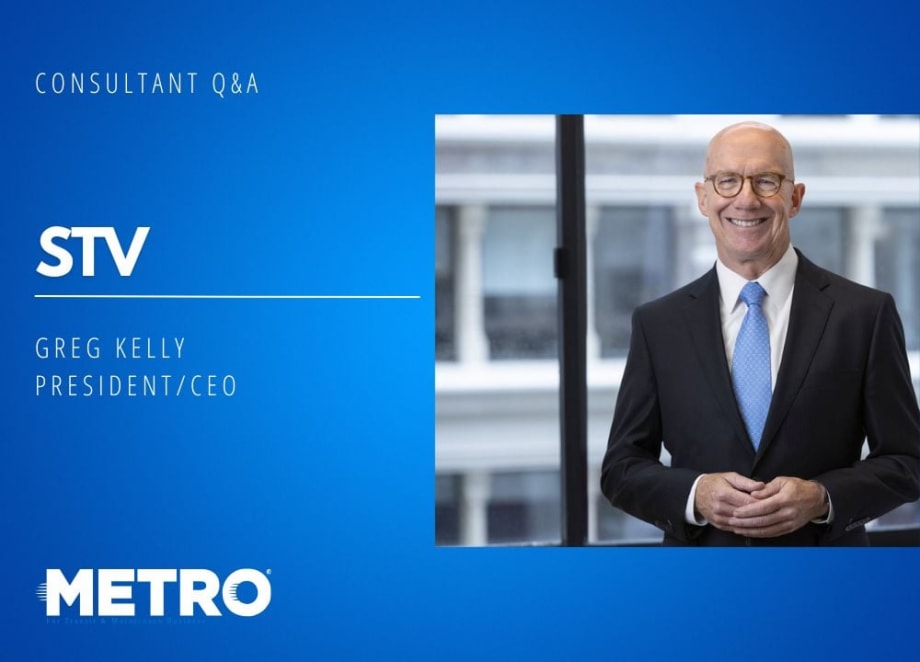
Greg Kelly was named president and CEO of STV in October 2020.
Photo: STV
In October 2020, STV Group’s board named Greg Kelly president and CEO, where he is responsible for guiding the firm toward achieving its short- and long-term strategic goals with an emphasis on performance, business development, technology, and human capital.
Prior to joining STV, Kelly was CEO of Heritage Construction + Materials, a provider of asphalt products, aggregates, and construction services in the Midwest. Before this role, he was president and CEO WSP USA.
METRO had the chance to speak with Kelly about federal funding execution, zero emission buses, the future of public transit, and much more.
From an industry standpoint, how do you feel the execution of IIJA funding is going and what’s next as funding from the bill continues?
In its first two years, IIJA funding has fundamentally redefined what’s possible for elected and private sector leaders across the country. Thanks to this transformational investment in our nation’s infrastructure, we’re seeing essential project starts in more than 4,500 communities of every size in every state — creating jobs and growing our economy in the process.
While the IIJA is already funding more than 40,000 projects and awards — including crucial public transportation initiatives — it has also incentivized the private sector to invest in long-term infrastructure projects and manufacturing. And when you combine the IIJA with the Inflation Reduction Act and the CHIPS Act, these monumental investments have been powerful force multipliers, driving economic development across the country.
As these resources continue to flow over the coming years, and with AI and other technological changes also impacting our industry, it will be critical for the public and private sectors to collaborate on workforce development and training. We need more workers to ensure future projects have the staffing they require, while upskilling and reskilling much of the existing workforce to adapt to new technologies in our systems.
The industry will always need civil engineers, construction managers and environmental planners, but to prepare for the future, the industry also needs to attract people with capabilities in data science, digital technologies, and AI.
What has the impact of IIJA funding been on the industry, particularly in executing capital projects and growing ZEB fleets and the necessary infrastructure?
IIJA funding and the legislation’s unprecedented focus on resilience is forcing local agencies to reimagine how they plan and execute capital projects and is fostering the growth of zero-emission fleets and associated infrastructure. Historic levels of funding for public transportation have catalyzed investments in electric and other low- to no-emission vehicles and the infrastructure needed to support them, such as charging stations and renewable energy sources.
While the early adopters of ZEB technology were primarily in public transit networks, a similar transition is now underway with school buses, trains, ferries, airports, municipal fleets, and other private sector fleets. The government is directly impacting this transformation with investments in some of these sectors through programs like the Federal Transit Administration’s Low or No Emission Grant Program, FTA’s Bus and Bus Facilities Program, or the Environmental Protection Agency’s Clean School Bus Program.
Combining this funding with the success of pilot projects is leading to an uptick in scalability. At STV, we’re continuing to help public transportation clients scale their zero-emission operations from pilot initiatives to comprehensive programs, while also sharing our expertise with other sectors embarking on similar decarbonization journeys.
How do you see the role of the USDOT evolving?
These once-in-a-generation investments in our nation’s infrastructure have enabled the USDOT to have a greater impact than ever before on the way they develop investment strategies. At the same time, USDOT has had to establish new and deeper relationships to deliver effective infrastructure projects.
More than ever before, the USDOT is collaborating with other federal agencies, state, and local governments, as well as private sector stakeholders to achieve shared objectives and maximize the impact of transportation investments. Additional resources and entirely new programs are pushing states, localities and public agencies to develop multimodal transportation solutions, advancing innovative technologies and addressing pressing issues such as climate change and social equity.
We have a role to play in all of this work as well. Private sector engagement in regulatory advocacy is key to infuse practicality and feasibility into government-set visions and goals. For instance, by voicing challenges about supply chain issues or operational realities, we can guide policy adjustments and funding allocations. While public agencies operate infrastructure, it’s companies like STV that drive innovation and execution, so collaboration between the public and private sector is essential.
What is your outlook for the future of public transportation?
The future of transportation will be driven by more data and intelligence, a focus on sustainability and a broadening of customer-centric solutions.
First, our transportation networks are generating more comprehensive data — and there is a growing number of sophisticated tools to better analyze that intelligence and inform decision making. This is enhancing operations and driving meaningful change in public transportation.
Meanwhile, a growing focus on sustainability at all levels of government in every kind of community is impacting all aspects of public transportation. From the design phase to planning and project delivery, the industry is collectively focused on making transportation more sustainable and more resilient for the future. While sustainable designs help address climate change by reducing our impact on the environment, resilience strategies are also helping us adapt our infrastructure to withstand and recover from climate-related hazards.
Finally, public agencies are embracing multimodal transportation and expanding the range of safe, reliable transportation options for users. This means more choice for commuters, more connectivity across communities and a better experience overall for passengers who can seamlessly switch between different modes of transportation. However, each community has unique challenges and opportunities. The growth of multimodal transportation means more micromobility and paratransit as well as light rail and high-speed rail, where we’re seeing continued investment in projects nationwide.
More Management

METRO Opens Submissions for 2026 Motorcoach Awards
Nominations are now being accepted for METRO Magazine’s Operator of the Year and Innovative Operator of the Year awards.
Read More →
New York MTA Advances Final Contract for Second Avenue Subway Expansion
Contract Four is the largest in the Second Avenue Subway Phase 2 project and includes construction of station infrastructure, tracks, and signals for the subway expansion, MTA officials said. Work on Contract Four will begin in 2027.
Read More →
Transit Agencies Highlight Safety Gains at National Summit
Leaders from 15 major transit systems shared crime-reduction results and safety initiatives while discussing the role of continued federal support.
Read More →

NITA Names New Leadership, Expands Reduced-Fare Program at First Board Meeting
The new regional transit authority appointed its first board chair and interim executive director while extending reduced fares across CTA, Metra, and Pace for eligible riders.
Read More →
Beyond the Checklist: A Structured Approach to Transit Maintenance
Reliability-Centered Maintenance helps transit agencies move beyond routine checklists to focus limited resources on the assets and failures that have the greatest impact on safety, reliability, and service.
Read More →
APTA 2026 Nominating Committee Selects Leadership Slate, Names Chair and Vice Chair Nominees
Leadership changes will help shape the association’s priorities and its representation of the transportation industry during the 2026–2027 term.
Read More →
DART Launches Major Security, Fare Enforcement Initiative
The 90-day demonstration will deploy coordinated security teams at five light rail stations while testing controlled access and gathering data to guide future investments.
Read More →
Advancing Fare Collection Through Technology and Innovation
Learn about delivering 1300 gates at 91 stations while managing fare evasion. Explore the large scale deployment, solution customization and real-world results that affect the region. Prepare for deployment in your region now.
Read More →
Game Day in Motion: Moving Millions During the 2026 World Cup
Between packed transit stations and team motorcoaches, see how agencies and operators across North America tackled the transportation demands of the 2026 FIFA World Cup.
Read More →
Surface Transportation Extension Averts Shutdown, Leaves Transit Funding Gap
The stopgap keeps federal transportation programs moving, but missing advance funding could complicate the transit and rail projects agencies are planning next.
Read More →