



Going the Extra Mile to Train Motorcoach Operators
Many operators are breaking away from typical 80-hour classroom/ behind-the-wheel-type training programs and are providing additional training to increase safety; improve vehicle efficiency; or better prepare drivers to perform in unique, area-specific driving conditions.
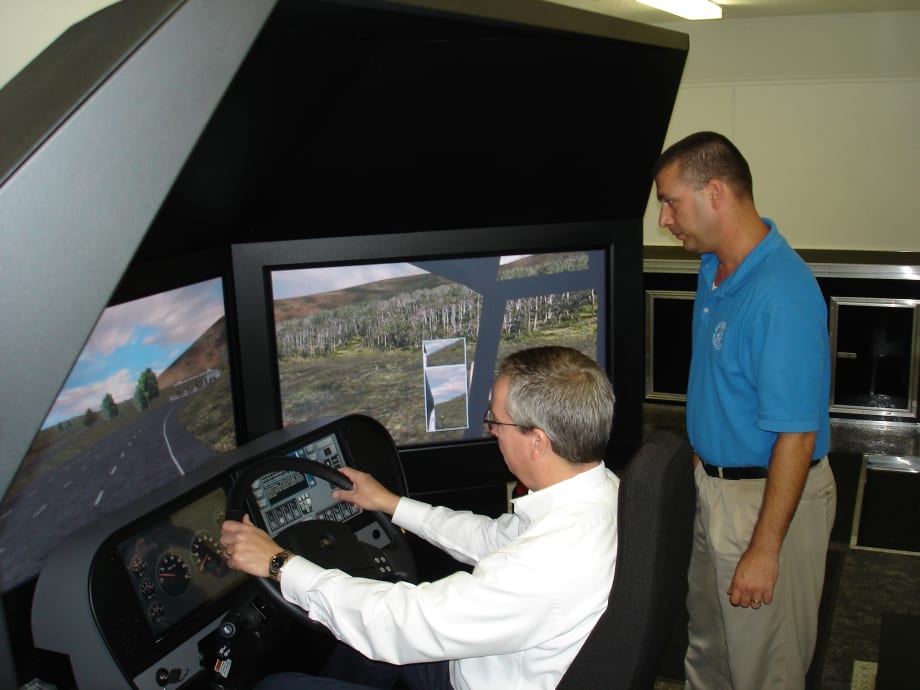
Though an investment, James River’s Stephen Story feels training drivers on a simulator enables them to make decisions instinctually rather than on the fly.
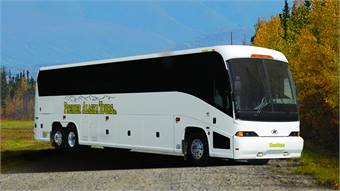
Premier Alaska Tours began hand-selecting its top drivers from the summer and training them to drive during the icy winter conditions as its wintertime business began to expand.
There is no one-size-fits-all training program for operators in the motorcoach industry. However, the standard program for many operations includes 40 hours in the classroom coupled with 40 hours behind the wheel. Many operators, though, have had to expand their training programs past those typical parameters as they begin to either focus on customer service or hire drivers with no previous experience.
Rather than focusing on typical 40/40 training programs, METRO discussed training with operations who have added something a little different to their programs, either to further increase safety or to deal with unique challenges they face out on the road.
Eco-driving, online refreshers
Milton, Vt.-based Premier Coach Co. Inc. has a roster of about 96 full- and part-time drivers with a fleet of 65 coaches. In addition to 40 hours in class and 40 hours behind the wheel, the operation has annual refresher courses for all drivers using the Smith System — an on-road, hands-on safety education program for experienced drivers — and recently introduced online modules their drivers can access on their website at any time.
“We focus a lot on the hands-on training behind the wheel, especially with our veteran drivers, because we understand that when they get back out on the road, their old habits take over to some degree,” says Sean Geraghty, manager, safety and compliance, at Premier Coach. “We encourage drivers to use the online training programs, but the Smith System is a way to reinforce good driving behavior and safe practices, which are our goals here at Premier.”
The Smith System training Premier is using relies on some of the same principles as the eco-driving philosophy the operation also trains drivers with, adds Geraghty. Eco-driving is based on several key principles to improve both road safety and fuel efficiency — anticipating traffic flow, maintaining a steady speed, accelerating and braking smoothly, no idling, checking tire pressure regularly and curtailing usage of energy-drawing systems such as air conditioning and electrical equipment.
“It is all about space management — space for the vehicle, visibility for the driver and time to make decisions,” Geraghty says. “To some degree, as more and more drivers follow the eco-driving and Smith System guidelines, we certainly do see the benefits — reduced collisions, better fuel consumption, less vehicle maintenance and those types of things.”
He adds that in addition to the benefits to the operation, eco-driving techniques also enable Premier’s passengers to enjoy a better, smoother trip.
[PAGEBREAK]
Though an investment, James River’s Stephen Story feels training drivers on a simulator enables them to make decisions instinctually rather than on the fly.
Tapping technology
To reinforce safety as well as its other values, which include teamwork and integrity, Richmond, Va.-based James River Transportation brings in a corporate trainer to teach drivers customer service, beginning with those core values as a way to establish the company’s culture.
To train its more than 150 full- and part-time drivers, James River uses the Smith System, teaches defensive driving techniques on an obstacle course and uses a driving simulator.
“[The simulator] has been a fairly expensive investment for us, but it teaches how to react when you have a front tire blowout, when your brakes fail or are driving in slippery conditions,” explains James River’s President Stephen Story. “When you go through Driver’s Ed in high school, and even when you go through training as a professional driver, nobody ever physically goes out there and teaches you what happens when you start sliding in snow or hydroplaning in water; they tell you what to do and show you some movies, but you can never truly recreate that.”
Story adds that practicing on the simulator enables drivers to make decisions out on the road without having to contemplate their options, and ultimately, possibly making the wrong decision. James River’s training program runs continuously throughout the year and includes quarterly assessments that consist of passengerless ride-alongs and driving on the simulator.
Some other tools James River uses to train drivers include satellite-based systems that monitor speed and hard-braking events, as well DriveCam video event recorders.
Story, who recently discussed his company’s safety culture with the National Transportation Safety Board alongside officials from industries including trucking, freight and aviation, explains it is difficult to actually measure how much impact the simulator or any of its other training practices have impacted his company’s overall safety record.
“We have always had a great safety record and things like the simulator just add to that,” he says. “With all this great technology that is out there, you have to utilize it and use it any way you can to continue training drivers.”
One way the bevy of training tools have benefitted James River, however, is allowing the operation to join a captive insurance program, which enables the operation to realize financial savings.
“[With the captive insurance program], when we drive safely we save money, which ends up going right into our pocket, but when we don’t, it comes right out,” Story says. “Financially, these tools have really helped us, but we had to make our training program and safety culture good before we could experience that savings. It can’t be all about the money, though, because you will lose sight of what is really important — being safe.”[PAGEBREAK]
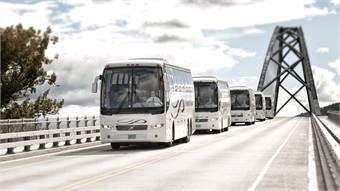
Vermont’s Premier Coach teaches eco-driving techniques that increase fuel efficiency and ensure safety, as well as improve the customer’s riding experience.
Weather Conditions
When Anchorage, Alaska-based Premier Alaska Tours began adding student group trips during the winter, the operation realized it had to add special training for dealing with the area’s unique conditions.
Beginning in fall 2007, Premier started taking some of its best summer drivers and training them to drive in the Alaskan winter by taking them out to drive in a parking lot to get a feel for what it’s like to hit the brakes and feel the coach slide.
“It is pretty intimidating to feel that while driving a big bus, but it is practical, hands-on training. You can explain how to deal with it until you are blue in the face, but unless you feel it for yourself, you don’t realize what can happen,” says Premier’s President Josh Howes. “The training gives the driver the opportunity to see what they don’t want to happen to them while they are going down the road, so they begin to watch their following distance and speed, because if they slam on the brakes, the bus will just keep going.”
The training also teaches drivers how to install chains on tires — a critical skill in Alaska — and what gear they need to have on the motorcoach when carrying gradeschool-aged children in temperatures that are as low as 30 degrees to 40 degrees below zero, such as hats, gloves, sleeping bags and jackets.
“In Alaska, we don’t have a lot of infrastructure, and during the winter the highways aren’t very well travelled, so it can be some time until somebody can reach the motorcoach to provide help,” says Howes. “They really have to be able to hunker down and make sure everybody has what they need to stay warm for a couple hours if the power is off.”
Howes adds that, typically, Premier has about 120 full- and part-time drivers during the summer and about 40 drivers in winter, of which 15 to 20 work regularly.
“It is a skilled position, one where you can only send out your best of the best,” says Howes. “It takes a while to get used to driving in those conditions. We might start drivers on a winter shift, which goes to and from a ski resort a couple times a week, until they work their way up to the more intense positions that require them to chain up and drive for 50 or 60 miles at a time.”
More Motorcoach

METRO Opens Submissions for 2026 Motorcoach Awards
Nominations are now being accepted for METRO Magazine’s Operator of the Year and Innovative Operator of the Year awards.
Read More →
Biz Briefs: Alstom Lands Canadian Contract, LYT to Supply California TSP, and More
In METRO's latest installment, we take a look at recent news from Complete Coach Works, Beep, FlixBus, and more partnerships making headlines across the transportation sector.
Read More →
Biz Briefs: RIPTA Unveils New Frontrunners, Clevland RTA Adds New Siemens, and More
In METRO's latest installment, we take a look at recent news from Siemens, Prevost, Dodge, and more partnerships making headlines across the transportation sector.
Read More →
People Movement: Holly Arnold Joins Transdev and More
In this edition, we also cover recent appointments and announcements at Pace, CamTran, MCI, and more, showcasing the individuals helping to shape the future of transportation.
Read More →
ABA Report: Motorcoach Travel Generates $161.6B Economic Impact
The 2025 analysis finds motorcoach travel supported nearly 900,000 jobs and generated $28 billion in federal, state, and local taxes.
Read More →
CharterUP’s Armir Harris on Technology, AI, and the Future of Group Mobility
In a recent episode of METROspectives, CharterUP Founder/CEO Armir Harris discussed the company’s evolution from an online charter bus marketplace into a technology platform supporting public- and private-sector mobility and much more.
Read More →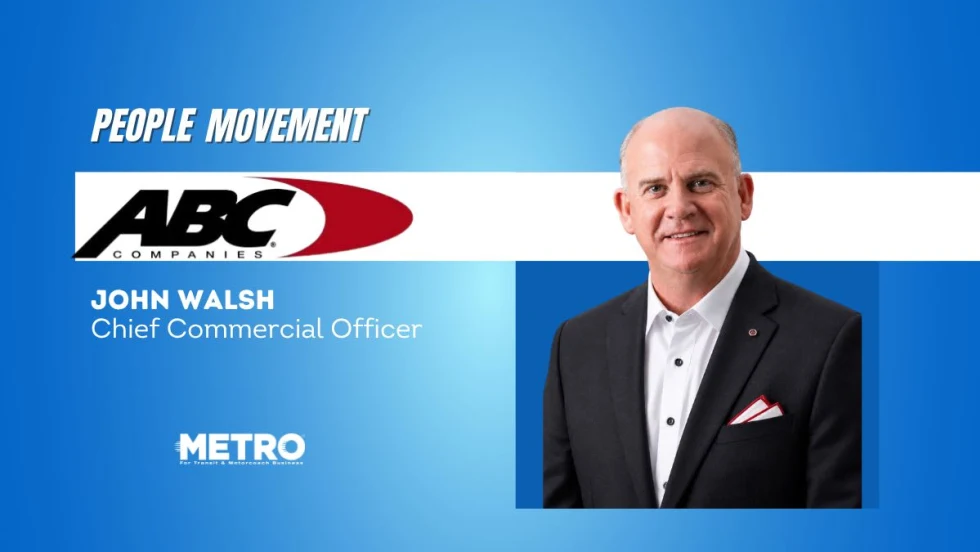
People Movement: ABC Names John Walsh as Chief Commercial Officer
In this edition, METRO also covers recent appointments and announcements at the DART, STV, and more, showcasing the individuals helping to shape the future of transportation.
Read More →
From Surviving to Thriving: Building Stronger Transportation Organizations
Bus Business Consultants founder Brian Dickson shares lessons on leadership, organizational health, and creating options for long-term success in a changing transportation industry.
Read More →
Biz Briefs: Luminator Marks Milestone and More
From manufacturers and suppliers to transit agencies and motorcoach operators, these updates offer a snapshot of the projects, partnerships and business moves driving the industry forward.
Read More →
ABAF Study Reveals Growing Insurance Crisis for Motorcoach Operators
Preliminary findings show 98% of operators faced premium increases over the past five years, while shrinking insurer participation is putting added pressure on businesses and customers.
Read More →