



Grand Central Terminal Endures as Transportation Icon
The “gateway to America” survived the threat of the wrecking ball, decline and disrepair, to emerge revitalized as a popular destination and lasting monument to New York City’s rebirth.
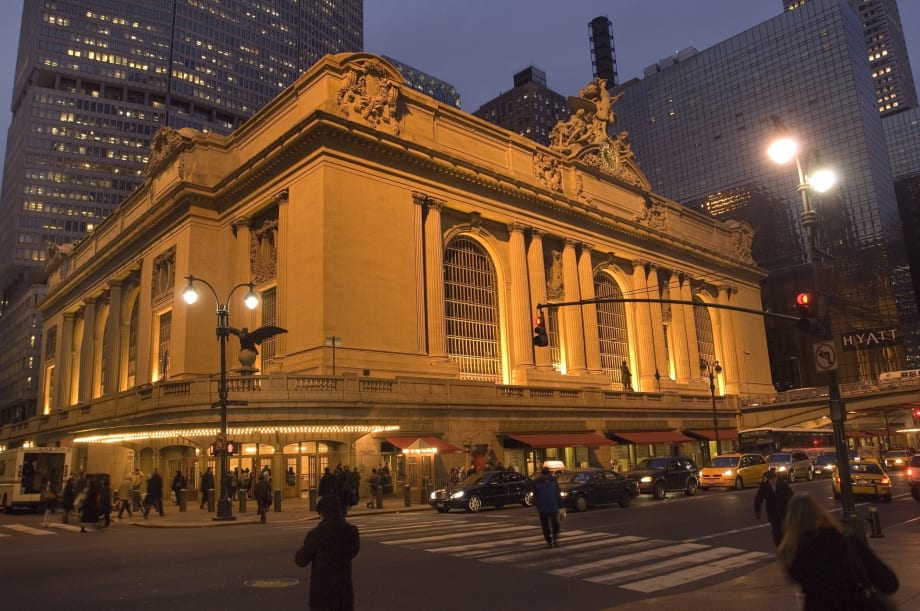
Designed in the French Beaux-Arts style, the structure features the world’s largest Tiffany clock.
Designed in the French Beaux-Arts style, the structure features the world’s largest Tiffany clock.
This year, New York City’s Grand Central Terminal celebrates its 100th anniversary. The iconic building, which began its storied history as the “gateway to America” has since survived the threat of the wrecking ball, decline and disrepair, to emerge revitalized as a popular destination and lasting monument to the city’s rebirth.
“Hundredth anniversaries come and go, but when it’s a building that you almost lost, it’s sort of a reminder that we didn’t,” says historian and lecturer Anthony W. Robins, who recently co-authored, with the staff of the New York Transit Museum, a new book commemorating the landmark.
Storied beginnings
Acclaimed as the “largest and greatest railway terminal in the world,” Grand Central was completed in 1913, after 10 years of construction, at a cost of $80 million. Before the terminal’s construction, steam trains serviced the original Grand Central Station. But, after a horrific accident in 1902, when trains collided in a smoke-filled tunnel, the switch to electric trains began. With electrification, engineer William J. Wilgus developed the idea of sinking the train tracks underground. This would create prime real estate above the rail yard, which could be sold or leased to help pay for the cost of the project. This followed the new concept of “air rights.”
Serving commuter and long distance rail lines, the terminal encompassed nearly 70 acres, with two levels of underground track. The terminal building had separate concourses for the various incoming and outgoing trains to help with passenger flow, who reached the different levels of the underground terminal using ramps. It was the first terminal to make use of this element as a mechanism to move people. [PAGEBREAK]
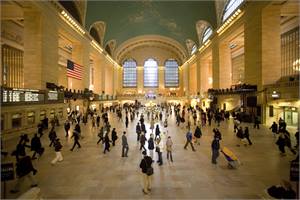
The main concourse features a 125-foot ceiling.
Architecture
The landmark building, designed by architect Whitney Warren, is in the French Beaux-Arts style, illustrated best by its classical façade on 42nd Street and the main interior concourse. Distinctive exterior features include the world’s largest Tiffany clock (14 feet in diameter), which adorns the roof. The clock is flanked by three sculptures of Roman gods weighing 1,500 tons and spanning 66 feet.
The interior showcases the magnificent concourse with its 125-foot cathedral-like ceiling, adorned with a mural of the zodiac. Other French artistic references include the staircase that leads up to Vanderbilt Avenue, which is modeled after the grand staircase at the famous Paris Opera.
The terminal’s other iconic clock, fashioned with four faces of opalescent glass, sits atop the information booth in the middle of the main concourse.
Decline and preservation
Following World War II, Grand Central plunged into decline and was threatened with demolition and plans to replace it with a skyscraper. Although rejected, a subsequent plan to build a tower on top of the terminal was also turned down. This led to and a multi-year battle in the courts by the owners spurring public opposition, most notably by former First Lady Jacqueline Kennedy Onassis, who helped with the effort.
“It drew such extraordinary attention to the idea that if you lose Grand Central, how will anything be preserved, everything is threatened,” says Laurie Beckelman, former chair of the New York City Landmarks Preservation Commission.
The battle to preserve the landmark finally ended in 1978, with the U.S. Supreme Court siding with the Landmark’s Commission.
Although saved from a major alteration, years of no investment in its maintenance also threatened the landmark. During the 1970s, Grand Central was in major disrepair, with homeless people sleeping on the long benches in Vanderbilt Hall at one point. The building was in poor shape, with dirty windows, remnants from being blackened during World War II that no one had bothered to clean, Robins says. The ceiling and walls were covered in tar and nicotine from years of tobacco smoke buildup.
Revitalization
In 1996, the Metropolitan Transportation Authority’s Metro-North Railroad, which operates the commuter rail service in Grand Central, managed a two-year $197 million dollar renovation to restore the building to its original grandeur. The aforementioned ceiling took restoration workers a year to clean. A small black patch on the ceiling was left to show visitors how dirty the terminal was prior to the renovation.
Other transformations included constructing an east staircase and converting the main waiting room into an exhibition space. With the addition of restaurants, a gourmet market and shops, Grand Central has become a real destination again,” Beckelman says.
More Rail
Amtrak, CN Reach Agreements to Strengthen Passenger Rail Service, Safety
The agreement resolves a more than decade-long proceeding before the Surface Transportation Board concerning the terms and conditions for Amtrak services, such as the City of New Orleans, Illini/Saluki, and Wolverine.
Read More →
New York MTA Advances Final Contract for Second Avenue Subway Expansion
Contract Four is the largest in the Second Avenue Subway Phase 2 project and includes construction of station infrastructure, tracks, and signals for the subway expansion, MTA officials said. Work on Contract Four will begin in 2027.
Read More →
San Diego MTS Breaks Monthly Trolley Ridership Record
Agency officials said July’s ridership indicates MTS’s continued recovery from the pandemic.
Read More →
Report Examines NJ TRANSIT Reliability, Funding Challenges
The Garden State Initiative analysis examines the roles of Amtrak infrastructure, fleet management, and agency operations while recommending a more performance-based approach to improving reliability.
Read More →
Stadler, CapMetro Sign Long-Term Rail Fleet Support Agreement
Beginning in 2027, Stadler will provide on-site technical expertise, spare parts support, training, and obsolescence management to help extend the reliability and longevity of CapMetro’s GTW fleet.
Read More →
Biz Briefs: Alstom Lands Canadian Contract, LYT to Supply California TSP, and More
In METRO's latest installment, we take a look at recent news from Complete Coach Works, Beep, FlixBus, and more partnerships making headlines across the transportation sector.
Read More →
CATS Gold Line Marks 5 Years of Service, 2.8M Passenger Trips
With a six-mile expansion planned, the Charlotte streetcar is positioned to connect more neighborhoods and major transit hubs across the region.
Read More →
Why Simulating Pedestrian Movement Has Become Essential for Modern Rail Stations
Pedestrian microsimulation is helping rail planners identify bottlenecks, test station designs, and prepare complex transit hubs for growing passenger volumes.
Read More →
Amtrak Begins Major Construction at New York’s Sunnyside Yard
The new maintenance facility will support Amtrak’s Airo trainsets while improving maintenance efficiency and turnaround times in New York.
Read More →
Chicago Leaders Unveil Plans for O’Hare Airport Express Train
The privately developed project would offer a 15-minute trip between downtown and O’Hare’s Terminal 2, with trains operating every 15 minutes on a dedicated track. The service would use battery-electric trains and three existing freight rail rights-of-way.
Read More →