



House, Senate advance authorization bills, expose vast chasm
In early February, House T&I Chairman John L. Mica (R-FL) and members of the committee held a press conference to unveil its five-year, $260 billion transportation authorization proposal.
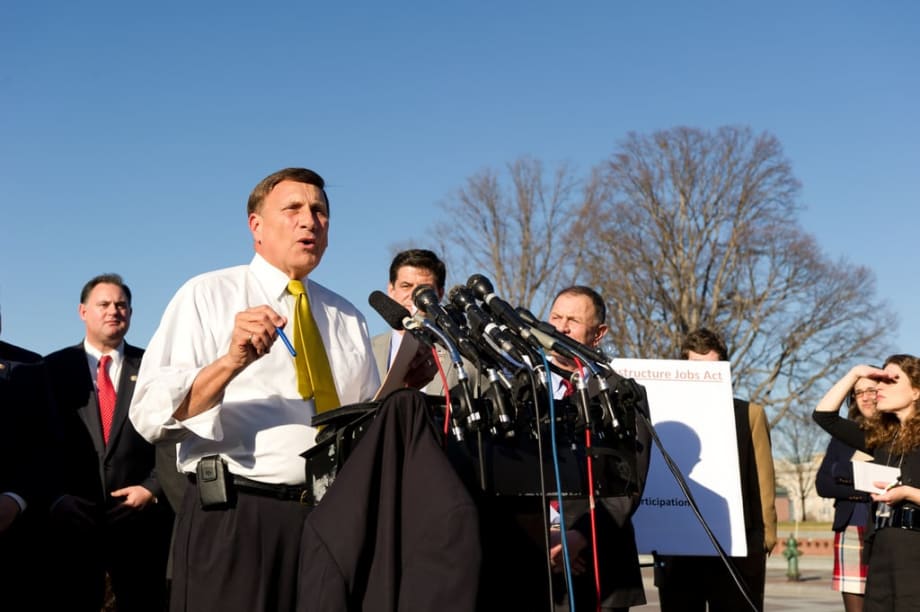

In early February, both the House and Senate began moving forward with public transportation authorization bills that varied in both length of time and amount of dollars, while the House Ways and Means Committee voted to eliminate the use of motor fuel tax revenues for public transportation.
The $260 billion, five-year American Energy & Infrastructure Jobs Act introduced by House Transportation and Infrastructure Chairman John L. Mica (R-FL) and members of the committee went through a 16-hour markup session before being approved by a 29 to 24 vote. The bill proposes several provisions to improve programs for freight and passenger rail transportation and calls for funds collected for maintaining the nation's harbors to be invested for that purpose. In addition, the bill cuts funding for high-speed rail, reforms and consolidates several programs, eliminating approximately 70 that are "duplicative or do not serve a federal purpose."
"This is a five-year bill that reforms our federal transportation programs, cuts the red tape and bureaucracy that delays projects across the country, gives states more flexibility to determine their most critical infrastructure needs, provides states with the long-term stability to undertake major improvements and encourages private sector participation in helping to finance transportation projects," Mica said.
Meanwhile, Banking Committee Chair Tim Johnson (D-SD) and Ranking Member Richard Shelby (R-AL) released a summary of the Federal Public Transportation Act of 2012, which serves as the transit component of the Senate Committee on Environment and Public Works' MAP-21, Moving Ahead for Progress in the 21st Century, that also went to markup. The proposed two-year reauthorization bill, which was introduced in November and unanimously passed, funds programs at FY 2012 levels.
Some of the points listed in the summary include the protection of the Job Access and Reverse Commute program; creation of a new pilot program to support transit-oriented development with planning grants; streamlining the New Starts program, eliminating duplicative steps and allowing smaller projects ($100 million or less) to complete an expedited review process; and expanding the Rail Modernization program to include "high-intensity bus" networks, renaming it the State of Good Repair Grant program.
Despite the apparent forward movement from both factions of Congress, public transportation was dealt a major blow when the House Ways and Means Committee, in a party-line vote with two dissenting Republican members, voted to end a 30-year federal commitment to dedicated funding for public transportation. The measure takes from transit the 2.86 cents of the federal gas tax and eliminates the Mass Transit trust fund, forcing public transit to compete for general funds.
"Since 1983, under President Ronald Reagan, fuel tax revenues have been dedicated to public transit through the Mass Transit Account of the surface transportation legislation," said American Public Transportation Association President/CEO Michael Melaniphy in a statement. "We call on Congress to continue the long-standing highway and public transit financing partnership in place today so that our country can continue to create American jobs and foster economic growth, as well as rebuild our aging infrastructure and meet the growing demand for improved and expanded transportation."
The bill also would finance highway and bridge construction with revenue from expanded oil and natural gas drilling on government land and offshore. The committee, before approving the bill, rejected an attempt by Democrats to strike the gasoline-tax provision.
"This move is sure to make it extremely difficult to adopt a multi-year transportation authorization during this session of Congress, a development that will continue to cloud the future of our transportation infrastructure," said James Corless, director of Transportation For America.
As of press time, the $260 billion, five-year House bill needed to be reconciled with the $109 billion, two-year Senate bill.
More Paratransit

Biz Briefs: RIPTA Unveils New Frontrunners, Clevland RTA Adds New Siemens, and More
In METRO's latest installment, we take a look at recent news from Siemens, Prevost, Dodge, and more partnerships making headlines across the transportation sector.
Read More →
King County Metro Makes ADA Paratransit Easier to Navigate
METRO's Innovative Solutions Award winner replaces complex service-area descriptions with an accessible, interactive map that puts paratransit information directly in customers’ hands.
Read More →
Jacksonville’s NAVI Project Charts a New Course for Autonomous Public Transportation
Through its NAVI program, JTA is showing how autonomous vehicles, intelligent infrastructure, and coordinated operations can work together to deliver everyday public transportation.
Read More →
Driving Smarter Paratransit
John Hanlon shares how AlphaRoute is leveraging AI-powered technology to help paratransit providers optimize operations, support frontline staff, and enhance the rider experience.
Read More →
METRO Magazine Announces 2026 Innovative Solutions Awards Winners
Projects Recognized for Advancing Mobility Through Technology, Accessibility, Workforce Innovation, and Operational Excellence
Read More →
Biz Briefs: STV teams with Amtrak, Motorcoach Operators Boost Fleet and Land Contracts, and More
From manufacturers and suppliers to transit agencies and motorcoach operators, these updates offer a snapshot of the projects, partnerships and business moves driving the industry forward.
Read More →
Biz Briefs: Masabi Teams with St. Louis Metro and More
In METRO's latest installment, we take a look at recent news from Transdev, Hitachi, and more partnerships making headlines across the transportation sector.
Read More →
New York MTA Leverages Zoning Program to Advance Station Accessibility
Accessibility enhancements at Nevins St Station will be financed through a development agreement tied to the MTA's Zoning for Accessibility initiative.
Read More →
Reinventing Fleet Maintenance with Real-time Visibility and AI
Transit leaders need to know what needs fixing, where to look, who is responsible, when work is completed, and what it costs without having to chase information across disconnected systems.
Read More →
SamTrans Sets Priorities for Potential Connect Bay Area Revenue
The board-approved framework allocates future funding to maintaining service, rider improvements, equity initiatives, and infrastructure repairs.
Read More →