



How Optibus, Transdev Are Improving Bus Driver Shifts
Optibus and Transdev are working to improve bus driver schedules. Senior transit planner Hope Ann Smith opened up about the elements of what makes a good bus driver schedule.


NICE Bus uses Optibus’ scheduling software to create better work schedules, with sufficient pre-trip and layover time, diverse routes, and better work-life balance.
Photo: METRO
Optibus recently released the results of how the Nassau-Inter County Express (NICE Bus), a Transdev operation in New York, uses Optibus’ software to create better work schedules for bus drivers.
Hope Ann Smith, senior transit planner and scheduler at NICE Bus, opened up about the five key elements of what makes a good bus driver schedule.
How Optibus Helps Create Better Driver Schedules
NICE Bus uses Optibus’ scheduling software to create better work schedules, with sufficient pre-trip and layover time, diverse routes, and better work-life balance.
NICE Bus serves the passengers of Nassau County, New York. Since 2012, the system has operated as a public-private partnership between Nassau County and Transdev.
Transdev manages all daily operations on behalf of and under contract to Nassau County. It runs 38 fixed bus routes operated by 422 drivers, serving 20 million passengers annually.
“Just because it looks good on paper doesn't mean it works well on the street,” said Smith. “The service that we're providing is being provided by humans just like me and you.”
Key factors Smith has learned as a driver:
Layover time: Ensuring drivers have enough time during their break to do everything they need to do to get recharged, including getting a coffee, using the restroom, having a meal, stretching their legs, or resting, all in a break location with adequate facilities.
Pre-trip time: Inadequacies in sign-on or sign-off times can cause operators to rush, which puts them, passengers, and pedestrians at risk.
Interlining: Analyzing opportunities to switch up a driver’s route or driving environment makes the job more exciting, rather than driving the same route day in and day out
Platform time: Creating work schedules that are not excessively long, and that respect work-life balance.
Data about schedule performance: Run time data shows whether drivers are able — or unable — to make it from point A to point B in the time allotted. When enough drivers can’t abide by the schedule, more run time may be necessary.
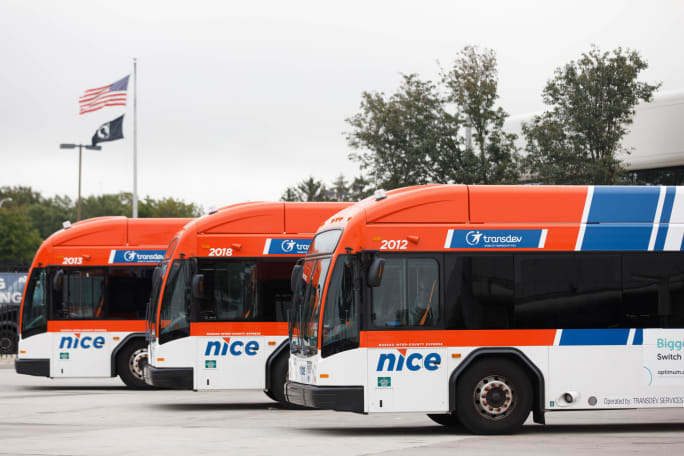
NICE Bus serves the passengers of Nassau County, N.Y. Since 2012, the system has operated as a public-private partnership between Nassau County and Transdev.
Photo: Transdev
Oren Hirsch, the primary customer success point of contact for NICE Bus at Optibus since early 2022, discussed Optibus’ software.
“Optibus users, such as Hope, are really good at their jobs,” Hirsch said. “However, software such as Optibus can sometimes ‘see’ opportunities for efficiencies that human eyes might miss.”
Hirsch also shared helpful tips for bus drivers. He said if an operator has an idea for how to improve the schedule, share it with the planning or scheduling team.
“Not every idea may be actionable or feasible, but the implementation rate for suggestions never made is zero,” he said.
It’s also important to understand to implement some ideas, there may be some tradeoffs that may not justify the change.
“For example, generally speaking, it may not be feasible to eliminate all split shifts, but there might be ways to do the runcut so that all split shifts end by a certain time so operators on the late shift are guaranteed straights,” Hirsch added.
Using Optibus, Smith has the ability to make data-driven decisions that prioritize the people behind the wheel while still accounting for operational efficiency and key performance indicators.
“It [Optibus] also gives you a chance to meet your departmental goals,” she said. “I still report to somebody who wants to see success. So, if we have to go back to the drawing board, we can. Having technology like Optibus gives me that chance to be like, ‘Okay. I'll have something for you by the end of the week.’ You know? Done.”
When trying to improve driver satisfaction through interlining, Smith can use Optibus Scheduling and its preferences capabilities to assess whether interlining also makes sense from an operational perspective.
“To the point Hope makes about how she also has a manager to report to, Optibus’s scenario testing allows management to understand the financial impact of implementing certain proposals,” Hirsch said. “Onboarding new employees or paying overtime to fill open runs due to an operator shortage also comes at a cost. Generally speaking, the cost of eliminating street reliefs on the weekend to make weekend work more attractive may be justified if operator retention increases, especially among the newest operators most likely to work such runs.”
More Bus

New York MTA Plans Largest Bus Fleet Upgrade in More Than a Decade
The agency is seeking manufacturers for 650 new CNG buses to replace aging vehicles, improve reliability, and advance its broader fleet modernization strategy.
Read More →
Building a Flexible Path to Transit Electrification
John Hroncich discusses BAE Systems’ modular and scalable approach, lessons learned from decades of real-world operations, and how agencies can identify electrification strategies that fit their fleets.
Read More →
Bus Tech Talk: Keeping Transit Technicians Ahead of the Technology Curve
LA Metro’s Obed Mejia discusses technician training, evolving maintenance technology, fleet replacement, and strategies for getting the most out of today’s transit fleets.
Read More →
Biz Briefs: RIPTA Unveils New Frontrunners, Clevland RTA Adds New Siemens, and More
In METRO's latest installment, we take a look at recent news from Siemens, Prevost, Dodge, and more partnerships making headlines across the transportation sector.
Read More →
People Movement: Holly Arnold Joins Transdev and More
In this edition, we also cover recent appointments and announcements at Pace, CamTran, MCI, and more, showcasing the individuals helping to shape the future of transportation.
Read More →
The High Cost of Transit Buses: Industry Leaders Look to Procurement Reform
Transit leaders and policymakers examine how standardized bus designs, streamlined procurement, and predictable funding could help agencies stretch budgets and deliver better service.
Read More →
The Business Voice Behind Public Transportation
As chair of APTA’s Business Members Board of Governors, Ray Melleady explains how more than 850 business members are partnering with transit agencies to advance funding, innovation, and industry-wide collaboration.
Read More →
From Surviving to Thriving: Building Stronger Transportation Organizations
Bus Business Consultants founder Brian Dickson shares lessons on leadership, organizational health, and creating options for long-term success in a changing transportation industry.
Read More →
Finding the ‘Happy Medium’: Optimizing Maintenance Without Sacrificing Reliability
The key to maintenance optimization isn’t doing less work—it’s doing the right work at the right time on the right assets.
Read More →
LA Metro, City of West Hollywood, and Partners Advance Smarter Bus Lane Enforcement
The award-winning partnership combines AI-powered detection with human oversight to improve bus reliability, accessibility, and enforcement efficiency.
Read More →