



LA Metro, City of West Hollywood, and Partners Advance Smarter Bus Lane Enforcement
The award-winning partnership combines AI-powered detection with human oversight to improve bus reliability, accessibility, and enforcement efficiency.

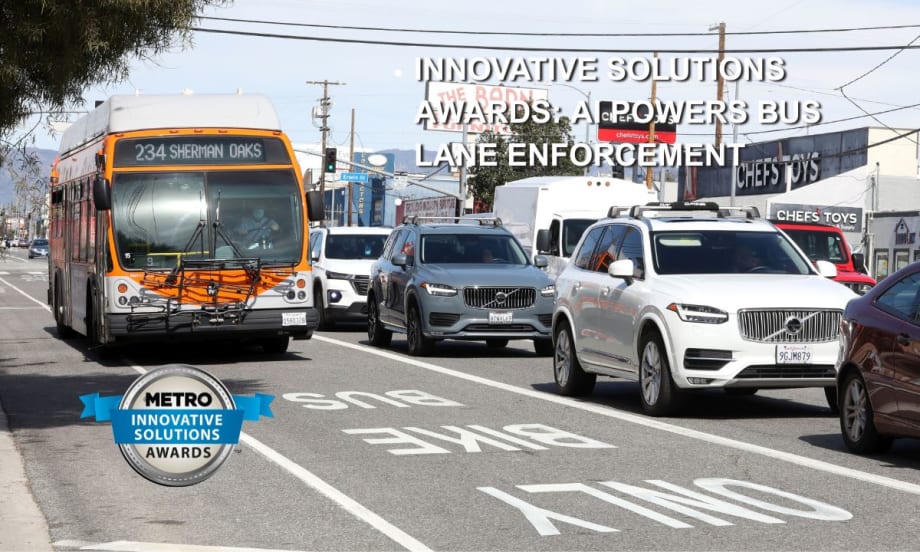
The project team said the award recognizes more than the technology itself — it recognizes the measurable improvements the program has delivered for transit operations and riders.
LA Metro/METRO Magazine
- LA Metro, the City of West Hollywood, and partners are collaborating to enhance bus lane enforcement using advanced technologies.
- The initiative integrates AI-powered detection systems with human oversight to boost bus service reliability and accessibility.
- This effort aims to increase enforcement efficiency, leading to improved overall transit operations in the area.
*Summarized by AI
The City of West Hollywood, in partnership with LA Metro, Hayden AI, T2 Systems, and LAZ Parking, implemented an AI-powered bus lane enforcement program that is redefining how cities keep dedicated transit lanes and bus stops clear.
The collaborative initiative, recognized with METRO Magazine's Innovative Solutions Award, combines onboard computer vision technology, automated citation processing, and human oversight to improve transit reliability, accessibility, and operational efficiency.
The program integrates Hayden AI's bus-mounted, vision-based camera technology with T2 Systems' Flex parking management platform to create a seamless enforcement workflow. AI-enabled cameras installed on select Metro buses identify vehicles illegally stopped or parked in bus lanes and at bus stops. City of West Hollywood parking enforcement personnel review potential violations before approved cases are automatically processed through T2 Flex for citation generation, DMV lookup, payment processing, appeals, and collections.
The result is a fully integrated system that replaces a time-intensive manual enforcement process with a streamlined digital workflow while preserving human review at every stage.
Delivering Better Transit Through Smarter Enforcement
The project team said the award recognizes more than the technology itself — it recognizes the measurable improvements the program has delivered for transit operations and riders.
"Winning a METRO Magazine Innovative Solutions Award is a tremendous honor, and it's especially meaningful because it recognizes a program built to solve a very practical, persistent problem: keeping bus lanes and bus stops clear so transit can move safely and reliably," project officials said.
Unlike traditional parking enforcement, which depends on officers witnessing violations in person, the mobile enforcement system extends coverage across an entire bus route.
"What we're most proud of isn't the technology for its own sake; it's the outcome," officials said. "A bus-mounted, mobile enforcement solution lets a city extend coverage across an entire bus route, including violations that were previously almost impossible to address."
That expanded coverage captures violations that fixed cameras or patrol officers may never see, including vehicles temporarily blocking bus lanes or bus stops.
"When enforcement becomes consistent and route-wide, drivers change their behavior, resulting in public transportation that people can count on: buses that are on time, bus stops that are unobstructed, and roads that are safer for everyone," officials said.
The benefits are especially significant for riders with disabilities.
"That includes riders with disabilities, who depend on bus stops being clear so operators can safely deploy wheelchair ramps," officials added.
Modernizing Enforcement
West Hollywood pursued the program to address the growing challenge of vehicles illegally parking, stopping, or traveling in dedicated bus lanes and bus stops. These violations slow buses, create safety concerns, reduce curb access, and make boarding more difficult for riders.
Traditional enforcement methods can be difficult to scale across active transit corridors because they rely on officers being physically present when a violation occurs.
The AI-powered system changes that by allowing enforcement to travel wherever Metro buses operate. Cameras mounted on buses continuously monitor designated enforcement zones. When a potential violation is detected, the system automatically captures a short video clip, a license plate image, and supporting location data. Only potential violations are transmitted for review, minimizing unnecessary data collection.
Each case is reviewed by trained City personnel before becoming an official citation, ensuring enforcement decisions remain human-led.
"The greatest value comes when the technology supports, rather than replaces, human judgment," project officials said. "Trained parking enforcement staff still review and approve every potential violation before a citation is ever issued."
The initiative brings together several organizations, each contributing a critical component of the overall program.
Hayden AI provides the onboard vision AI platform that detects potential violations. T2 Systems connects validated violations directly into the City's citation management process through T2 Flex, automating citation creation, registered owner lookup, notices, payments, appeals, and collections. LAZ Parking supports day-to-day enforcement operations.
Together, the partners have created an end-to-end workflow that moves seamlessly from AI detection and human review to citation issuance and resolution.
The collaboration has also demonstrated how regional transit agencies and municipalities can work together across jurisdictional boundaries. By using Metro buses to enforce West Hollywood's bus lanes and bus stops, the program establishes a model that other metropolitan regions can replicate as transit routes cross multiple cities.
Improving Efficiency, the Customer Experience
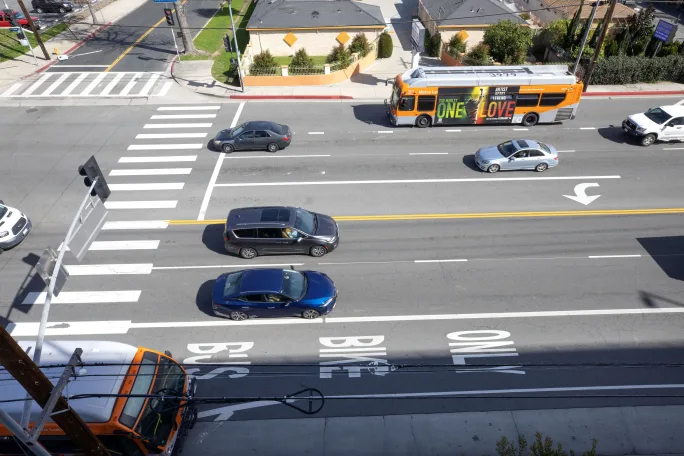
By combining AI-powered detection with human oversight, automated workflows, and strong privacy protections, the partnership among West Hollywood, LA Metro, Hayden AI, T2 Systems, and LAZ Parking demonstrates how technology can improve transit operations while maintaining public trust.
LA Metro
Operationally, the system has significantly reduced the time required to process violations while increasing consistency throughout the enforcement process.
Before implementation, staff often spent 10 to 15 minutes processing each violation. Today, automation reduces much of that administrative work to seconds once a violation has been approved.
The integrated workflow eliminates duplicate data entry and manual handoffs while allowing staff to devote more time to higher-priority community needs.
For transit riders, the impact is equally important. Clearer bus lanes improve travel times and service reliability, while unobstructed bus stops make boarding safer and more accessible for all passengers.
Project leaders emphasized that privacy, transparency, and fairness were foundational considerations throughout development.
The cameras are designed to detect roadway features, bus lanes, and vehicles — not people. The system does not use facial recognition, does not monitor activity inside buses, and only transmits images when a potential violation occurs.
Data retention complies with California's AB 917 requirements. Footage without evidence of a violation is automatically deleted within 15 days, while evidence supporting citations is retained only for the legally prescribed period before deletion.
"The goal of the program is compliance and safer, more reliable transit operations," project officials said. "The technology is focused on specific bus lane and bus stop violations, and the City retains final authority over whether an incident should proceed as a citation."
By combining AI-powered detection with human oversight, automated workflows, and strong privacy protections, the partnership among West Hollywood, LA Metro, Hayden AI, T2 Systems, and LAZ Parking demonstrates how technology can improve transit operations while maintaining public trust. The project offers a scalable model for agencies seeking to improve bus reliability, accessibility, and enforcement efficiency across increasingly complex urban transportation networks.
Quick Answers
The partnership aims to enhance bus lane enforcement by integrating AI-powered detection with human oversight to improve bus reliability, accessibility, and enforcement efficiency.
*Summarized by AI
More Technology

ENC Lands MATA Contract and More in Biz Briefs
In this edition of Biz Briefs, we spotlight the latest developments shaping the future of mobility.
Read More →
Strada360’s Steve Lassey on Turning Transit Data Into Better Decisions
From breaking down data silos to preparing for AI, Strada360 CEO Steve Lassey discusses how transit agencies can use technology to improve operations, customer information, and long-term decision-making.
Read More →
Almaviva Looks to Open Architecture to Advance Transit Technology
Eric Reese discusses how interoperability, open architecture, and modular design can help transit agencies control costs, reduce vendor lock-in, and upgrade technology without starting over.
Read More →

Driving Smarter Paratransit
John Hanlon shares how AlphaRoute is leveraging AI-powered technology to help paratransit providers optimize operations, support frontline staff, and enhance the rider experience.
Read More →
From Hardware to Digital Partner: Luminator Charts Its Next Chapter
CEO Magnus Friberg discusses Luminator’s shift toward becoming a digital partner, the growing importance of software and interoperability, and how AI can help agencies improve operations and passenger experience.
Read More →
Beyond the Checklist: A Structured Approach to Transit Maintenance
Reliability-Centered Maintenance helps transit agencies move beyond routine checklists to focus limited resources on the assets and failures that have the greatest impact on safety, reliability, and service.
Read More →
NJ TRANSIT Advances Bus Technology Upgrades Across Statewide Fleet
More than 1,500 buses now feature upgraded technology designed to improve arrival predictions and provide free Wi-Fi, with deployment expected to reach nearly 2,000 buses by the end of 2026.
Read More →
Building a Flexible Path to Transit Electrification
John Hroncich discusses BAE Systems’ modular and scalable approach, lessons learned from decades of real-world operations, and how agencies can identify electrification strategies that fit their fleets.
Read More →
Biz Briefs: Alstom Lands Canadian Contract, LYT to Supply California TSP, and More
In METRO's latest installment, we take a look at recent news from Complete Coach Works, Beep, FlixBus, and more partnerships making headlines across the transportation sector.
Read More →
From Legacy Silos to Conversational Intelligence
What if transit leaders could ask any operational question and get a trusted answer in seconds? Conversational AI is transforming how agencies use their data.
Read More →