September 1, 2026
How World Cup Mobility Put Transit and Motorcoaches to the Test
Behind the seamless trips were months of planning, multimodal partnerships, and lessons agencies and operators can carry into the next mega-event.
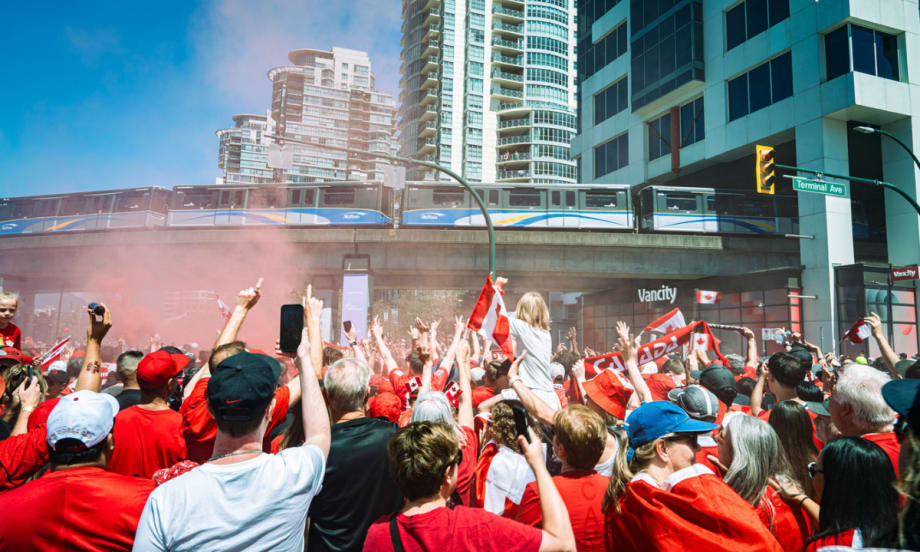
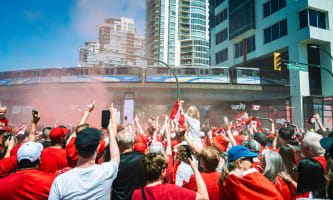
A crowd of FIFA World Cup fans gathered near a TransLink SkyTrain during the Canada-Qatar match day in Vancouver on June 18, 2026. The tournament brought significant ridership increases across the region as fans turned to public transit to reach matches and celebrations.
Credit:
TransLink
11 min to read
- Achieving seamless transportation for the World Cup required extensive planning and collaboration between different transit systems and motorcoach operators.
- Multimodal partnerships were crucial in ensuring efficient and integrated travel solutions for the event.
- Lessons learned from this experience will inform and improve planning for future large-scale events.
*Summarized by AI
For most fans, getting to a World Cup match was the easy part. Board the train. Find the shuttle. Follow the signs. Get to the stadium. Celebrate. Then do it all again on the way home.
What riders didn’t see was everything happening behind that trip. The amount of effort that went into transportation planning for the World Cup made it seem seamless to the uninitiated, but an almost endless network of companies and operators really stepped up.
Across the U.S. and Canada, transit agencies, regional planners, motorcoach operators, law enforcement, event organizers, and thousands of frontline employees spent weeks managing crowds, shifting schedules, staging vehicles, answering questions, and adjusting plans in real time. And unlike a Super Bowl or championship parade, the World Cup was not a one-day assignment.
“We have supported other major events, including Super Bowls, but the World Cup was different in its duration and repetition,” said Frede Smith, director of business development for Houston-based First Class Transportation. “Operationally, it was almost like having multiple Super Bowls every few days.”
That repetition became one of the defining transportation challenges of the tournament since agencies and operators could not simply deliver one strong match day and move on. They had to reset, maintain vehicles, adjust staffing, learn from what worked, and be ready to do it again a few days later. Agencies nationwide were tasked with supporting this large-scale event while continuing to serve the people who still needed to get to everyday destinations.
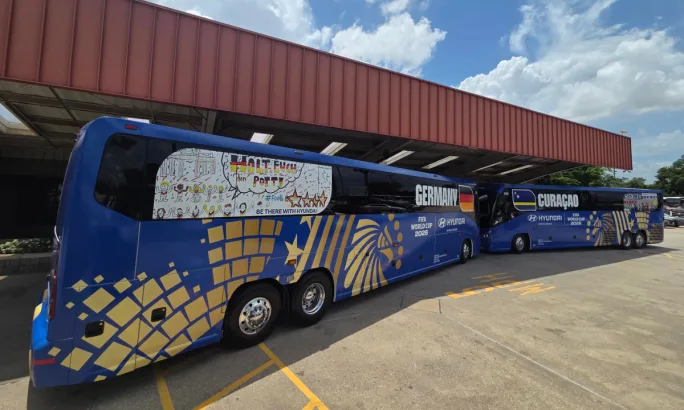
World Cup-wrapped motorcoaches for Germany and Curaçao sit staged as First Class Transportation supports team movements and other transportation needs during the tournament.
Credit:
First Class Transportation
Sometimes Success Is Measured by Nobody Noticing
For Jared Flaum, director of sales and operations at Lux Bus America, the best type of operations are often the least memorable.
“One thing we often say is that the best transportation operation is the one nobody notices,” Flaum said. “If teams arrived on time, schedules stayed on track, and transportation became something they never had to think about, then we had done our job.”
That is a high bar, especially at an event where one delayed movement can have consequences far beyond a single bus. Working with Accord Pitch USA, Lux Bus America provided dedicated transportation for national teams, base camps, media and broadcast personnel, FIFA workers, and other tournament stakeholders across Los Angeles and San Francisco, with additional operations in San Diego and Arizona. Airport arrivals, training sessions, hotels, and match-day movements all had to fit together.
Before the launch of the tournament, Lux Bus spent months reviewing routes, developing contingency plans, training drivers, and making sure each department knew exactly what it was responsible for.
“You can’t wait until game day to solve problems. You solve them long before the buses ever leave the yard,” Flaum said.
Public transit agencies were working through the same reality on a much larger scale. In Atlanta, MARTA recorded 4.7 million rail passenger trips during 35 days of World Cup matches, fan festivals, concerts, other events, and the July 4 Peachtree Road Race.
Its busiest World Cup day came June 24, when the Morocco-Haiti match helped push rail ridership to approximately 240,000 passenger trips, which is about 2.6 times a typical weekday. On match days, MARTA regularly saw rail ridership reach two to three-and-a-half times normal levels.
Although those numbers tell a large part of the story, the other part was visible at station entrances and on platforms, where people needed directions, reassurance, water, and sometimes just a friendly face.
Six hundred MARTA Transit Ambassadors worked 6,400 assignments, joined by 100 multilingual FIFA volunteers. Safety employees distributed water and sunscreen and provided first aid, while hundreds of MARTA Police officers and partner law enforcement personnel covered trains, stations, buses, parking facilities, transfer hubs, and operations centers.
For an international visitor trying to figure out which train to board, that human presence could matter just as much as additional capacity.
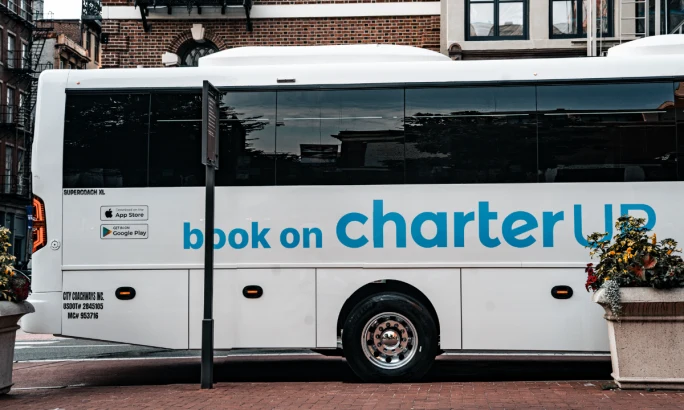
CharterUP motorcoaches represents the charter transportation network that helped fill mobility gaps during the World Cup, connecting passengers with destinations beyond fixed-route transit.
Credit:
CharterUP
Where the Charter Bus Became the Connector
The tournament also offered a clear reminder of what buses and motorcoaches do best: fill the spaces between fixed pieces of a transportation network.
North Texas was one of the clearest examples. For the nine matches held at the Arlington stadium, the Trinity Railway Express carried fans to CentrePort Station. From there, 125 charter buses handled the final leg to the venue.
More than 40,000 fans rode those charter buses during the tournament, with roughly 30,000 arriving at CentrePort by the Trinity Railway Express.
In effect, the station became a temporary transportation hub built around a handoff between rail and bus. For Peter Gould, vice president of transit for CharterUP, that type of relationship was central to the company’s role throughout the tournament.
“Public transit was always the foundation,” Gould said. “We weren’t there to replace it, but to fill the gaps where fixed-route transit wasn’t designed to operate.”
And there were plenty of gaps to fill.
CharterUP supported first- and last-mile connections, hotel shuttles, park-and-ride operations, volunteer transportation, private groups, hospitality programs, VIP movements, and international supporters following their teams from city to city.
In North Texas, the Trinity Railway Express ran longer trains at increased frequencies, including Sunday service. Charter buses stood ready not only to move fans to the stadium, but also to provide extra capacity if rail service ran into a problem.
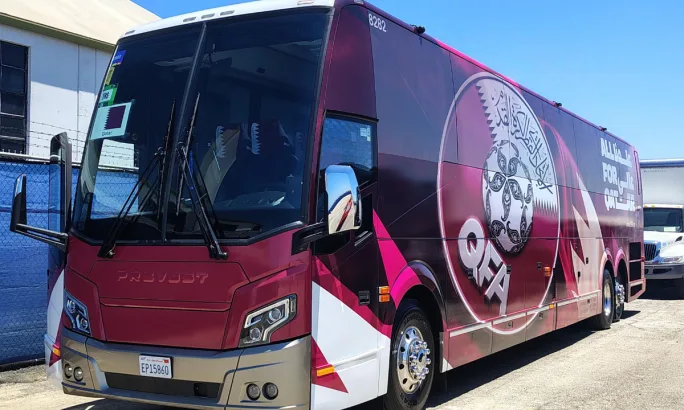
A Qatar team motorcoach operated by Lux Bus America stands ready for service. Lux Bus provided dedicated transportation for national teams and other World Cup stakeholders across several host markets.
Credit:
Lux Bus America
No Two Host Cities Were Alike
The question was never really whether rail or bus was more important, but what each mode is best positioned to do. The answer changes depending on one factor.
“The biggest challenge was that every market had its own transit network and operational constraints,” Gould said. “There wasn’t a one-size-fits-all solution. Our job was to build transportation plans tailored to each city's unique needs, which would deliver a consistent experience for riders and organizers.”
Vancouver’s preliminary TransLink figures showed an average of 87,000 additional boardings on each of the city’s seven match days, adding up to more than 600,000 additional transit boardings.
June 24, when Canada played Switzerland at BC Place, brought nearly 1.4 million boardings across the system — TransLink’s highest ridership day in more than six years.
To absorb the demand, TransLink:
- Added 600 daily bus trips
- Introduced two new bus routes
- Maximized SkyTrain service on match days
- Added SeaBus sailings
- Ran special weekend West Coast Express trips
- Placed additional frontline staff across the system
However, one of the more interesting measures of success had nothing to do with ridership. Even with all those additional customers, calls to TransLink’s Customer Information team dropped 7.6% compared with June 2025.
For a transit leader, that number says a lot. Thousands more people, especially many unfamiliar with the region, were using the network, yet fewer needed to pick up the phone for help.
In the Bay Area, Santa Clara Valley Transportation Authority also pushed past previous special-event records. Nearly 230,000 passengers traveled to and from the stadium through VTA during six matches, surpassing ridership from events including the Super Bowl and major stadium concerts.
The busiest day, June 25, brought nearly 42,000 stadium passengers onto the system.
Enhanced light rail, supporting buses, transit ambassadors, and coordination with BART, Caltrain, local jurisdictions, law enforcement, and event organizers helped turn a stadium crowd into a regional transportation effort.
South Florida had its own version of the challenge as Tri-Rail recorded more than 11,000 rides on Saturday, June 27, its highest Saturday ridership, as fans traveled for the Portugal-Colombia match in Miami.
The tournament also lifted ridership during a time of year when student commuting normally drops off. Tri-Rail added express trains, special post-game trains, and connections to stadium shuttle service from Golden Glades Station.
Atlanta did not look like Miami. Miami did not look like Vancouver. Vancouver did not look like Dallas. That was precisely why advance planning mattered.
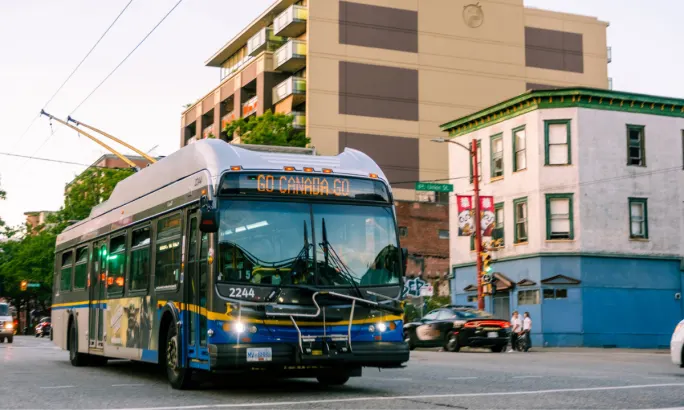
TransLink buses displayed a “Go Canada Go” message as Vancouver’s transit network helped move fans and residents during the 2026 FIFA World Cup.
Credit:
TransLink
How Motorcoach Teams Solved Tough Transportation Challenges
Some of the most complicated transportation problems were nowhere near a station platform.
For example, First Class Transportation supported team base camps in Austin and Houston, team movements, media trips, international fan groups, and direct game-day transportation through its contract with The Woodlands Transit. Its Woodlands game-day service operated at 100% capacity throughout the tournament.
But a full bus is only useful if there is a driver available, the vehicle is maintained, the timing works, and the bus is where it needs to be. Behind the scenes, First Class maintenance crews worked around the clock to keep up with preventive maintenance and tight vehicle turnarounds. Shops also had to make room for overnight bus-wrap changes as one team departed and another arrived.
Office staff handled bookings and helped with loading and dispatch. Drivers adjusted when schedules changed.
“Our drivers were the backbone of the entire operation,” Smith said. “They had to be flexible as schedules and operational needs changed, while maintaining the safety and professionalism expected during an event of this magnitude. They understood that this was a unique opportunity and took a great deal of pride in being part of it.”
Then came the kind of problem that rarely makes a highlight reel in public transit: airport curb space.
One international group from Portugal required as many as seven buses for a transfer at George Bush Intercontinental Airport, but the recently completed international terminal has limited room for motorcoach loading.
Moving the entire group, along with luggage, to another terminal would have created another layer of complexity. Instead, First Class worked with airport operations on a staggered solution. Up to four buses loaded near international departures, while the remaining vehicles waited in a nearby lot and rotated in as space became available.
It wasn’t flashy, but it worked. In fact, the solution worked well enough that First Class later used a similar approach for another large international group after the World Cup.
That is the kind of legacy major events can leave behind. It’s not always a feat of infrastructure, but a better way to handle the next difficult situation.
Planning for the Crowds, and the Unexpected
If there was one thing operators could count on during the tournament, it was that something would change. The goal was not to pretend variables like traffic and stadium access could be eliminated. It was to build an operation that could absorb them.
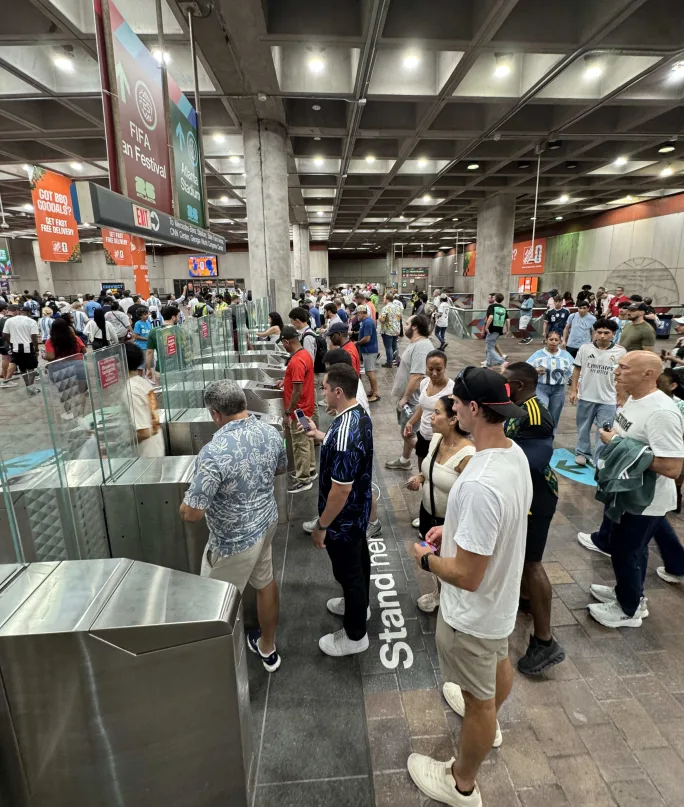
World Cup crowds moved through MARTA fare gates in Atlanta, where the agency handled major ridership surges while continuing to serve its everyday customers throughout the tournament.
Credit:
MARTA
Technology helped. CharterUP used its platform to maintain visibility into vehicles, drivers, and trip performance, while its Transit Intelligence Platform supported route optimization, vehicle flow, and real-time changes to shuttle operations. Private and hospitality coordinators could also manage trips, adjust itineraries, add stops, and track buses through a single dashboard.
However, across the interviews and agency information compiled here, technology was consistently described as one tool within a much more human operation.
“Successful transportation isn’t built on vehicles alone,” Flaum said. “It’s built on people, preparation, and processes. Technology is an important tool, but it's the quality of the team and the strength of the partnerships behind the scenes that ultimately determine success.”
The Port Authority of New York and New Jersey saw that same idea play out across a massive regional network.
Hundreds of employees, from executive leadership and civilian personnel to police officers, monitored PATH, the agency’s six crossings, the Midtown Bus Terminal, five airports, the Port of New York and New Jersey, and the World Trade Center campus as the region hosted seven matches.
There were command centers, operating plans, security coordination, and countless moving pieces. But ultimately, there were also people making judgment calls in real time.
How Mega-Events Can Be Used As Mobility Laboratories
Once the crowds go home, one question always remains: What was left behind?
- Vancouver’s partnership with Transit app gave riders free premium Transit Royale access during the tournament, and TransLink said that access would continue afterward.
- North Texas filled sidewalk gaps, improved lighting, upgraded traffic signals, and enhanced electronic wayfinding around the Arlington Entertainment District.
- First Class Transportation has already reused an airport operating strategy developed during the World Cup.
Federal support also played a role in preparing transit systems for the surge. In March, the Federal Transit Administration announced $100.3 million for public transportation supporting the 2026 World Cup, with funding available for planning, capital, and operating expenses tied to matches and other public events in U.S. host cities, but the investment in mega-event mobility didn't end there. In April, FTA announced another $94.3 million to support public transportation for the 2028 Olympic and Paralympic Games, helping agencies prepare for increased demand as the next major international sporting event approaches.
Transit agencies and operators now have firsthand data showing where passengers entered systems, when crowds arrived, which stations and transfer points faced the most pressure, how much extra service was needed, and how quickly thousands of people could be moved after a match.
Those lessons matter because the next mega-event is never very far away. For Los Angeles, that is especially true with the 2028 Olympic and Paralympic Games approaching.
Flaum said Lux Bus America views the World Cup as “the beginning, not the finish line” as the company prepares for the Olympics and future global events.
Gould sees a lesson that applies well beyond any one city or tournament.
“The biggest takeaway is that no single transportation system can support an event of this scale on its own,” he said. “Success comes from integrating public transit, charter transportation, rideshare, and other mobility options into one coordinated transportation strategy.”
That may be the most useful transportation legacy of the World Cup.
The big numbers belonged on scoreboards, press releases, and ridership reports, but the tournament actually moved because operators, dispatchers, mechanics, ambassadors, planners, police officers, drivers, and partner agencies handled thousands of small details that most fans never had to think about.
And in transportation, that is often the point. A fan gets off a train, finds the waiting bus, reaches the stadium on time, and never wonders how many people worked to make that trip feel simple.
Quick Answers
Extensive planning is crucial as it ensures that transit and motorcoach systems can handle increased demand seamlessly, minimizing disruptions for attendees and locals.
*Summarized by AI
Topics:Management
Loading data...