



Judge's decision to bolster Calif. high-speed rail project
The judgment means bidding and construction will move ahead as planned on the first phase of the 800-mile high-speed rail system set to connect the northern and southern parts of the state.

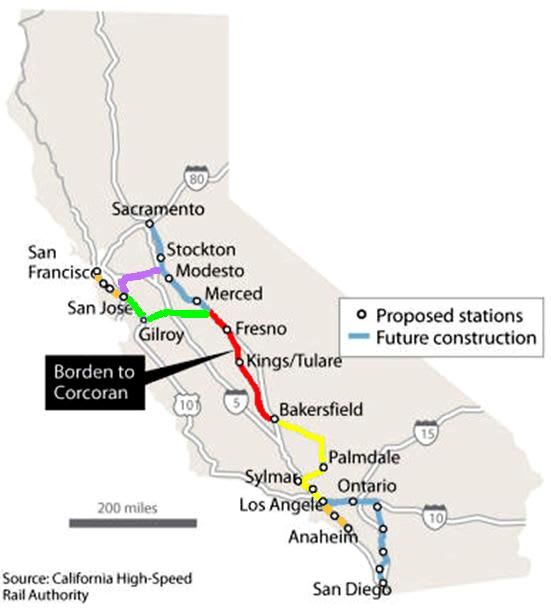
In November, Sacramento County Superior Court Judge Timothy Frawley made a preliminary ruling to reject a bid by agricultural interests to temporarily stop California’s high-speed rail project in the Central Valley until a lawsuit can be decided.
The judgment means bidding and construction will move ahead as planned on the first phase of the 800-mile high-speed rail system set to connect the northern and southern parts of the state.
At press time, a final ruling was not announced but it is not expected to change, Rod Diridon, head of the Mineta Transportation Institute at San Jose State University, said.
Judge Frawley ruled that the cost of delaying the project outweighed the risk to farmers and others along the route whose property would be affected. The judge also said it was not clear to him at this point that the authority had failed to meet the standards of the environmental quality act, which was the premise of the lawsuit.
Meanwhile, additional factors, such as President Barack Obama’s re-election, Gov. Jerry Brown’s signing of a bill authorizing the sale of bonds for the project and a Democrat majority in the state legislature, has spurred support for high-speed rail in California.
“The president touted high-speed rail as part of his campaign platform. That [could] be a referendum on high-speed rail nationally,” Diridon said. “Certainly the judge’s ruling is an element of that.”
Currently, project bids and RFPs are out for the first five contracts. These entail rail from Chowchilla to South Fresno, including a complicated construction project with several undercrossings; preparing the road bed; rail from Fresno and Chowchilla to Bakersfield; and capping off the road bed and installing ties and rail at a standard that would support 220-mile per hour (mph) speeds.
The Central Valley was chosen as the project’s starting point based on strictures given by the state to the California High Speed Rail Authority (CaHSRA) in the mid-2000s. One required the line to be located between two large population centers — the Fresno metropolitan area now has nearly one million people and the Bakersfield metropolitan area is approaching 500,000 people. The other strictures required the maintenance base to be in the middle of the line, and for a section of track to be straight enough to test the rolling stock at maximum speed.
With those factors combined, and the fact that the area had the highest construction unemployment, nearing 30% in the state, CaHSRA adopted the idea of starting the system in the Central Valley.
The ruling may change the opinion of people who were doubtful the project could be completed because of issues such as the lawsuit.
Diridon said that among the three major positions on high-speed rail in the state, the largest group is comprised of people who want the system built immediately, no matter the cost, and the second group, made up of about 25% of Californians, is fundamentally opposed to spending money on the project.
However, the third group, which was uncertain, is shrinking as more positive information about the project comes out, Diridon said.
“The latest version of the business plan, which had been assailed for so many years as being too liberal, is now being recognized as being conservative and accurate by a conservative advisory group to the California High Speed Rail Authority, as well as many legislative review organiza-tions,” he added.
The next steps on the project are to open the bids, identify the preferred bidders, negotiate the details and begin the contracts. Construction of the first phase of the project is set to begin in July with the route between Merced and Fresno, an area in the central part of the state that consists primarily of farms.
The total project cost is expected to be $68 billion.
“We’re hoping that the president is able to create additional funding for high-speed rail, not just for California, but for the 12 other corridors in the nation,” Diridon said.
He added that as the project moves forward, the hope is that private investors will realize the potential for “big net positive cash flow” and be willing to build the rest of the system in return for the franchise fees and profits.
More Rail
Amtrak, CN Reach Agreements to Strengthen Passenger Rail Service, Safety
The agreement resolves a more than decade-long proceeding before the Surface Transportation Board concerning the terms and conditions for Amtrak services, such as the City of New Orleans, Illini/Saluki, and Wolverine.
Read More →
New York MTA Advances Final Contract for Second Avenue Subway Expansion
Contract Four is the largest in the Second Avenue Subway Phase 2 project and includes construction of station infrastructure, tracks, and signals for the subway expansion, MTA officials said. Work on Contract Four will begin in 2027.
Read More →
San Diego MTS Breaks Monthly Trolley Ridership Record
Agency officials said July’s ridership indicates MTS’s continued recovery from the pandemic.
Read More →
Report Examines NJ TRANSIT Reliability, Funding Challenges
The Garden State Initiative analysis examines the roles of Amtrak infrastructure, fleet management, and agency operations while recommending a more performance-based approach to improving reliability.
Read More →
Stadler, CapMetro Sign Long-Term Rail Fleet Support Agreement
Beginning in 2027, Stadler will provide on-site technical expertise, spare parts support, training, and obsolescence management to help extend the reliability and longevity of CapMetro’s GTW fleet.
Read More →
Biz Briefs: Alstom Lands Canadian Contract, LYT to Supply California TSP, and More
In METRO's latest installment, we take a look at recent news from Complete Coach Works, Beep, FlixBus, and more partnerships making headlines across the transportation sector.
Read More →
CATS Gold Line Marks 5 Years of Service, 2.8M Passenger Trips
With a six-mile expansion planned, the Charlotte streetcar is positioned to connect more neighborhoods and major transit hubs across the region.
Read More →
Why Simulating Pedestrian Movement Has Become Essential for Modern Rail Stations
Pedestrian microsimulation is helping rail planners identify bottlenecks, test station designs, and prepare complex transit hubs for growing passenger volumes.
Read More →
Amtrak Begins Major Construction at New York’s Sunnyside Yard
The new maintenance facility will support Amtrak’s Airo trainsets while improving maintenance efficiency and turnaround times in New York.
Read More →
Chicago Leaders Unveil Plans for O’Hare Airport Express Train
The privately developed project would offer a 15-minute trip between downtown and O’Hare’s Terminal 2, with trains operating every 15 minutes on a dedicated track. The service would use battery-electric trains and three existing freight rail rights-of-way.
Read More →