



Legislation to Play Critical Role in Motorcoach Safety
While motorcoach crash testing is underway, progress has been slow for proposed regulation of entry level training for commercial drivers. A rulemaking on electronic onboard recorders is also waiting in the wings.
[IMAGE]MET8p50-large-2.jpg[/IMAGE] There is change in the wind. As fuel prices climb, people are rediscovering the bus. Transit ridership growth has accelerated this year, and intercity coach travel has begun a resurgence not seen in the past 30 years. Once onboard, passengers are discovering that coach travel is both comfortable and safe, made all the more attractive with its ability to move passengers at energy consumption levels six times more efficient than their automobiles.
Safety is clearly a critical leverage point to maintaining this ridership growth. To continue high levels of safety performance, multiple approaches are demanded. Over the past 50 years, the bus and coach industry has built and maintained an enviable record of safety that demonstrates bus travel is significantly safer than other modes. Individual operating companies continue to make safety their highest priority through the application of responsible management, providing employee development and the use of traditional safety tools.
LEGISLATION PLAYS SAFETY ROLE
Legislation promises to play a role in building a safer passenger transportation network. Over the next year or so, as we approach the next “Highway” legislation reauthorization dates, much discussion will focus on new safety mandates that might be imposed through congressional legislation. Over the past quarter century, virtually all major bus safety initiatives have come as a result of congressional mandates. These include the Commercial Drivers License (CDL), driver substance abuse testing, and even some of the current medical and training rule proposals. Later this year, much of the post-election legislative agenda promises to be financial, accessibility or security-based in nature, but some current motorcoach crash testing promises to begin a new round of legislative activity on passenger protection.
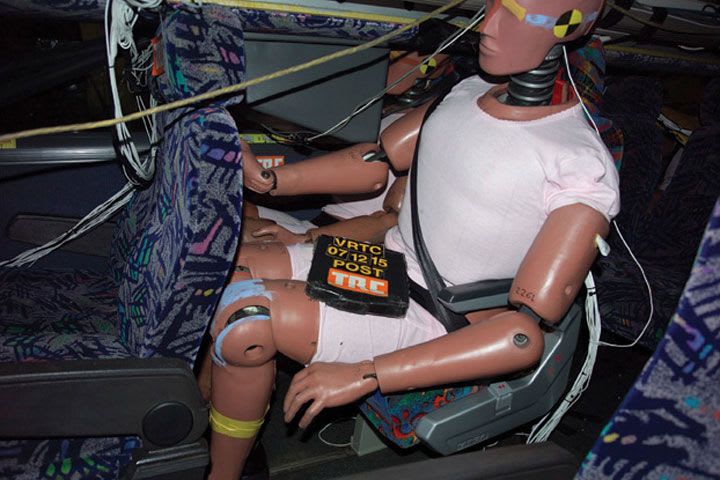
Crash testing of motorcoaches is currently underway through the efforts of the National Highway Traffic Safety Administration (NHTSA), the federal agency that mandates design and safety features in vehicles. In the aftermath of the serious bus crash in Atlanta in 2007, as well as other state legislation pending or in place, a legislative rush toward mandatory seat belt installation on motorcoaches was clearly underway.
Industry lobbyists in Washington, D.C., quickly made appeals for a more reasoned approach to passenger protection, appeals which were met with a positive response and resulted in quick funding of motorcoach crash tests. Several tests have already been conducted, with more on the way. While no agency report is expected for some time, insiders indicate that the first tests failed to demonstrate the intense occupant “G forces” that might have been expected.
HARNESSING TECHNOLOGY
Another safety factor is the current rulemaking activity of the Federal Motor Carrier Safety Administration (FMCSA). This agency, whose assignment of ensuring highway safety has not changed much since the 1930s, has begun public dialogue on a number of new ways to address the safety challenges of the 21st century. Some of these changes harness technology utilization; others enhance existing safety practices required of all passenger carriers. Still others, in partnership with the NHTSA, make research the path of choice to a safer future.
The list of FMCSA rulemaking proposals is an extensive one, with a number of proposals having remained on the open agenda for several years. Given that this year marks the end of tenure for a number of Bush Administration appointees, the agency has promised to complete action on several significant safety proposals. The desire of the current leadership for closure is understandable. They have been forced into battle on virtually every rule proposal they have issued the past several years, and to finally achieve some results has to be an appealing parting gesture. Politics is not supposed to impact or slow the activity of agencies such as the FMCSA, but inevitably it does when a new administration with its new leadership takes time to acclimate to current conditions and determine whether they can support (and thus permit continuing action) proposals in process.
[PAGEBREAK]
SAFETY PROGRESS SLOW
Other forces have slowed safety progress at the FMCSA. Over the past several years, regulation followed by litigation has engrossed the attention of officials, seemingly denying resources to other safety initiatives. Two major safety programs, hours-of-service for truck drivers and entry level training for commercial drivers have met similar fates. Born out of Congressional mandates, each was the subject of rulemaking by the DOT and were both met by legal challenges, which were then upheld by the federal court, upon being put into effect. Both then entered an extended period of evaluation, revision and new rulemaking activity.
One of these two controversial rulemaking proposals directly affects the bus and coach industry. Under an entry level training regulatory proposal, applicants for CDL licenses would not be allowed to acquire their professional license until they have provided the state driver licensing agency with evidence of the completion of a qualified training course taught by an approved educational program.
Many service providers do not consider individuals who do not already possess a CDL license eligible for hire. But there are many operators, both larger operators with training schools and smaller school bus operators, who customize training on an almost individual basis that depend on newly trained CDL holders as the means to create necessary driver assets. Technology offers unprecedented opportunities for safety improvements. “[It is]…a major ingredient in reducing accidents, saving lives, preventing injuries and lessening the immense emotional and monetary toll…,” according to Mark Rosenker, head of the National Transportation Safety Board, (NTSB) the DOT’s accident investigation and analysis agency. The FMCSA has responded to this challenge with both a major rulemaking and an extensive research and informational program. Technology educational information can be accessed at www.fmcsa.dot.gov/facts-research/art-safety-tech.htm.
TECHNOLOGY RULEMAKING
The current technology rulemaking promises another rule, for completion by the end of 2008, which will involve Electronic On Board Recorders (EOBRs). The initial rulemaking, published in early 2007, offered in response to a congressional mandate, made installation of tracking tools for drivers a voluntary process for all but a very few motor carriers whose record of abuse of the hours-of-service regulations made them obvious targets for enforcement. But that initial 2007 proposal was widely panned by safety advocates and members of Congress who saw the proposed rule as weak and ineffective.
Since that time, agency internal reconsideration of the EOBR rule has been underway. In the normal flow of events, the next step in bringing this issue forward would be a “final rule,” but given the overwhelming lack of success of the original proposal, a lighter touch, perhaps an “interim” final rule balancing congressional demands against litigation threats, may be the next agency step forward on the subject of onboard recorders.
In 1996, the Office of Motor Carriers, one of the direct ancestors of today’s FMCSA, convened a negotiated rulemaking designed to address the complexity of the then-current driver medical qualification process, with an eye on merging medical qualification with the CDL. The panel reached few agreements, given the many points of view represented around the negotiating table.
Some less critical elements of the 1996 impasse have slowly resolved themselves, a new medical form was implemented and a medical review board empanelled. But the goal of eliminating driver medical cards by maintaining physical qualification records within and as a part of the work of state CDL agencies has never been achieved. This is the year that FMCSA has promised to carry this proposal across the goalline it set more than 10 years ago.
Driver fatigue has long been seen as a safety risk that could be further managed. Individual companies have long established practices that help them mitigate driver fatigue. Over recent years, it has become more apparent that government intervention into this concern is increasingly likely.
In the most recent approach to address driver fatigue concerns, the FMCSA medical review board has offered its opinion that certain obese drivers should be subject to additional medical evaluation — sleep testing — prior to being granted their physical qualification. The review board has drawn links between driver safety performance and driver fatigue, with sleep apnea acting as a fatigue causative factor and body mass as an indicator of sleep apnea.
CLOCK RUNNING DOWN
Throughout the remainder of 2008, the clock will be running down on the top leadership at FMCSA. The promise of “final” action on a few rulemaking issues is appealing to everyone, but much remains on the “open agenda.” Important rule proposals such as financial responsibility, which may revise and upgrade insurance coverage levels that were originally set in 1982, and specific medical qualification standards for vision impaired and diabetic drivers have yet to be issued.
The bus and coach industry continues its great job of offering safe transportation to its customers. With industry diligence, rational congressional mandates and a reasoned approach by the FMCSA, our collective passengers will have the confidence in our efforts to trust their safety to an industry that is able to respond to all of their transportation requirements.
▶ Jack Burkert is a 30-year veteran of fleet safety and management, currently engaged in safety consulting from his home in Maryland. He may be contacted at burkert@dmv.com.
More Management

ENC Lands MATA Contract and More in Biz Briefs
In this edition of Biz Briefs, we spotlight the latest developments shaping the future of mobility.
Read More →
From Surviving to Thriving: Building Stronger Transportation Organizations
Bus Business Consultants founder Brian Dickson shares lessons on leadership, organizational health, and creating options for long-term success in a changing transportation industry.
Read More →
Everett Transit, Community Transit Outline Consolidation Agreement
The proposed agreement calls for a 50% increase in bus service in Everett, a new microtransit zone, continued paratransit service, and the transfer of Everett Transit operations to Community Transit.
Read More →

Strada360’s Steve Lassey on Turning Transit Data Into Better Decisions
From breaking down data silos to preparing for AI, Strada360 CEO Steve Lassey discusses how transit agencies can use technology to improve operations, customer information, and long-term decision-making.
Read More →
People Movement: Phil Washington Joins HNTB, Denver RTD Launches CEO Search, and More
In this edition, we also spotlight recent personnel moves at STV, the Eno Center for Transportation, and more, highlighting the people taking on new roles across the transportation industry.
Read More →
SEPTA Details Accelerate Vision for Transit System
The plan outlines investments in trolley modernization, new Metro and Regional Rail vehicles, accessible stations, and more frequent bus and rail service.
Read More →
FTA Ends Direct Oversight of MBTA Safety Actions
The federal agency closed its remaining special directive to the Massachusetts Department of Public Utilities following a safety review that began in 2022.
Read More →
Report: Transit Bus Manufacturing Supports 34,100 Jobs, $5.1B in GDP
The “Buses Mean Business” report examines the transit bus manufacturing industry’s economic footprint, supply chain, and rising demand for vehicle replacements.
Read More →
LIT Marks 10-Year Milestone at Annual Summit
Hosted by the COTA from September 10 to 13, the Summit carried the theme “Celebrating 10 Years of Excellence, Leadership, and Impact,” with every part of the program honoring the people, agencies, and partners who built LIT over its first decade.
Read More →
People Movement: Dan Dipert Coaches Adds Third-Generation Leader, Keolis Names New Valley Metro VP/GM, and More
In this edition, we also cover recent appointments and announcements at the Wabtec, SilverRide, HNTB, and more, showcasing the individuals helping to shape the future of transportation.
Read More →