Maximizing Passenger Safety with Fire Suppression Systems
About two-thirds of all bus fires start in the engine compartment, according to researchers. Various types of suppression agents are used, including different sorts of dry chemical, water mist, foam, aerosol, gaseous agents, or sometimes combinations of those.
by Frederik Rosen
February 6, 2017
A way of increasing fire protection is to install an automatic fire suppression system in the engine compartment.
5 min to read
Recent statistics from Sweden show that, annually, at least 0.76% of all buses in service will have a fire or smoke incident. This is confirmed by surveys conducted in Germany, where between 0.5% and 1% of all buses suffer from a fire incident every year, which corresponds to at least 350 to 400 fires annually.
About two-thirds of all bus fires start in the engine compartment, according to researchers. This area is a well-known fire hazard that provides particular challenges for detection and suppression of fires.
Ad Loading...
Ventilation, through fans and openings, is necessary for cooling, but will also increase fire intensity and spread. The windy and often dusty environment in the engine compartment influences the possibility for fire detection and suppression. This has naturally led to efforts of reducing the risks.
A way of increasing fire protection is to install an automatic fire suppression system in the engine compartment. Such systems consist of one or more containers of suppression agent and a fire detection and activation system that releases the suppression agent in the event of fire.
A piping or tubing system is often used for the distribution of the suppression agent from the container to the different areas of the engine bay. Some systems, such as those with aerosol generators, often have generators installed in the engine compartment and releases the agent directly from the generator.
In addition to suppressing the fire, the systems are normally also designed to warn the bus driver via an alarm. Various types of suppression agents are used, including different sorts of dry chemical, water mist, foam, aerosol, gaseous agents, or sometimes combinations of those.
The installation of automatic fire detection and suppression systems for buses has been recommended by fire researchers, trade associations, accident investigators, and transport authorities. It is generally not perceived as the ultimate solution, but as one of several tools necessary to limit the extent and consequences of bus fires occurring.
Ad Loading...
Firetrace
The Firetrace system detects fire using a proprietary red detection tubing. This heat-sensitive polymer tubing is pressurized and reacts to the heat and radiant energy of a fire by bursting, thus activating the fire suppression system.
Also, as Firetrace systems are pneumatically operated, they require no power from the vehicle to operate and do not place additional strain on the vehicle’s electrical system.
Firetrace’s system primarily uses an ABC dry chemical agent. That this is due to the lightweight nature of the agent, which works well in high-air flow and hidden fires that aren’t in direct line of sight of the spray nozzle, explains Firetrace’s Marketing Director Scott Starr.
Once the system is activated, the pneumatic tubing bursts releasing the ABC Dry Chemical Powder for up to 45 seconds from numerous nozzles. The powder billows around all areas of targeted compartments and coats the affected surfaces. As this is happening, the system alerts the driver via audible and visual notification.
Firetrace offers a variety of notification options, the most common of which includes a small status indicator box located in the driver station in clear view of the driver. www.firetrace.com
New Test Method
During recent years, some major research initiatives have been taken to develop standardized tests for engine compartment fires. Southwest Research Institute was contracted by The National Highway Traffic Safety Administration (NHTSA) in the U.S. to develop test apparatuses and test procedures to evaluate candidate fire detection and suppression systems for motorcoach engine compartments.
U.S.-based commercial and industrial property insurance and loss prevention company, FM Global’s Research Division has developed FM Approval Standard 5970: Protection Systems for Heavy Duty Mobile Equipment. Though focusing on heavy-duty equipment rather than buses, the applications have much in common, and thus, are worth mentioning here.
Despite the growing demand for fire suppression systems for buses, as well as recent year’s research efforts, there were previously no existing international standards for testing and validating such systems.
Based on earlier research on bus fire safety, the SP Fire Research (SP) initiated a project in 2010, supported by the Swedish Transport Agency, with the purpose of developing a test standard for evaluating automatic fire suppression systems meant for bus engine compartments.
The purpose was to design a standardized test setup that allows systems with any type of suppression agent or combination of agents to be tested against the same fire hazards under realistic conditions, and thus, facilitate comparison of the performance of different agents and suppression system solutions.
Ad Loading...
The main goal was to develop a test method that possibly could be implemented in the UNECE Regulation No 107. In cooperation with a worldwide reference group, a comprehensive work started, which included both theoretical and practical studies.
Different models of buses were reviewed, paying special attention to their aerodynamic, geometrical, and thermodynamic aspects, as well as the properties of the flammable materials contained in these compartments. Full-scale fire tests were also conducted using commercial buses with operating engines, and more than 450 laboratory fire suppression tests were performed with different suppression system types to develop the test methodology.
Fogmaker
Fogmaker’s fire suppression system is based on the selection of pistion accumulators or suppression cylinders. The suppression cylinder’s size, combination, and distribution system is designed depending on the chosen application.
Fogmaker uses a wet chemical mist that contains a small percentage of non-hazardous Aqueous Film-Forming Foam (AFFF) Concentrates. Its main source of detection is a loss-of-pressure tube that melts in the event of a fire.
The melted tube triggers the piston accumulator bottle to open, releasing the pressurized water mist and foaming solution from its nozzles for 45 to 60 seconds, extinguishing the fire and lowering the temperature in the targeted area. The system doesn’t need battery power or electronics to activate.
The Fogmaker system can be specified with thermal wire, which activates at 350 to 450 degrees, although this feature is not required.
The system is ideally placed toward the rear of the vehicle, outside of targeted compartments. When the system is activated, an alarm panel set up within eyesight of the driver provides audible and visual signals. If the system detects a fire (or methane), the display screen alerts the driver.
The system controls the engine shutdown process, which is time-delayed for 15 seconds. The control panel will also permit the driver to override the engine shutdown as needed to move the vehicle to a safe location. www.fogmaker.com
Under its development, careful attention was paid to the identification of test conditions that would represent realistic fire scenarios. This work led to the established test method SP Method 4912, for testing the suppression performance of fire suppression systems installed in engine compartments of buses and coaches.
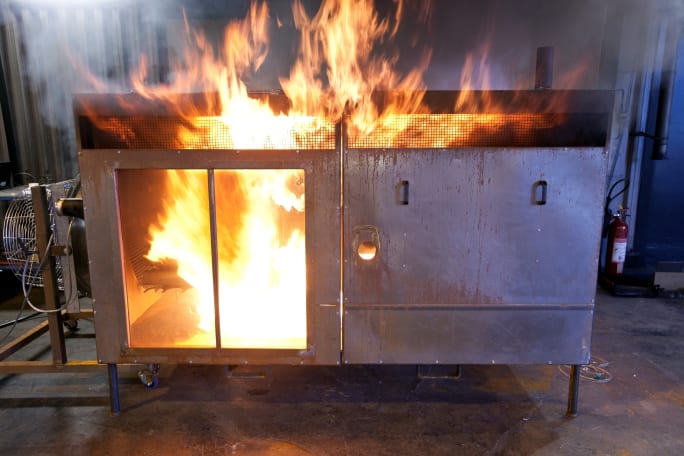
The fire suppression tests are performed in a test apparatus, which is a full-scale engine compartment mock-up with obstructions, aiming to represent generally cluttered engine compartment interior. This method includes 11 different suppression tests that differ from each other with respect to fire source type, severity and location, grade of obstruction, and number of the fire sources used, as well as air-flow rate applied.
The report of the conducted tests rates the tested suppression system based on the number of passed (extinguished) tests and the ability to protect against hot surface re-ignition.
Ad Loading...
This means that manufacturers can compete with each other by improving their systems to increase the number of passed tests. It also allows e.g. purchasers to set stricter requirements, such as passing certain types of tests, for buses frequently utilized in special hazard areas, including tunnels and underground car parks, for example.
Since the method focuses on suppression performance, SP started a project in 2013 to complement with a method for testing detection capability, called SP Method 5320, which currently is getting finalized.
Fire Suppression System Technology
Vehicle fire suppression technology significantly increases the safety of passenger transportation, and ideally, will prevent any dangerous scenarios from occurring. New technologies in the industry, such as data-logging capabilities and real-time reporting systems, are certainly beneficial, but companies like Firetrace and Fogmaker still emphasize a focus on simplicity.
“At its core, the purpose of fire suppression is to protect equipment and save lives. We offer hi-tech solutions like data logging and telematics, but I like to emphasize the effectiveness of the basic system,” said Fogmaker’s Managing Director, North America, Ray Melleady.
To evaluate companies on their reliability and quality of product, a competency test was recently developed by SP, which has been welcomed by the industry.
“It’s driving a lot of awareness, in terms of functionality, so we all make sure our systems are as ideal for the environment as possible,” said Firetrace’s Managing Director Scott Starr. “The [SP] test is creating awareness globally that there should be a standard.”
Both Firetrace and Fogmaker fire suppression systems — certified as effective by the SP test — begin around $2,500, though the price may increase or decrease depending on fleet size and additional options selected by the operator. – Nancy Kirk
SP Fire Research
Fire suppression testing is performed in a test apparatus, which is a full-scale engine compartment mock-up.
Certification Mark
In parallel with the study, SP has established a voluntary certification and quality mark for fire suppression systems for buses and coaches – SPCR 183 (SP Certification Rules 183).
In the SP P-mark system the suppression systems are fire-tested in accordance with SP method 4912, but in addition, the incorporated components are also tested for mechanical and thermal stress resistance, corrosion resistance, and ingress protection rating of electrical equipment.
Further on, a risk assessment has to be made prior to installation of the system by an experienced professional. An annual follow-up inspection of the manufacturers’ production facility and quality control plan would also have to be conducted to ensure compliance to the requirements of the certification rules.
Ad Loading...
Fire suppression systems that fulfil all requirements are then allowed to be P-marked. A certificate is then issued for the system concerned and the certificate is also published at: www.sp.se/safebus/certified.
Fredrik Rosén is marketing and sales manager for SP Fire Research in Sweden.
The 90-day demonstration will deploy coordinated security teams at five light rail stations while testing controlled access and gathering data to guide future investments.
The app expands on RTD’s existing NextRide web application and allows customers to view real-time vehicle locations and service alerts, purchase and store digital fares, and access customer support.
The revamped program addresses 26 OSHA standards for maintenance facilities, with TAPTCO pointing to training, documentation, and everyday shop hazards as continuing challenges for transit operations.
Wabtec engineers explain how the system improves doorway detection, strengthens diagnostics and gives transit agencies and OEMs greater operating flexibility.
The award-winning partnership combines AI-powered detection with human oversight to improve bus reliability, accessibility, and enforcement efficiency.
The agency's latest homelessness count offers new data on how care-based services and cross-sector partnerships can complement traditional transit security strategies.
The online dashboard transforms National Transit Database information into a public-facing resource that allows users to compare transit agencies on key operational and safety metrics.