



MBTA converts station, tunnel into training facility
Using grant money from the Department of Homeland Security (DHS), MBTA will convert the Oak Street railway into a “mock” train station to carry out drills, which will also be accessible to emergency responders from all surrounding cities and towns.


The Massachusetts Bay Transportation Authority’s plans to turn an unused train tunnel and station into a training facility will provide a dedicated location for transit police and first responders to train in at any time without inconveniencing passengers (rendering shown).
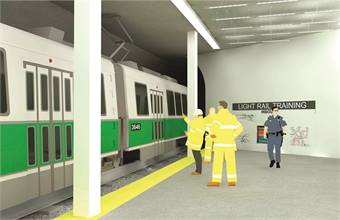
The Massachusetts Bay Transportation Authority’s plans to turn an unused train tunnel and station into a training facility will provide a dedicated location for transit police and first responders to train in at any time without inconveniencing passengers (rendering shown).
Boston area transit police officers and first responders will soon have a dedicated location for training in emergency situations occurring in the Massachusetts Bay Transportation Authority (MBTA) subway. Transit officials are turning an unused train tunnel and station into a training facility to teach officers how to handle underground emergencies within the MBTA system.
Using grant money from the Department of Homeland Security (DHS), MBTA will convert the Oak Street railway into a “mock” train station to carry out drills, which will also be accessible to emergency responders from all surrounding cities and towns.
The idea to transition the tunnel and station into an emergency training center came about eight years ago once an old subway tunnel was no longer being used, MBTA Transit Police Chief Paul MacMillan explained.
“We had been looking for a funding stream to get it constructed during that time period,” he said. “About two or three years ago, DHS funds were made available to retrofit the tunnel into a training facility.”
The DHS is providing $4 million in funds for the facilities. The project is fully funded by the federal grants. The project is supported by various local, state and federal emergency response agencies, including the City of Boston Mayor’s Office of Emergency Management, Executive Office of Safety and Security, and the Federal Emergency Management Agency.
Creating the facilities will consist of three phases and is anticipated to be complete in spring 2013. Phase one, which consists of water mitigation and structural repairs that will address long-term concrete and leak issues at the site, is expected to be completed by July, 2012. Phase two will include the delivery of two blue line cars and one green line trolley to the training center. The training facility will include a light rail vehicle, a heavy rail vehicle and a bus, allowing first responders to train in various scenarios that would involve each vehicle type. This move is anticipated to be completed in July, 2012. Phase three will include the larger construction contract that will build out the center and install the necessary code and fire life safety components of the facility.
The renovation will provide a dedicated emergency training facility that first responders can train in any time without inconveniencing passengers with station shutdowns.
“We rely on first responders to respond to emergency situations in our subway system,” MacMillan said. “Currently, we have no area that is dedicated to training those responders to come into our tunnels and make emergency evacuations or do emergency work.”
To conduct training in the subway environment, he added, transit police need to either shut down a station or use a closed station, which is difficult to do since it requires stopping service.
Transit police will be trained in how to respond to a terrorist attack, fire or smoke, and any type of collision or emergency situation that may occur in the tunnels with simulated incidents.
The facility will also feature two training classrooms. Observers will be able to watch the scenarios unfold on closed-circuit TV in the station.
More Rail

New York MTA Advances Final Contract for Second Avenue Subway Expansion
Contract Four is the largest in the Second Avenue Subway Phase 2 project and includes construction of station infrastructure, tracks, and signals for the subway expansion, MTA officials said. Work on Contract Four will begin in 2027.
Read More →
San Diego MTS Breaks Monthly Trolley Ridership Record
Agency officials said July’s ridership indicates MTS’s continued recovery from the pandemic.
Read More →
Report Examines NJ TRANSIT Reliability, Funding Challenges
The Garden State Initiative analysis examines the roles of Amtrak infrastructure, fleet management, and agency operations while recommending a more performance-based approach to improving reliability.
Read More →
Stadler, CapMetro Sign Long-Term Rail Fleet Support Agreement
Beginning in 2027, Stadler will provide on-site technical expertise, spare parts support, training, and obsolescence management to help extend the reliability and longevity of CapMetro’s GTW fleet.
Read More →
Biz Briefs: Alstom Lands Canadian Contract, LYT to Supply California TSP, and More
In METRO's latest installment, we take a look at recent news from Complete Coach Works, Beep, FlixBus, and more partnerships making headlines across the transportation sector.
Read More →
CATS Gold Line Marks 5 Years of Service, 2.8M Passenger Trips
With a six-mile expansion planned, the Charlotte streetcar is positioned to connect more neighborhoods and major transit hubs across the region.
Read More →
Why Simulating Pedestrian Movement Has Become Essential for Modern Rail Stations
Pedestrian microsimulation is helping rail planners identify bottlenecks, test station designs, and prepare complex transit hubs for growing passenger volumes.
Read More →
Amtrak Begins Major Construction at New York’s Sunnyside Yard
The new maintenance facility will support Amtrak’s Airo trainsets while improving maintenance efficiency and turnaround times in New York.
Read More →
Chicago Leaders Unveil Plans for O’Hare Airport Express Train
The privately developed project would offer a 15-minute trip between downtown and O’Hare’s Terminal 2, with trains operating every 15 minutes on a dedicated track. The service would use battery-electric trains and three existing freight rail rights-of-way.
Read More →
OCTA Maps Out 30-Year Strategy to Protect Coastal Rail Corridor
The draft feasibility report identifies strategies to protect the coastal rail line for decades as the agency continues near-term stabilization and sand placement efforts.
Read More →