MV Transportation at 50: A Legacy of Purpose and a Future Driven by Innovation
To mark MV’s 50th anniversary, METRO Magazine sat down with Gary Coles, the company’s chief customer success officer, to discuss how MV honors its founding values, continues to innovate across service models, and helps transit agencies meet the evolving demands of modern mobility.
Today, MV is the largest American-owned provider of contracted transit services in the U.S., serving millions of riders with paratransit, fixed-route, microtransit, and shuttle operations across North America.
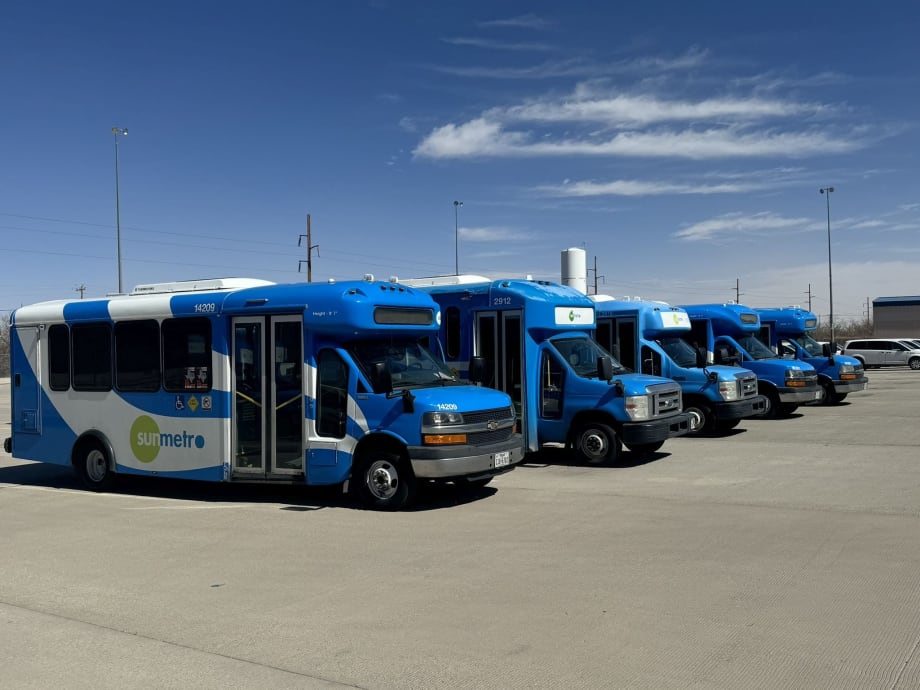
Photo: MV Transportation
4 min to read
MV Transportation celebrates its 50th anniversary, reflecting on its founding values and ongoing commitment to innovation.
Gary Coles discusses how MV supports transit agencies in adapting to the changing demands of modern mobility.
The company continues to evolve its service models to meet the needs of its diverse clientele.
*Summarized by AI
In 1975, on the sloping streets of San Francisco, Feysan and Alex Lodde recognized a critical need: many elderly and disabled neighbors couldn’t perform everyday tasks most people take for granted. To help circumvent that issue, the Loddes launched a revolutionary but straightforward service using two vehicles to help people get to the doctor, the grocery store, church, or to visit a friend. It was a grassroots effort built on compassion, long before paratransit was federally mandated.
Today, MV is the largest American-owned provider of contracted transit services in the U.S., serving millions of riders with paratransit, fixed-route, microtransit, and shuttle operations across North America. However, while the company’s scale has grown exponentially, the core mission has remained constant: to provide freedom through mobility.
To mark MV’s 50th anniversary, METRO's Executive Editor Alex Roman sat down with Gary Coles, the company’s chief customer success officer, on a recent episode of METROspectives to discuss how MV honors its founding values, continues to innovate across service models, and helps transit agencies meet the evolving demands of modern mobility.
To mark MV’s 50th anniversary, METRO Magazine sat down with Gary Coles, the company’s chief customer success officer, to discuss a litany of topics.
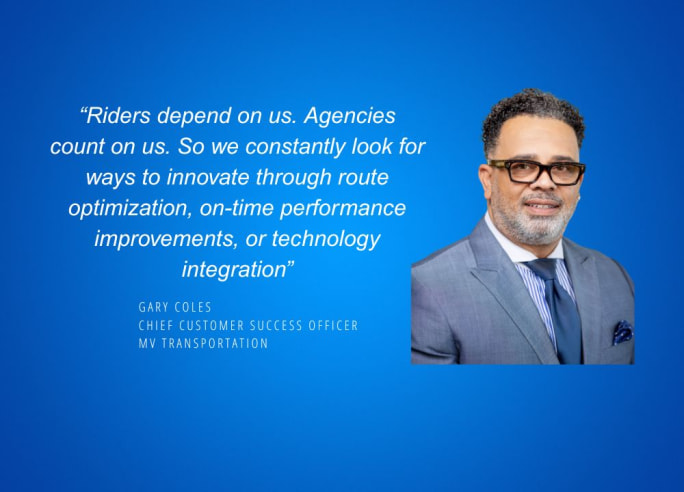
Photo: METRO
From Purpose to Presence
“MV was founded to help people,” Coles said. “Faison and Alex didn’t start this as a business idea — they saw people in need and decided to serve.”
Coles explained that the spirit of service continues to shape the company's DNA, even as it has grown into a national operation. With a 25-year career in public transportation, Coles joined MV in 2007 and has seen firsthand the trajectory from a paratransit-focused provider to a leader in multimodal mobility management.
“Around the time I came in, MV was expanding rapidly, building its brand not just on operations, but on relationships and results,” he said. “We grew in every major U.S. city — from Chicago and New York to Texas and California — and even had international contracts. It was clear we were becoming more than a contractor; we were becoming a partner.”
Ad Loading...
Building Partnerships, Driving Results
Coles emphasized MV’s growth has been guided by listening to and aligning with agency goals, then layering in operational efficiencies and scalable innovations.
An MV Transportation Timeline
1975: Alex and Feysan Lodde start a wholesale travel business focused on disabled individuals in the San Francisco Bay Area. Increased requests for non-ambulance transportation to/from hospitals and dialysis centers led to the addition of vans to the fleet.
1978: Business incorporated in California as California MediVan.
1983: Company signs its first paratransit contract and rebrands to MV Transportation.
1986: MV begins expanded transportation operations in regional centers across Northern California.
1990: The Americans with Disabilities Act (ADA) is passed, requiring communities to provide comparable paratransit service to individuals with disabilities who may not reasonably be able to use fixed-route bus service. MV emerges as a strong independent competitor in the public transportation market.
1998: MV wins its first fixed-route bus service contract.
1999: Begins operating its first contract outside of the state of California, in Oregon. Reaches $25 million in annual revenue.
2003: MV expands into student transportation services.
2005: MV wins its first corporate shuttle contract.
2007: MV wins its first university shuttle contract.
2008: Annual revenue grows to $650 million, and MV is recognized as the market leader in paratransit. It expands into fixed-route bus services.
2012: MV corporate headquarters relocated from Fairfield, California, to Dallas, Texas.
2013: Annual revenues reach $1 billion.
2018: MV wins the largest paratransit and fixed-route contract awards in North America.
2020: MV operates more than 200 contracts across 30 states with revenues exceeding $1.3 billion and over 20,000 team members.
2025: MV celebrates its 50th anniversary.
“It’s not just about delivering service. It’s about understanding the agency’s short- and long-term vision,” he said. “Our job is to enhance what they’re trying to do, whether introducing rail, expanding paratransit, or launching microtransit zones.”
That collaborative mindset is part of why MV has maintained long-term relationships with agencies nationwide. Coles noted that continuous improvement, paired with a personal touch, differentiates MV.
“Riders depend on us. Agencies count on us. So we constantly look for ways to innovate through route optimization, on-time performance improvements, or technology integration,” he said.
Tech-Forward, Rider-Focused
Coles pointed to the evolution of rider expectations as a key driver for innovation.
Ad Loading...
“Services like Uber and Lyft changed what people expect, such as real-time information, quick pick-ups, easy booking,” he said. “We work with our partners to bring that flexibility into public transit.”
MV's deep understanding of available technologies and strong vendor relationships allow them to guide agencies through software decisions, pilot programs, and full-scale implementations.
“It’s not about selling a product, it’s about finding the right fit,” Coles added. “We evaluate needs, identify gaps, and recommend tools that improve operations and rider experience.”
One of MV’s proudest innovations is its work with electric vehicles. The company operates the only fully electric bus fleet in the U.S., in Antelope Valley, California. Through that work, Coles said MV learned valuable lessons, particularly about infrastructure readiness, and now shares that expertise with other agencies preparing for a zero-emissions transition.
Investing in People and the Industry’s Future
While technology is critical, Coles emphasized that MV’s focus remains on people — employees, riders, and agency partners.
Ad Loading...
“One of the hardest positions to hire for right now is maintenance,” he said. “So we launched a D.O.T.-approved apprenticeship program to grow our talent. It’s about giving people a career path and ensuring the workforce supports the next 50 years of transit.”
That human-centered approach also shaped MV’s post-pandemic transformation. With new leadership, including Executive Chairman and CEO Harry Wilson, MV restructured its strategic vision with renewed investment in employees and customer service.
“The new MV is about transformation with purpose,” Coles said. “We’re building efficient systems, yes, but also compassionate. That’s how you support communities, especially those with the greatest need.”
What’s Next: Efficiency and Equity in a Changing Landscape
With federal COVID-19 relief funds dwindling and ridership still rebounding in some areas, agencies are again being asked to do more with less. MV is helping them find more innovative solutions, like integrating smaller vehicles to reduce operating costs, and leveraging technology to improve scheduling and reduce no-shows.
“Fixed-route and rail haven’t bounced back as quickly as paratransit,” Coles said. “We’re helping agencies right-size their fleets and implement microtransit to cover gaps. The goal is still the same: reliably and affordably get people where they need to go.”
Ad Loading...
Looking ahead, MV sees itself as a driver of innovation and equity.
“A well-planned transit system is the engine of a city,” Coles said. “It connects essential workers to jobs, families to care, and people to opportunity. We’ve known that for 50 years and are ready for 50 more.”
This article, generated using OpenAI, was edited for accuracy and style and based on an episode of METROspectives
Quick Answers
MV Transportation is celebrating its 50th anniversary.
Gary Coles, the chief customer success officer of MV Transportation, was interviewed.
The interview discussed how MV honors its founding values, continues to innovate in service models, and supports transit agencies with modern mobility demands.
MV Transportation approaches innovation by continuously evolving its service models to meet modern mobility demands.
MV Transportation helps transit agencies by meeting the evolving demands of modern mobility.
Contract Four is the largest in the Second Avenue Subway Phase 2 project and includes construction of station infrastructure, tracks, and signals for the subway expansion, MTA officials said. Work on Contract Four will begin in 2027.
The new regional transit authority appointed its first board chair and interim executive director while extending reduced fares across CTA, Metra, and Pace for eligible riders.
Reliability-Centered Maintenance helps transit agencies move beyond routine checklists to focus limited resources on the assets and failures that have the greatest impact on safety, reliability, and service.
The 90-day demonstration will deploy coordinated security teams at five light rail stations while testing controlled access and gathering data to guide future investments.
Learn about delivering 1300 gates at 91 stations while managing fare evasion. Explore the large scale deployment, solution customization and real-world results that affect the region. Prepare for deployment in your region now.
Between packed transit stations and team motorcoaches, see how agencies and operators across North America tackled the transportation demands of the 2026 FIFA World Cup.
The stopgap keeps federal transportation programs moving, but missing advance funding could complicate the transit and rail projects agencies are planning next.