



New fare system in 2013 to reshape TransLink police force duties
With a new fare payment system and fare gates slated to be introduced on its SkyTrain rapid transit system in 2013, British Columbia's TransLink is beginning to explore what will become of its effective police force once the new fare system is introduced.
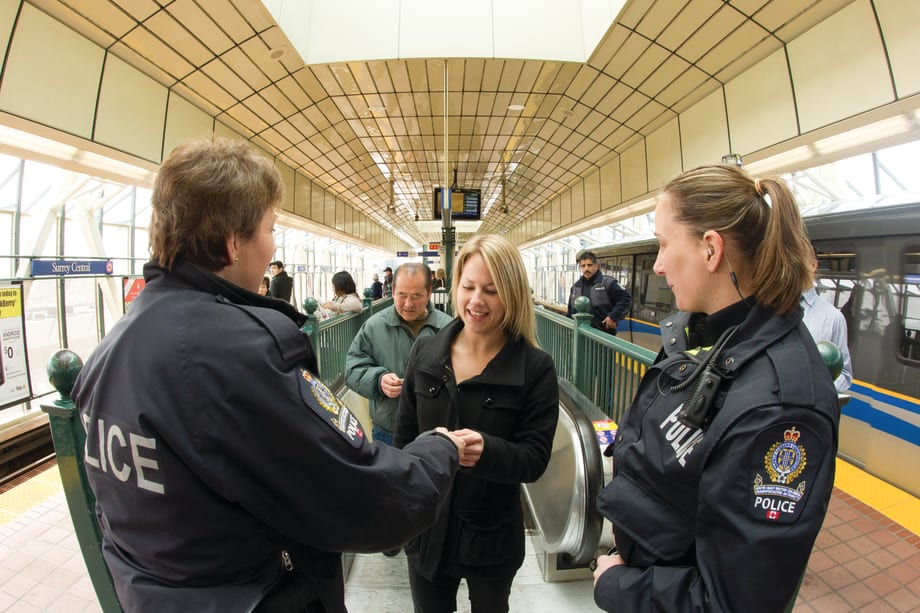
TransLink police officers issued approximately 31,000 citations in 2010, a large majority of which were for fare evasion. The fare checking system also routinely helps police catch people with outstanding warrants for other crimes or find runaways.
With a new fare payment system and fare gates slated to be introduced on its SkyTrain rapid transit system in 2013, British Columbia's TransLink is beginning to explore what will become of its effective police force once the new fare system is introduced.
"What we have today is a barrier-free proof of payment system, which means that, on demand, riders must show a valid fare if they are in a fare paid zone," said TransLink spokesperson Ken Hardie. "In the process of checking fares, if police find somebody without a valid fare then that person is subject to a fine."
The "Compass" smart card system, which will be launched in 2013 along with the fare gates, allows customers to "tap on," or swipe, their card when they enter the system and "tap off" when they exit, enabling TransLink to charge customers the appropriate fare for their trip.
TransLink police officers issued approximately 31,000 citations in 2010, a large majority of which were for fare evasion.
Hardie said that one major benefit of police officers doing fare checks is the hundreds of people they catch that may have outstanding warrants for other crimes. He also said it can be helpful when trying to actually locate people, such as runaways, who may be riding the system.
"There is value, obviously, as far as what we get from the current approach to fare checking," he said. "It remains to be seen how we continue to derive that value once a different system is in place."
With a pilot project still needing to be completed before the payment system and gates are actually implemented, the change in transit police officers' job duties is admittedly far off at this point, according to Hardie. One aspect that will play a large role in how enforcement will be adapted is the addition of a new police chief, Neil Dubord, in February.
One area that may see an increase in police presence is on TransLink's Coast Mountain Bus Co. bus system, where the agency reportedly saw its financial losses from fare evasion double from $2.4 million in 2008 to $5.3 million in 2010. Along with the rise in fare evasions have come a growing number of driver assaults, such as the attack on bus driver Charles Dixon in February, according to a Vancouver Sun report.
Dixon was sucker-punched in the face by a man who boarded the bus from the back and refused Dixon's request to get in line and enter from the front. Dixon was left with mild to moderate brain damage, short-term memory loss and back injuries from the assault.
Hardie said that TransLink is concerned about bus safety, and that in the wake of the Dixon assault, a number of drivers and passengers are hoping that more transit police resources will be allocated to provide more protection.
"The stats are immaterial...one is too many," said Hardie about incidents on buses. "There are certainly calls for the transit police to have a larger presence on the bus fleet and that is something that has to be looked into, simply for the purposes of keeping operators and passengers safe from this kind of disorder."
Hardie said that officers will still need to provide some type of enforcement once the new fare payment system is implemented. He also added that ridership has continued to grow since the 2010 Olympic Games, as will SkyTrain, with the rapid transit system adding approximately seven miles and five new stations once the Evergreen Line opens in 2016. Add to that the more than 2,000 vehicles in the bus system, and it is obvious that there are some critical decisions TransLink will have to make regarding how it will police its system in the next year or so, said Hardie.
"In terms of what's next for transit police, that will be up to [incoming police chief] Mr. Dubord and his agenda, as well as the mandate he will have received from the police board, which really governs the day-to-day activity of the police service," he said. "There are definitely some tough decisions ahead."
More Bus

New York MTA Plans Largest Bus Fleet Upgrade in More Than a Decade
The agency is seeking manufacturers for 650 new CNG buses to replace aging vehicles, improve reliability, and advance its broader fleet modernization strategy.
Read More →
Building a Flexible Path to Transit Electrification
John Hroncich discusses BAE Systems’ modular and scalable approach, lessons learned from decades of real-world operations, and how agencies can identify electrification strategies that fit their fleets.
Read More →
Bus Tech Talk: Keeping Transit Technicians Ahead of the Technology Curve
LA Metro’s Obed Mejia discusses technician training, evolving maintenance technology, fleet replacement, and strategies for getting the most out of today’s transit fleets.
Read More →
Biz Briefs: RIPTA Unveils New Frontrunners, Clevland RTA Adds New Siemens, and More
In METRO's latest installment, we take a look at recent news from Siemens, Prevost, Dodge, and more partnerships making headlines across the transportation sector.
Read More →
People Movement: Holly Arnold Joins Transdev and More
In this edition, we also cover recent appointments and announcements at Pace, CamTran, MCI, and more, showcasing the individuals helping to shape the future of transportation.
Read More →
The High Cost of Transit Buses: Industry Leaders Look to Procurement Reform
Transit leaders and policymakers examine how standardized bus designs, streamlined procurement, and predictable funding could help agencies stretch budgets and deliver better service.
Read More →
The Business Voice Behind Public Transportation
As chair of APTA’s Business Members Board of Governors, Ray Melleady explains how more than 850 business members are partnering with transit agencies to advance funding, innovation, and industry-wide collaboration.
Read More →
From Surviving to Thriving: Building Stronger Transportation Organizations
Bus Business Consultants founder Brian Dickson shares lessons on leadership, organizational health, and creating options for long-term success in a changing transportation industry.
Read More →
Finding the ‘Happy Medium’: Optimizing Maintenance Without Sacrificing Reliability
The key to maintenance optimization isn’t doing less work—it’s doing the right work at the right time on the right assets.
Read More →
LA Metro, City of West Hollywood, and Partners Advance Smarter Bus Lane Enforcement
The award-winning partnership combines AI-powered detection with human oversight to improve bus reliability, accessibility, and enforcement efficiency.
Read More →