



New OCTA chief takes helm
Under the direction of the board of directors, Darrell Johnson is responsible for planning, financing and coordinating Orange County’s freeway, street and rail development, as well as managing bus, commuter rail and paratransit service.


Part of Johnson's initiatives is the agency’s first bike share program, which it will implement on a pilot basis by the summer, connecting bike trails city by city into a regional network.
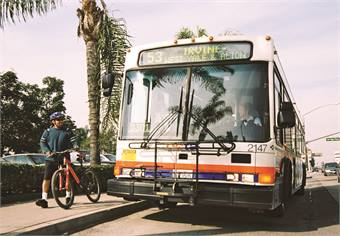
Part of Johnson's initiatives is the agency’s first bike share program, which it will implement on a pilot basis by the summer, connecting bike trails city by city into a regional network.
As Darrell Johnson assumed his new post as the CEO of the Orange, Calif.-based Orange County Transportation Authority (OCTA) on March 4, his initiatives include a safety review, sustainability, workforce development and restoration of service.
Under the direction of the board of directors, Johnson is responsible for planning, financing and coordinating Orange County’s freeway, street and rail development, as well as managing bus, commuter rail and paratransit service.
Johnson, a 20-year veteran of the transportation industry, joined OCTA in 2003 and has served as the deputy CEO since 2010. He helped lead OCTA on local, state and national issues related to transportation programs and policies and assisted the CEO in coordinating business, operations and management activities.
Johnson was selected by the board of directors to succeed Will Kempton, who retired in February, to become the executive director of a nonprofit public transportation advocacy group, Transportation California.
First, Johnson is emphasizing safety. On his first day on the job, he wrote a letter to the president of APTA asking for a top to bottom safety review of OCTA.
“I don’t think we’re unsafe by any means, but it’s good to continue to focus on safety,” Johnson said. “We requested APTA do that in the next 90 days, so we have a solid baseline of where we’re at, at this point in time.”
OCTA had completed a review with high-quality status about three years ago. Still, he stresses, “Safety is something you can’t take your eye off of. If we were to go on a normalized cycle, we would not do this again for another year. I want to make sure that is engaged right away, underscoring our commitment to passenger, customer and employee safety.”
Johnson also plans to promote environmental sustainability in all of OCTA’s capital programs and initiatives.
“Whether it’s a station, shelter, parking structure or bus [maintenance] facility, we need to do better at integrating sustainability in both operations and capital,” Johnson said. “We’re going to seek a baseline assessment and integrate sustainability options into the entire capital program.”
Part of that initiative is the agency’s first bike share program, which it will implement on a pilot basis by the summer, connecting bike trails city by city into a regional network.
Additionally, Johnson is implementing a succession planning effort, stressing the need to develop and nurture the workforce on all levels, he said.
“One of the things we don’t do well in the industry is cross-train people,” John-son added. “We develop really good transit operations, budget and government relations people, but don’t push cross-training. I’m going to continue to push that under my leadership.”
Johnson will expand succession planning efforts at the executive level into the agency for key positions, particularly in the transit operations group, which has an aging workforce.
“We’re trying to get ahead of that curve, as opposed to being taken by surprise,” Johnson explained.
OCTA currently offers a one-year leadership development academy, which focuses on senior-level managers. Participants receive exposure to various departments, from transit operations to government relations; training in presentation and writing skills; and understanding how transportation projects are financed.
That successful model will be modified as a management development academy, under Johnson’s direction.
Meanwhile, OCTA is in a position, after the recession, to begin restoring bus service.
“We cut about 20% to 23% of our bus service in 2009 and 2010. We’ve added about 5% back,” Johnson said. “We’re going to continue that with this year’s budget and [be] selective [in] how we put things back.”
The agency is also looking into rolling out three express bus routes, one of which will launch in June.
“It’s really important to me to make sure that we’re looking at how we serve the customer, making sure we understand the regional context of the work that we’re doing,” he added.
More New Mobility

From Hardware to Digital Partner: Luminator Charts Its Next Chapter
CEO Magnus Friberg discusses Luminator’s shift toward becoming a digital partner, the growing importance of software and interoperability, and how AI can help agencies improve operations and passenger experience.
Read More →
Biz Briefs: Alstom Lands Canadian Contract, LYT to Supply California TSP, and More
In METRO's latest installment, we take a look at recent news from Complete Coach Works, Beep, FlixBus, and more partnerships making headlines across the transportation sector.
Read More →
CharterUP’s Armir Harris on Technology, AI, and the Future of Group Mobility
In a recent episode of METROspectives, CharterUP Founder/CEO Armir Harris discussed the company’s evolution from an online charter bus marketplace into a technology platform supporting public- and private-sector mobility and much more.
Read More →
Jacksonville’s NAVI Project Charts a New Course for Autonomous Public Transportation
Through its NAVI program, JTA is showing how autonomous vehicles, intelligent infrastructure, and coordinated operations can work together to deliver everyday public transportation.
Read More →
Biz Briefs: Luminator Marks Milestone and More
From manufacturers and suppliers to transit agencies and motorcoach operators, these updates offer a snapshot of the projects, partnerships and business moves driving the industry forward.
Read More →
New Tricks for Old Bureaucracies: Joshua Schank on Making Transit Innovation Stick
Former LA Metro Chief Innovation Officer Joshua Schank discusses why good ideas aren't enough, how transit agencies can overcome resistance to change, and why today's challenges demand more innovation.
Read More →
How DART's GoPass Is Redefining Regional Mobility
Serving 14 transit agencies, GoPass simplifies multimodal travel by allowing riders to plan, pay for, and manage an entire trip through one app.
Read More →
Biz Briefs: OCTA Taps Clean Energy for Hydrogen Station, Stadler to Supply Via Rail Vehicles, and More
From manufacturers and suppliers to transit agencies and motorcoach operators, these updates offer a snapshot of the projects, partnerships and business moves driving the industry forward.
Read More →CharterUP Expands Into New Mobility and Autonomous Transportation
Vice President of New Mobility Stephen Joos discusses how CharterUP is leveraging its nationwide transportation network, technology platform, and autonomous vehicle partnerships to expand into workforce mobility, campus shuttles, and transit solutions.
Read More →
METRO Magazine Announces 2026 Innovative Solutions Awards Winners
Projects Recognized for Advancing Mobility Through Technology, Accessibility, Workforce Innovation, and Operational Excellence
Read More →