



OCTA’s ‘quiet zone’ rail program enhances safety, quality of life
Orange County (Calif.) Transportation Authority’s quiet zone program work included the enhancement of 52 railroad crossings and helped silence train horns for local communities.

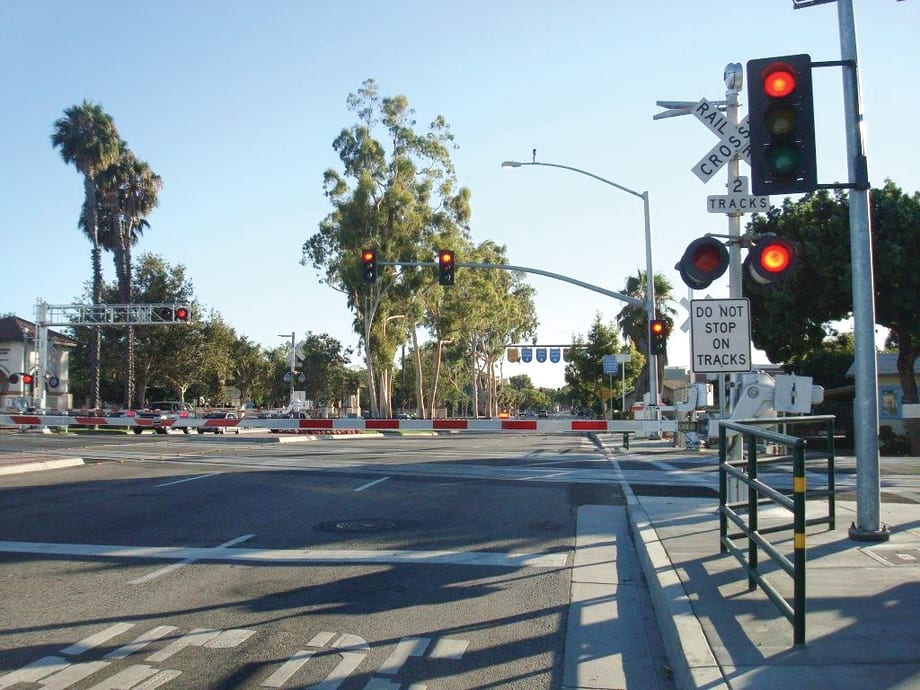
An $85 million rail safety enhancement program led by the Orange County Transportation Authority (OCTA) that established quiet zones throughout Orange County, Calif., was completed in December.
The program enhanced 52 railroad crossings and helped silence train horns for local communities.
Improvements included upgraded and updated warning devices, additional gate arms, extended and raised medians, improved signage and coordinated traffic signals.
OCTA partnered with eight cities to implement the rail safety enhancement program, which allowed cities to apply for quiet zone status once construction at the crossings was complete.
Typically, a train engineer must sound their horn up to four times when they approach a crossing. When a quiet zone is established, trains only sound their horns in the event of an emergency.
There are 48 Metrolink trains operating in Orange County and more than 72 commuter and freight trains travel through the county daily. By 2030, the number of daily trains is anticipated to grow to 108.
"Having these safety improvements and quiet zones in place ahead of that expected growth is a positive outcome of the program," Will Kempton, CEO, OCTA, said. "We get to ensure our communities are safer and the quality of life isn't routinely disrupted by train horns."
The Metrolink system expansion program is primarily financed through local sales tax program Measure M, Orange County's half-cent sales tax for transportation improvements, as well as state dollars. Participating cities also contributed 12% of the project cost.
"We worked with a lot of partners because this affects a number of operations," Kempton said. Project collaborators included Amtrak; Metrolink; freight rail line operators Burlington Northern Santa Fe and Union Pacific; the California Public Utilities Commission and the Federal Railroad Administration.
"We have 45 trains a day operating in Orange County, so we had to be very careful that we didn't disrupt or have too much of a negative impact on the service," Kempton said. "We found that our partners were pretty cooperative. We had some limitations on what we could do, but for the most part, I think we worked pretty effectively together."
The project is one of the first system approaches to be implemented across an entire county that has been taken nationwide, according to Kempton.
Additionally, the project will make the rail system even safer. California's high rate of fatalities from grade crossing deaths was a crucial factor in motivating the agency to implement the program, he added.
Establishing the quiet zones also enabled OCTA and its partners to help enhance the community's quality of life. "There's a lot of community concern about the noise associated with rail operations in the county," Kempton said. "It's an issue [that] we've been trying to deal with for a long time, so in most instances where we've done these improvements, we're already receiving positive public response to our efforts."
OCTA is working with one city on traffic implications that resulted from the program, but the vast majority of the public is happy with the results, Kempton said. "The city of Orange is a great example. [Mayor Carolyn Cavecche] received a lot of positive comments about the significant down-turn in noise.
"It's not easy to upgrade 52 grade crossings with all the things that you have to do in terms of the scheduling the work, making sure you're not disrupting the existing passenger rail service [or] having a negative impact on the freight rail operations in the counties," he added. "We do appreciate the patience of the public while all of this was going on."
More Rail
Amtrak, CN Reach Agreements to Strengthen Passenger Rail Service, Safety
The agreement resolves a more than decade-long proceeding before the Surface Transportation Board concerning the terms and conditions for Amtrak services, such as the City of New Orleans, Illini/Saluki, and Wolverine.
Read More →
New York MTA Advances Final Contract for Second Avenue Subway Expansion
Contract Four is the largest in the Second Avenue Subway Phase 2 project and includes construction of station infrastructure, tracks, and signals for the subway expansion, MTA officials said. Work on Contract Four will begin in 2027.
Read More →
San Diego MTS Breaks Monthly Trolley Ridership Record
Agency officials said July’s ridership indicates MTS’s continued recovery from the pandemic.
Read More →
Report Examines NJ TRANSIT Reliability, Funding Challenges
The Garden State Initiative analysis examines the roles of Amtrak infrastructure, fleet management, and agency operations while recommending a more performance-based approach to improving reliability.
Read More →
Stadler, CapMetro Sign Long-Term Rail Fleet Support Agreement
Beginning in 2027, Stadler will provide on-site technical expertise, spare parts support, training, and obsolescence management to help extend the reliability and longevity of CapMetro’s GTW fleet.
Read More →
Biz Briefs: Alstom Lands Canadian Contract, LYT to Supply California TSP, and More
In METRO's latest installment, we take a look at recent news from Complete Coach Works, Beep, FlixBus, and more partnerships making headlines across the transportation sector.
Read More →
CATS Gold Line Marks 5 Years of Service, 2.8M Passenger Trips
With a six-mile expansion planned, the Charlotte streetcar is positioned to connect more neighborhoods and major transit hubs across the region.
Read More →
Why Simulating Pedestrian Movement Has Become Essential for Modern Rail Stations
Pedestrian microsimulation is helping rail planners identify bottlenecks, test station designs, and prepare complex transit hubs for growing passenger volumes.
Read More →
Amtrak Begins Major Construction at New York’s Sunnyside Yard
The new maintenance facility will support Amtrak’s Airo trainsets while improving maintenance efficiency and turnaround times in New York.
Read More →
Chicago Leaders Unveil Plans for O’Hare Airport Express Train
The privately developed project would offer a 15-minute trip between downtown and O’Hare’s Terminal 2, with trains operating every 15 minutes on a dedicated track. The service would use battery-electric trains and three existing freight rail rights-of-way.
Read More →