



Optibus, Ohio’s WRTA Team to Combat Driver Shortage
The Western Reserve Transit Authority is working with Optibus’ technology to schedule their employees more efficiently and plan more appealing routes.
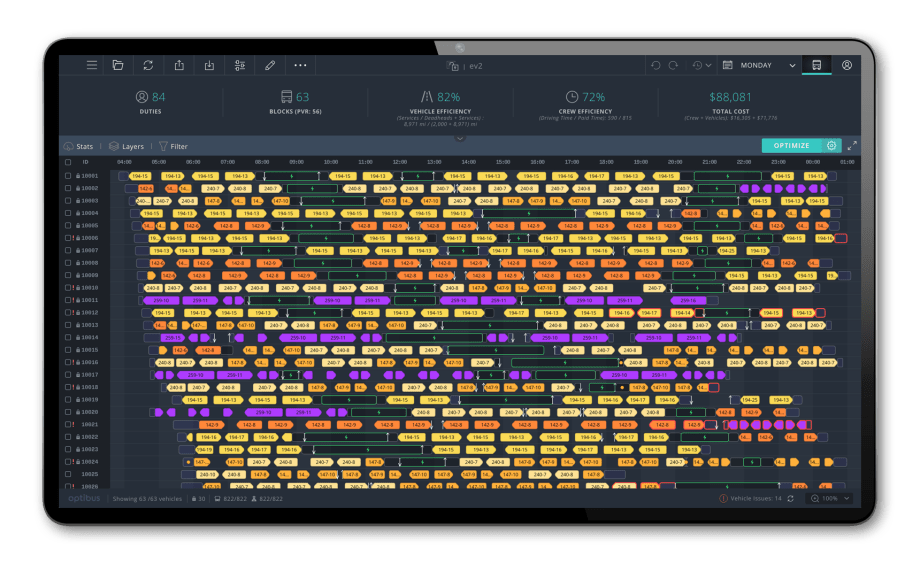
Screenshot via Optibus
The driver shortage has hit many facets of the transportation world, and it’s led to service cancellations and delays, as well as increased pressure on drivers and agencies. To better manage local operator shortages, the Youngstown, Ohio-based Western Reserve Transit Authority (WRTA) is using Optibus’ planning and scheduling modules to increase the quality of drivers’ work shifts, optimize their budget, and work faster. METRO caught up with Optibus and the WRTA to discuss the changes they’ve made and how it’s worked out.
How bad has the driver shortage been? How short are you and how did it impact services?
Judy Rodriguez, director of transportation, WRTA: We have had a lot of operator shortages but are fortunate to have good operators that will work overtime when needed to cover trips.
What led you to Optibus?
Rodriguez: A main challenge we faced was how to automatically handle premium pay for long shifts. We previously had a mix of part‐time and Saturday work shifts. It was challenging to fill in runs no one wanted to work, and no one was benefiting from that many part-time runs. Operators often volunteered for overtime, and the overtime impacted our budget. We needed a planning solution that would help us design the best shifts possible from the beginning. Optibus increases transparency into our operation and resource allocation, allowing us to see how to distribute work pieces and create shifts in a way that’s more appealing to operators.
What steps does Optibus take when coming onboard? How did the agency and Optibus work together?
Oren Hirsch, solutions engineer, Optibus: There is an onboarding process for every Optibus user, involving training on the software and through the Optibus Academy, which includes ‘learning tasks’ and tutorials that help users gain mastery in the software. In general, the software is quite intuitive and easy to use. Every client has a specific set of goals, however, and we help them master the software to see the results they need.
Rodriguez: We approached Optibus with defined goals: Improving the quality of operators’ work shifts and services, optimizing our budget, and enabling schedulers and planners to work faster. Optibus supported us in creating a suitable solution, mainly involving multiple scenario creation for planning. We have been working with Optibus for one year now and we use the software independently. However, there is always an Optibus customer success representative or solutions engineer available to brainstorm technological solutions to more complex scenarios.
What were the ultimate steps taken to improve services and what have the results been to this point?
Rodriguez: In June 2021, we implemented our first service change generated in Optibus. Since then, we redesigned our weekday run cut in a way that reduced runs by 12%, reduced split duration by 17%, and eliminated part‐time runs (trippers) while maintaining nearly identical service levels. We improved the quality of Saturday runs, which reduced operator callouts and improved operator relationships. We even generated cost savings that offset overtime costs incurred because of the shortage.
In the spring of 2022, when the operator shortage was most acute, we used Optibus’ multiple scenario creation capability to explore and model scenarios for handling the shortage, such as operating Saturday service on weekdays on all routes, or only on certain routes. The software made it simple to create multiple scenarios for our director to review and understand the impact of any service changes.
Hirsch: Regardless of staffing levels, transit scheduling has always been about trying to find the right balance between planned levels of service, operator availability, and costs such as guarantee time or overtime. With the operator shortage, it’s better for everyone — agencies, operators, passengers — if service frequency is reduced and run services on time, versus setting unrealistic schedules that are late or unreliable. In WRTA’s case, this meant developing a schedule that maintained service on all weekday only commuter routes while reducing other routes to a Saturday schedule. It took us and WRTA a matter of minutes to see what the operator requirements for different versions of this plan would be.
Optibus enables agencies such as WRTA to make smart decisions to keep everyone satisfied. Part‐time pieces can be distributed more economically while ensuring shifts are covered, without worrying about overtime. Sometimes, guaranteed time is not valuable for operators or the agency. In other circumstances, overtime may be more cost and time effective, especially in comparison to hiring more operators. You need to crunch a lot of data and test many scenarios to find the best solution. With Optibus, WRTA eliminated runs that pay more than 10 to 15 minutes of guaranteed time and reduced guaranteed time to almost zero.
How have operators responded to the agency working with Optibus? How has it improved the quality of their runs?
Rodriguez: With the new runs in place, people working on Saturdays are much happier. Reducing split durations has helped tremendously, along with reducing the number of people who need to come in. There are fewer call outs and complaints. Optibus has improved our relationship and communication with our operators. We are involving operators more in the operation and demonstrating their value to the network by better incorporating their suggestions and insights about shifts. I can feed their suggestions into Optibus and quickly show them on the platform its impact on the operation. We can incorporate operators’ insights about hard‐to‐serve stops, missed connections, traffic, break locations, and more, and have management consider their input. That makes operators feel valued and invested in the operation and shows them they aren’t just a number.
Hirsch: WRTA used the Optibus platform skillfully to improve both operators’ runs and communication with operators. Before using Optibus, no one wanted to take Saturday runs (WRTA does not operate Sunday service). WRTA redesigned their shifts to make all their operators happier and made them valuable partners in improving the network.
At every agency, the insight operators bring from the field is invaluable to schedulers and planners who are squeezed for time. Using real‐world feedback about services helps operational teams make reality‐based decisions and not just judgment calls about services. That comes full circle to improving the network for both operators and riders.
Now that the initial solution is in place, how are Optibus and the agency continuing to work together to fine tune and continue to improve the program?
Hirsch: We continue to meet with WRTA on a regular basis. The operational landscape is always changing, so there is a continual need to provide the agile infrastructure and tools needed to adapt to new circumstances and rosters. For example, the Optibus team has assisted with platform configuration changes for WRTA’s emergency scenario planning. We also use our meetings to highlight the new features Optibus is rolling out. Optibus is continuing to train WRTA on these new capabilities and bring potential solutions to their attention.
Rodriguez: The driver shortage is not over. We continue to use Optibus to stay agile and responsive and create shifts that attract and retain operators.
What feedback would you give to an agency experiencing the same issues who are looking for solutions to help them do more with less?
Rodriguez: Understand your operators’ needs and consider the occupational stresses of driving a bus. Take the time to test scenarios. Think about things differently than you did before. See what comes out. It could be there is a scenario that eliminates splits on certain days or adds mid‐route reliefs at certain times with little or no additional expenses and also greatly improves operators’ lives. If you can work with your operators to improve shifts at no expense to you, then why not do it? Also, consider your budget and operational bandwidth and make smart, data‐driven decisions about overtime versus guaranteed time.
Hirsch: There is a tendency for agencies and contractors to focus on the bottom line. Things may cost extra over a certain timespan, but what if that cost means not having to train new operators because you have not lost any? Consider hard costs as well as intangible costs. A seemingly radical idea may not be as radical as when you plug it in and model it.
Think about operators coming in on a Sunday. Can you design a service so the operators who have to pick a Sunday run due to having less seniority get some other benefit to maintain a good quality of life? Can that benefit be given to less senior operators while still retaining the perks belonging to the most senior operators, who worked so hard to secure those perks? Consider what is important to your workforce. Because if they all walk out, you are going to have a problem. Consider what’s important to customers. They want to know if the bus says it will come every fifteen minutes, it will actually come every fifteen minutes. Don’t overpromise and under deliver. If you can’t achieve fifteen‐minute frequency, make it 20 or 25 minutes. Riders may not be happy with the service reduction, but at least you communicate the reality of the situation and work to meet it.
More Technology

From Hardware to Digital Partner: Luminator Charts Its Next Chapter
CEO Magnus Friberg discusses Luminator’s shift toward becoming a digital partner, the growing importance of software and interoperability, and how AI can help agencies improve operations and passenger experience.
Read More →
Beyond the Checklist: A Structured Approach to Transit Maintenance
Reliability-Centered Maintenance helps transit agencies move beyond routine checklists to focus limited resources on the assets and failures that have the greatest impact on safety, reliability, and service.
Read More →
NJ TRANSIT Advances Bus Technology Upgrades Across Statewide Fleet
More than 1,500 buses now feature upgraded technology designed to improve arrival predictions and provide free Wi-Fi, with deployment expected to reach nearly 2,000 buses by the end of 2026.
Read More →

Building a Flexible Path to Transit Electrification
John Hroncich discusses BAE Systems’ modular and scalable approach, lessons learned from decades of real-world operations, and how agencies can identify electrification strategies that fit their fleets.
Read More →
Biz Briefs: Alstom Lands Canadian Contract, LYT to Supply California TSP, and More
In METRO's latest installment, we take a look at recent news from Complete Coach Works, Beep, FlixBus, and more partnerships making headlines across the transportation sector.
Read More →
From Legacy Silos to Conversational Intelligence
What if transit leaders could ask any operational question and get a trusted answer in seconds? Conversational AI is transforming how agencies use their data.
Read More →
USDOT Announces Rail Vehicle Replacement Grants, Chattanooga AV Shuttle Funding
More than $191 million in federal funding will help three transit agencies replace aging rail vehicles and support a new autonomous shuttle service in Chattanooga.
Read More →
Bus Tech Talk: Keeping Transit Technicians Ahead of the Technology Curve
LA Metro’s Obed Mejia discusses technician training, evolving maintenance technology, fleet replacement, and strategies for getting the most out of today’s transit fleets.
Read More →
Biz Briefs: RIPTA Unveils New Frontrunners, Clevland RTA Adds New Siemens, and More
In METRO's latest installment, we take a look at recent news from Siemens, Prevost, Dodge, and more partnerships making headlines across the transportation sector.
Read More →
Why Simulating Pedestrian Movement Has Become Essential for Modern Rail Stations
Pedestrian microsimulation is helping rail planners identify bottlenecks, test station designs, and prepare complex transit hubs for growing passenger volumes.
Read More →