



Proposed New Jersey Light Rail Expansion Moves Forward
With STV Incorporated serving as the lead of a multi-firm team for the project, the Delaware River Port Authority and its PATCO subsidiary continue work to open a new light rail line that would not only tie together parts of South New Jersey, but provide access to Philadelphia.
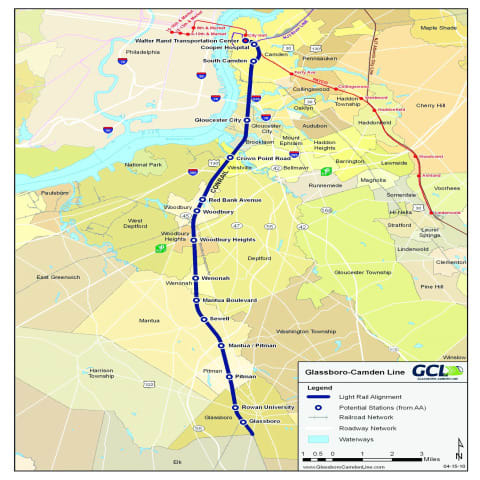
[IMAGE]Map.jpg[/IMAGE]The Delaware River Port Authority (DRPA) and Port Authority Transit Corp. (PATCO), a subsidiary of the DRPA, in close cooperation with the New Jersey Department of Transportation (NJDOT), are pursuing new transit service between Glassboro and Camden in Southern New Jersey.
The Glassboro-Camden Line (GCL) Light Rail Project, which is a proposed expansion of transit service in the area, would traverse the communities within the corridor from Glassboro to Camden. The new line would provide passenger rail service along the existing rail line using light rail technology similar to the New Jersey Transit (NJ Transit) River Line. Light rail along this corridor was selected as the Recommended Alternative based on the two-year Alternatives Analysis funded by NJDOT and completed by DRPA/PATCO in 2009.
"The purpose of this project is to improve transit service along the Glassboro-to-Camden corridor in southern New Jersey, with a focus on increasing mobility and improving links between the established communities and activity centers," explains Richard Amodei, sr. vice president and chief strategic growth officer at STV Incorporated, which is serving as the lead of a multi-firm team for the project.
The new line would primarily run along Consolidated Rail Corp.'s (Conrail) freight alignment, which is roughly parallel to Woodbury-Glassboro Road and NJ Route 45. The northern segment in Camden would follow a new right-of-way adjacent to I-676 before entering an in-street alignment to reach Walter Rand Transportation Center, where riders could transfer to the PATCO Speedline and the NJ Transit River Line, Amodei adds.
The Light Rail Alternative would use diesel-powered light rail vehicles operating on new dedicated tracks and/or sharing portions of Conrail track with temporal separation. Approximately 14 new stations would be located along the alignment.
Why light rail?
The Glassboro-to-Camden corridor is characterized by older, densely populated communities that developed along the rail line, as well as major employment and activity centers including universities, medical centers and other institutions, Amodei explains. He adds, however, that connections between these activity centers are not efficient, and travel within the corridor is difficult for the people who access them.
Currently, NJ Transit provides bus service throughout the corridor, which travels on existing roads and highways that are subject to congestion, with no rapid transit option that can get travelers into Camden or downtown Philadelphia and beyond. The GCL would provide passenger rail service along an existing underutilized transportation corridor.
"Right now the area relies on the PATCO Speedline system, which is to the east of the study area core and that's the only rapid transit service available to the residents of southern New Jersey," says Amodei. "[A light rail line] would serve as an extension of rapid transit into an area just southwest of the PATCO system where there are high levels of population that wouldn't use the existing service. It's really an untapped market to a great extent."
With the communities that surround the proposed alignment serving as some of the earliest examples of transit oriented development (TOD), GCL would enhance those TOD areas, while also re-solidifying the urban fabric, Amodei says.
"The recommended alignment conforms to policies promoted by New Jersey's Office of Smart Growth to help prevent development 'sprawl' into open space and agricultural land, requiring new supporting infrastructure," he adds.
[PAGEBREAK]
Progress
The area that the GCL would serve has, essentially, been studied for more than 20 years and a suitable solution had yet to be found.
"What it came down to it, there was agreement that the transportation system needed to be improved, but the needs and the options to meet them required more vetting and more outreach and explanation to the public — the pros and cons of each and what the advantages would be to the region over time if the system was put in place," says Amodei about the previous attempts to move forward on any of the options.
STV's role as the lead consultant started with the Southern New Jersey to Philadelphia Transit Study, which was completed in 2005, and continued with the Alternatives Analysis phase completed in 2009 that included three alignments, two of which followed highway corridors. The third option, eventually selected, called for a light rail line that shared the already existing rail assets with Conrail.
"The initial study completed in 2005 was all about defining the need, the options to meet the need, and then working with and providing outreach to the public to build consensus for the option or options selected," Amodei explains.
To build consensus, STV, DRPA and PATCO held numerous open house meetings and conducted targeted outreach with stakeholders and elected officials. The legwork has paid off with excellent support from residents surrounding the proposed line, who look forward to a better public transportation system that includes the GCL in combination with the existing transportation system.
Amodei also credits Conrail, the owner of the proposed right-of-way, which has been involved since early in the project, for being a key factor in the successes of this latest study of the corridor.
Currently, STV is working on the Draft Environmental Impact Statement (DEIS) study with the Federal Transit Administration (FTA) serving as the sponsor agency. As the lead consulting firm, STV will lead and coordinate all project tasks including environmental analyses, public outreach and advanced engineering, to name a few. The firm expects the DEIS phase to take anywhere from 18 to 24 months, with the opening of the completed system targeted for 2016.
Although PATCO, as a subsidiary of the DRPA, has operated the existing Speedline rapid transit system, which runs between Philadelphia and Lindenwold, for more than 40 years, Amodei says a decision has not yet been made as to who will operate the GCL when it is finally built.
"The decision to run the system has not been made yet. It could be DRPA or NJ Transit or a third party," he says. "It will be something that will be looked at as we get further into the design, operation and financing of the actual system."
More Rail

New York MTA Advances Final Contract for Second Avenue Subway Expansion
Contract Four is the largest in the Second Avenue Subway Phase 2 project and includes construction of station infrastructure, tracks, and signals for the subway expansion, MTA officials said. Work on Contract Four will begin in 2027.
Read More →
San Diego MTS Breaks Monthly Trolley Ridership Record
Agency officials said July’s ridership indicates MTS’s continued recovery from the pandemic.
Read More →
Report Examines NJ TRANSIT Reliability, Funding Challenges
The Garden State Initiative analysis examines the roles of Amtrak infrastructure, fleet management, and agency operations while recommending a more performance-based approach to improving reliability.
Read More →
Stadler, CapMetro Sign Long-Term Rail Fleet Support Agreement
Beginning in 2027, Stadler will provide on-site technical expertise, spare parts support, training, and obsolescence management to help extend the reliability and longevity of CapMetro’s GTW fleet.
Read More →
Biz Briefs: Alstom Lands Canadian Contract, LYT to Supply California TSP, and More
In METRO's latest installment, we take a look at recent news from Complete Coach Works, Beep, FlixBus, and more partnerships making headlines across the transportation sector.
Read More →
CATS Gold Line Marks 5 Years of Service, 2.8M Passenger Trips
With a six-mile expansion planned, the Charlotte streetcar is positioned to connect more neighborhoods and major transit hubs across the region.
Read More →
Why Simulating Pedestrian Movement Has Become Essential for Modern Rail Stations
Pedestrian microsimulation is helping rail planners identify bottlenecks, test station designs, and prepare complex transit hubs for growing passenger volumes.
Read More →
Amtrak Begins Major Construction at New York’s Sunnyside Yard
The new maintenance facility will support Amtrak’s Airo trainsets while improving maintenance efficiency and turnaround times in New York.
Read More →
Chicago Leaders Unveil Plans for O’Hare Airport Express Train
The privately developed project would offer a 15-minute trip between downtown and O’Hare’s Terminal 2, with trains operating every 15 minutes on a dedicated track. The service would use battery-electric trains and three existing freight rail rights-of-way.
Read More →
OCTA Maps Out 30-Year Strategy to Protect Coastal Rail Corridor
The draft feasibility report identifies strategies to protect the coastal rail line for decades as the agency continues near-term stabilization and sand placement efforts.
Read More →