



Safety, Accessibility Key for FTA's Molinaro
Federal Transit Administrator Marc Molinaro recently addressed the crowd at the APTA's TRANSform Conference, which was held Sept. 14 to 17 in Boston.

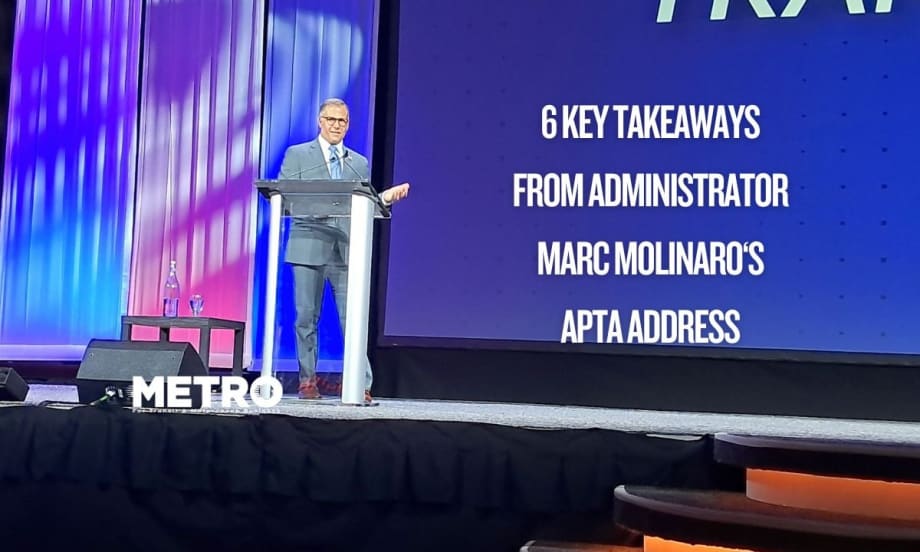
Federal Transit Administrator Marc Molinaro addressed the APTA crowd in Boston this past September.
Photo: METRO
- Federal Transit Administrator Marc Molinaro spoke at the APTA's TRANSform Conference.
- The conference took place from September 14 to 17 in Boston.
- Safety and accessibility were highlighted as focal points in his address.
*Summarized by AI
Federal Transit Administrator Marc Molinaro recently addressed the crowd at the American Public Transportation Association’s (APTA) TRANSform Conference, which was held Sept. 14 to 17 in Boston.
Molinaro’s speech combined urgency with a sense of partnership.
He cast transit as the “circulatory system of the American economy,” warned against complacency on safety, demanded universal accessibility, pledged support for American manufacturing, and urged agencies to focus relentlessly on outcomes that matter to families.
6 Key Takeaways from Molinaro's Address
Some key highlights of Molinaro’s address included:
1. Transit as the “Front Door of Government”
Molinaro began by suggesting that public transportation is one of the most visible and personal ways Americans interact with their government. Whether at a bus stop, subway platform, or ferry terminal, transit represents a daily touchpoint, and with that comes heightened expectations.
“Public transportation may be the one place that the American people and American families interact every day with their government,” he said.
Molinaro also emphasized that the reliability, affordability, and safety of these services shape trust in government.
“American families want to trust that when they enter and use a public transportation system, they will arrive at their destination efficiently, effectively, affordably, and safely,” he said.
The underlying message is that transit leaders are judged not just as service providers, but as representatives of the government itself.
2. Outcomes Over Processes: “Fix the Roof”
Molinaro pushed for results-driven leadership, warning against getting bogged down in bureaucracy, committees, or paperwork. Families, he argued, don’t care about process metrics; they care about outcomes that make their lives easier and safer.
“Families don’t measure success based on the number of advisory committees or reports that are published. They don’t. It’s not about analysis, it’s about outcomes,” he said. “The job of government is to fix the roof, not blame someone else for why the roof’s leaking, not explain away why someone else should fix it. At the end of the day, the American people expect us to fix the damn roof.”
Molinaro also reminded agencies that the administration’s focus is on “real results,” not reports or metrics that are “disconnected from reality.”
3. Safety as a Non-Negotiable Priority
Much of his speech centered on safety, where Molinaro was both personal and pointed. He stated bluntly that safety is the Administration’s “top priority” and linked recent crimes on transit to policy failures at both the state and local levels.
“The safety of those who rely on transportation systems around America and the security of their systems is, without question, the top priority of this administration,” he said. “We will confront it boldly, bluntly, and in some ways unorthodoxly. Why? Because we don’t have time.”
He cited high-profile crimes — including the recent murder of a woman in Charlotte and violent incidents in New York City — as stark reminders of what’s at stake.
“Families should not have to come to accept whether or not their child will be safe on their way to school, or whether a spouse will come home from work,” he told the crowd.
Molinaro rejected the normalization of “low-level offenses” like fare evasion, warning they often escalate into more serious crimes.
“Low-level offenses often escalate into higher-level offenses, and those higher-level offenses frequently have devastating consequences,” he said.
To that end, Molinaro urged agencies to continue investing in crisis intervention, mental health response teams, and de-escalation tools, but also pledged the administration will call out policymakers whose decisions make systems less safe.
4. Universal Accessibility: Designing for Everyone
Drawing on his personal experience as a father of a child with a disability, Molinaro made a passionate case for universal accessibility in transit design and operations.
“When you design, develop, and deploy projects that meet the needs of individuals with disabilities, you create accessibility for everyone,” he said.
He argued accessibility should not be an afterthought or something rushed, but a foundational principle across projects, from new stations to bus rapid transit to core capacity expansions.
“We want universal accessibility. We don’t want you to rush it. We want to be sure it is fundamental to providing access to everyone,” Molinaro said.
He painted a picture of who benefits when systems are built with accessibility in mind.
“Think about the mom or dad with a stroller, the grandmother or grandfather with a walker, the adult with a mobility challenge, or the young woman with a neurological difference — all of them deserve to have access,” he said, harkening back to his broader message that transit must connect people to their futures, no matter their background or ability.
5. Supporting American Manufacturing and Cutting Red Tape
Molinaro also highlighted the Administration’s commitment to strengthening U.S. manufacturing in the transit supply chain, from major rolling stock plants to small suppliers.
He likened this ecosystem to the arteries that keep the “circulatory system” of transit alive.
“If the transit systems are our circulatory system, the suppliers and manufacturers are the arteries that keep rural and urban communities linked together,” he said.
Molinaro pledged support for policies that bolster domestic jobs and ensure manufacturers can reliably deliver to agencies, connecting this to the President’s infrastructure investments.
At the same time, he acknowledged the need to expedite project delivery by reducing bureaucratic delays, reforming regulatory frameworks, and streamlining NEPA reviews.
“We will focus on cutting red tape, reforming some of our regulatory environments, making it easier to navigate through the maze of federal, state, and local agencies, so that together, we can move projects fast, efficiently, and affordably,” he said.
6. Preparing for the Global Stage
Looking ahead, Molinaro framed upcoming events, such as the 2026 World Cup and the 2028 Los Angeles Olympics and Paralympics, as opportunities for U.S. transit systems to demonstrate excellence on the world stage.
“All of this will put America on the international stage, and the President and Secretary Duffy want us to put our best foot forward,” he said, while also calling for transparency and proactive mobility planning, stressing that both athletes and fans must have reliable, accessible ways to move through host cities.
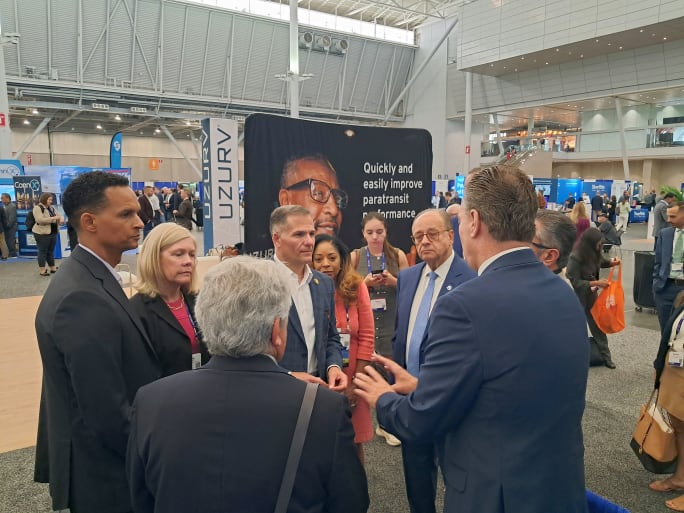
Prior to addressing the crowd, Molinaro walked the TRANSform show floor with APTA officials.
Photo: METRO
A Partnership Built on Accountability
Molinaro ended with a call for partnership between agencies and the Administration, while promising to hold policymakers accountable when their choices jeopardize safety or outcomes.
“My call to action is that every time we make a decision, it should be based on one question: Will this make transit safer, more accessible, and more useful for American families? And if the answer is no, we should change course together,” he said.
He pledged that the Federal Transit Administration will continue to push for measurable improvements and focus on rebuilding public trust and ridership through practical, family-centered outcomes.
Quick Answers
Marc Molinaro is the Federal Transit Administrator.
*Summarized by AI
More Management

METRO Opens Submissions for 2026 Motorcoach Awards
Nominations are now being accepted for METRO Magazine’s Operator of the Year and Innovative Operator of the Year awards.
Read More →
New York MTA Advances Final Contract for Second Avenue Subway Expansion
Contract Four is the largest in the Second Avenue Subway Phase 2 project and includes construction of station infrastructure, tracks, and signals for the subway expansion, MTA officials said. Work on Contract Four will begin in 2027.
Read More →
Transit Agencies Highlight Safety Gains at National Summit
Leaders from 15 major transit systems shared crime-reduction results and safety initiatives while discussing the role of continued federal support.
Read More →

NITA Names New Leadership, Expands Reduced-Fare Program at First Board Meeting
The new regional transit authority appointed its first board chair and interim executive director while extending reduced fares across CTA, Metra, and Pace for eligible riders.
Read More →
Beyond the Checklist: A Structured Approach to Transit Maintenance
Reliability-Centered Maintenance helps transit agencies move beyond routine checklists to focus limited resources on the assets and failures that have the greatest impact on safety, reliability, and service.
Read More →
APTA 2026 Nominating Committee Selects Leadership Slate, Names Chair and Vice Chair Nominees
Leadership changes will help shape the association’s priorities and its representation of the transportation industry during the 2026–2027 term.
Read More →
DART Launches Major Security, Fare Enforcement Initiative
The 90-day demonstration will deploy coordinated security teams at five light rail stations while testing controlled access and gathering data to guide future investments.
Read More →
Advancing Fare Collection Through Technology and Innovation
Learn about delivering 1300 gates at 91 stations while managing fare evasion. Explore the large scale deployment, solution customization and real-world results that affect the region. Prepare for deployment in your region now.
Read More →
Game Day in Motion: Moving Millions During the 2026 World Cup
Between packed transit stations and team motorcoaches, see how agencies and operators across North America tackled the transportation demands of the 2026 FIFA World Cup.
Read More →
Surface Transportation Extension Averts Shutdown, Leaves Transit Funding Gap
The stopgap keeps federal transportation programs moving, but missing advance funding could complicate the transit and rail projects agencies are planning next.
Read More →