



Related: Automated and Connected Vehicle Tech Offers Promise for Transit Agencies
Smart Cities: Critical Opportunities for Transit Agencies
Improvements in communication and information technologies are especially valuable to public transportation agencies, which are frequently charged with optimizing a complex system with competing needs.
by Katharina McLaughlin and Rachel Zack
September 28, 2017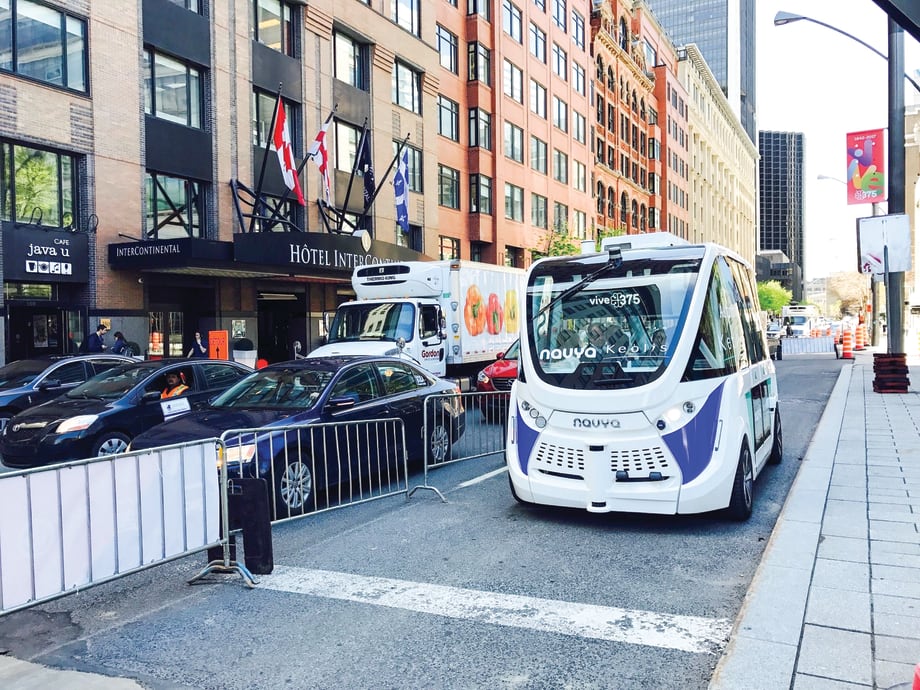
Electric autonomous vehicles, like the one pictured here during a demonstration at the 2017 UITP Summit in Montreal, are seen as a key mode in a smart city plan. Photo by METRO Magazine/J. Starcic
4 min to read
As technology continues to evolve and influence societal trends, cities are exploring what it means to be a “smart city.” The core of this initiative is the desire to deploy and utilize advances in communication and information technologies to better understand and address challenges that face cities.
Improvements in these technologies are especially valuable to public transportation agencies, which are frequently charged with optimizing a complex system with competing needs, including customer mobility, congestion reduction, asset management, customer safety, fleet management and system prioritization. Adding to that complexity is the recent introduction of on-demand, privately operated mobility services and the rapid push toward an automated vehicle future. While both private and public leadership have declared that the future is shared, automated and electric, it will take a true “smart transportation agency” to realize this vision.
Electric autonomous vehicles, like the one pictured here during a demonstration at the 2017 UITP Summit in Montreal, are seen as a key mode in a smart city plan. Photo by METRO Magazine/J. Starcic
Connected/Automated Tech
In 2016, over 40,000 people died in motor vehicle crashes in the U.S. Connected and automated vehicles have the potential to significantly reduce that figure, as our transportation network begins to operate more as a connected system of constantly communicating vehicles, passengers, cyclists and pedestrians.
In 2015, New York City’s Taxi and Limousine Commission (TLC) piloted crash-avoidance technologies that alerted drivers to hard braking, hard accelerating, hard turning, and abrupt lane changes by other vehicles. This data was collected to enable the TLC to determine if the crash-avoidance technologies helped reduce crashes across different types of taxi services. The preliminary results showed that for vehicles participating in the pilot, crashes decreased by almost 24%, compared to the industry-wide decrease of 1.38% during the same quarter.
Electric Vehicles
Planners, private mobility providers, state agencies, and transportation operators have made varying levels of commitment to an electric vehicle future. Fleet electrification brings upfront costs, such as the capital costs of purchasing fleet vehicles, and infrastructure investments, such as overnight charging facilities. But the long-term benefits of an electrified fleet on fuel consumption and emissions are clear. Making such infrastructure investments offers an opportunity to build or enhance a transportation agency’s communications network. That in turn will help to optimize the benefits of electric vehicles while also providing future capacity to support connected and automated vehicles.
Specific to the electric vehicle ecosystem, for example, a robust communication network will enable electric vehicles to pull energy from the grid during off-peak loading, and will enable drivers to locate charging stations that are supported by renewable energy instead of conventional power plants. Strong communication networks can also enable more data-driven service planning and system optimization, leveraging more connectivity with vehicles.
Shared Mobility
When discussing automated vehicles, professionals often talk about two extreme scenarios. In one scenario, privately owned automated vehicles are running around picking up kids and dropping off dry cleaning while the owners are working, creating increases in congestion, and emissions. The second scenario is one in which fleets or co-leased vehicles provide shared trips along high-demand routes and as first/last mile solutions to and from high-frequency transit, particularly services operating on dedicated rights-of-way in areas with significant congestion. Addressing these challenges will require regional policy solutions spanning infrastructure investment, pricing, and land use. The confluence of technology advancements, travel behavior changes, and increased electrification is likely to drive a need to reconsider funding models for the broader transportation system.
“While both private and public leadership have declared that the future is shared, automated and electric, it will take a true ‘smart transportation agency’ to realize this vision.”
For example, in January of 2016, Sao Paulo proposed creating a credit system for vehicle miles traveled. Private providers could purchase credits for a month of service and were charged a fee if the credits were exceeded. Credits were cheaper in underserved neighborhoods to make them more appealing to private providers. Hence, the ability to track and communicate vehicle miles traveled opens up an array of opportunities around pricing and incentives that could lead to more shared and equitable service.
The mobility environment is rapidly changing and agencies will need to leverage communications technology to understand impacts of these changes, create informed policy, and adapt. The examples cited here offer a glimpse into the possible technology-enabled leadership roles that transportation agencies could take to achieve a shared, autonomous, electric future. As we move to a future of technology-enabled mobility, it’s important for transit agencies to think beyond the bus and the train, and about the technology solutions that will help them identify energy and sizing efficiencies, and make mobility shared and accessible. Communications technology will play a central role.
Katharina McLaughlin and Rachel Zack are associate consultants with WSP USA.
Subscribe to Our Newsletter
More New Mobility

From Hardware to Digital Partner: Luminator Charts Its Next Chapter
CEO Magnus Friberg discusses Luminator’s shift toward becoming a digital partner, the growing importance of software and interoperability, and how AI can help agencies improve operations and passenger experience.
Read More →
Biz Briefs: Alstom Lands Canadian Contract, LYT to Supply California TSP, and More
In METRO's latest installment, we take a look at recent news from Complete Coach Works, Beep, FlixBus, and more partnerships making headlines across the transportation sector.
Read More →
CharterUP’s Armir Harris on Technology, AI, and the Future of Group Mobility
In a recent episode of METROspectives, CharterUP Founder/CEO Armir Harris discussed the company’s evolution from an online charter bus marketplace into a technology platform supporting public- and private-sector mobility and much more.
Read More →
Jacksonville’s NAVI Project Charts a New Course for Autonomous Public Transportation
Through its NAVI program, JTA is showing how autonomous vehicles, intelligent infrastructure, and coordinated operations can work together to deliver everyday public transportation.
Read More →
Biz Briefs: Luminator Marks Milestone and More
From manufacturers and suppliers to transit agencies and motorcoach operators, these updates offer a snapshot of the projects, partnerships and business moves driving the industry forward.
Read More →
New Tricks for Old Bureaucracies: Joshua Schank on Making Transit Innovation Stick
Former LA Metro Chief Innovation Officer Joshua Schank discusses why good ideas aren't enough, how transit agencies can overcome resistance to change, and why today's challenges demand more innovation.
Read More →
How DART's GoPass Is Redefining Regional Mobility
Serving 14 transit agencies, GoPass simplifies multimodal travel by allowing riders to plan, pay for, and manage an entire trip through one app.
Read More →
Biz Briefs: OCTA Taps Clean Energy for Hydrogen Station, Stadler to Supply Via Rail Vehicles, and More
From manufacturers and suppliers to transit agencies and motorcoach operators, these updates offer a snapshot of the projects, partnerships and business moves driving the industry forward.
Read More →CharterUP Expands Into New Mobility and Autonomous Transportation
Vice President of New Mobility Stephen Joos discusses how CharterUP is leveraging its nationwide transportation network, technology platform, and autonomous vehicle partnerships to expand into workforce mobility, campus shuttles, and transit solutions.
Read More →
METRO Magazine Announces 2026 Innovative Solutions Awards Winners
Projects Recognized for Advancing Mobility Through Technology, Accessibility, Workforce Innovation, and Operational Excellence
Read More →