



Streetcar design, tech advances give owners greater flexibility in alignments
Modern streetcars have been successfully inserted into the built environment without the need for additional right-of-way and with minimal disturbance to existing on-street parking spaces, streets, or utilities, allowing owners to bring greater mobility to urban areas once thought too complex for streetcars.
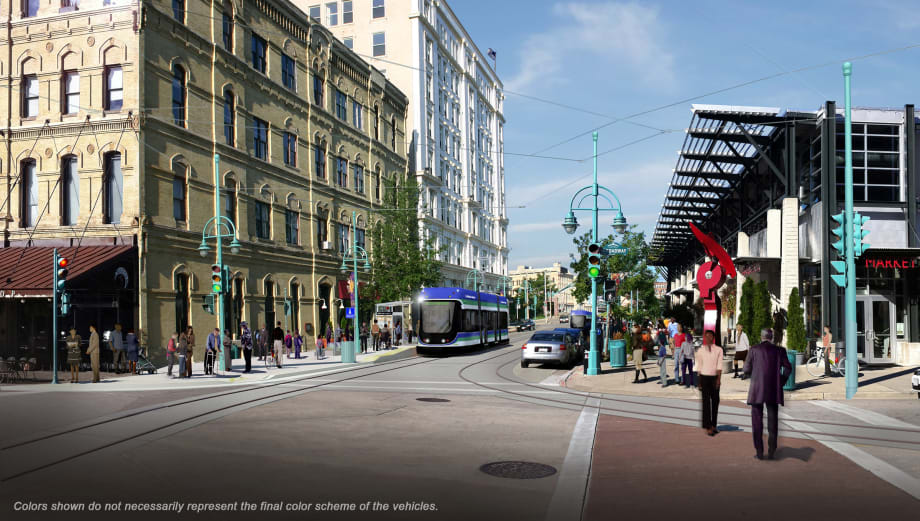
The initial 2.5-mile route of the Milwaukee Streetcar (rendering shown) will connect 80,000 downtown workers, 25,000 downtown residents and millions of annual visitors.
The initial 2.5-mile route of the Milwaukee Streetcar (rendering shown) will connect 80,000 downtown workers, 25,000 downtown residents and millions of annual visitors.
There are few design challenges the modern streetcar cannot overcome: Streetcars are running on streets with existing trolley bus wires, operating in mixed traffic, slipping under low-clearance underpasses, and gliding over historic lift bridges.
In fact, modern streetcars have been successfully inserted into the built environment without the need for additional right-of-way and with minimal disturbance to existing on-street parking spaces, streets, or utilities, allowing owners to bring greater mobility to urban areas once thought too complex for streetcars.
Narrow vehicles are streetwise
Modeled after European trams, the modern streetcar is designed to fit within constrained environments:
The streetcar’s narrow width and eight-foot-wide guideway let it maneuver more easily on busy streets.
The streetcar’s low-floor boarding means it can operate in curbside or a median and provides enhanced ADA accessibility.
The streetcar can switch between mixed traffic and exclusive guideways, adapting to the speeds and operating conditions of each with ease.
Doors on both sides of the streetcar mean stations can be built on the left or the right side of the tracks, giving designers more flexibility to place stations and tracks at locations where they will have minimal impact to the environment.
Off-wire technology offers more flexibility
Without the need for overhead wires, poles, and traction power substations, off-wire propulsion adds to the freedom of choosing where the streetcar operates.
The innovative technology is being embraced by a number of cities nationwide. The Dallas-Oak Cliff line opened in 2015, becoming the first off-wire system in the U.S. Seattle opened the First Hill Streetcar line in 2016. Detroit’s Q-Line, scheduled to open in May 2017, will include two miles of off-wire technology and Oklahoma City and Milwaukee are starting construction on systems with significant off-wire segments.
Onboard energy storage systems are the most common off-wire application in the U.S., as opposed to onboard energy generation and third rail systems. All five off-wire systems will operate with onboard energy storage. Batteries and/or supercapacitors are charged when the streetcar either encounters intermittent overhead contact wires or docks at designated charging stations.
Defining project early is key To staying on budget, schedule
The technology, whether overhead catenary systems, off-wire or hybrid (systems with and without overhead contact systems), will dictate the project’s scope, cost, schedule, and how the design disciplines interact. Thus, one of the riskiest and costliest decisions an owner can make is to change the framework after the project has progressed in project development. The best approach is to conduct a thorough assessment of the risks, weigh the pros and cons, and then make an informed choice.
After extensive due diligence, Dallas, Detroit, Seattle, Milwaukee, and Oklahoma City decided hybrid systems would work best. Below are some of the pros and cons on which they based their decisions.
Pros of off-wire
Aesthetics. Off-wire does not require poles or wires, which will enable M-1 RAIL to navigate downtown Detroit’s Campus Martius Park and giant traffic circle and allows the area to maintain its high-quality aesthetic environment.
Historic preservation. When Dallas’ historic preservation committee prohibited the Dallas-Oak Cliff line from installing overhead wires and poles on the Trinity River Bridge, off-wire technology provided a solution for preserving the historic qualities of the bridge.
No overhead conflicts. Overhead catenary wires would have created physical challenges for Seattle officials, who, instead, opted for off-wire technology on the First Hill line to avoid conflicts with existing overhead trolley wires used by the city’s electric bus system.Detroit installed off-wire technology to accommodate the large, aerial floats in its annual Thanksgiving Day parade. The off-wire portion also will navigate without conflict under a low-clearance overpass that carries two freight rail lines.
No underground conflicts. Utilities and “unknown” conflicts often are encountered when installing large, deep overhead catenary system pole foundations from on-wire systems.
Can reduce capital costs. The cost premium for off-wire is typically 10% to 15% compared to typical vehicles. The more overhead wires/poles that can be removed, and if systems can eliminate a traction power substation or two, the more real capital cost savings can be realized.
Cons of off-wire
Evolving technology. U.S. off-wire technology is new and rapidly evolving, which means cities must consider technology advancement in the procurement of rolling stock and equipment.
Unknown aspects. The battery system’s life expectancy, maintenance, and replacement costs are unknown, so additional operations and maintenance costs may need to be factored into the decision.
Achoice and a catalyst
Modern streetcars hold a distinct promise: They offer users a mobility choice and catalyze economic development in urban environments. New vehicle technologies and systems designs are providing solutions to the design challenges that often deter cities from considering streetcars as an option. Advances in streetcar designs give owners flexibility in designing multimodal transportation networks to help meet the mobility needs of today’s urban environments.
Ashley Booth is a National Streetcar Practice Leader with HNTB Corp.
More New Mobility

From Hardware to Digital Partner: Luminator Charts Its Next Chapter
CEO Magnus Friberg discusses Luminator’s shift toward becoming a digital partner, the growing importance of software and interoperability, and how AI can help agencies improve operations and passenger experience.
Read More →
Biz Briefs: Alstom Lands Canadian Contract, LYT to Supply California TSP, and More
In METRO's latest installment, we take a look at recent news from Complete Coach Works, Beep, FlixBus, and more partnerships making headlines across the transportation sector.
Read More →
CharterUP’s Armir Harris on Technology, AI, and the Future of Group Mobility
In a recent episode of METROspectives, CharterUP Founder/CEO Armir Harris discussed the company’s evolution from an online charter bus marketplace into a technology platform supporting public- and private-sector mobility and much more.
Read More →
Jacksonville’s NAVI Project Charts a New Course for Autonomous Public Transportation
Through its NAVI program, JTA is showing how autonomous vehicles, intelligent infrastructure, and coordinated operations can work together to deliver everyday public transportation.
Read More →
Biz Briefs: Luminator Marks Milestone and More
From manufacturers and suppliers to transit agencies and motorcoach operators, these updates offer a snapshot of the projects, partnerships and business moves driving the industry forward.
Read More →
New Tricks for Old Bureaucracies: Joshua Schank on Making Transit Innovation Stick
Former LA Metro Chief Innovation Officer Joshua Schank discusses why good ideas aren't enough, how transit agencies can overcome resistance to change, and why today's challenges demand more innovation.
Read More →
How DART's GoPass Is Redefining Regional Mobility
Serving 14 transit agencies, GoPass simplifies multimodal travel by allowing riders to plan, pay for, and manage an entire trip through one app.
Read More →
Biz Briefs: OCTA Taps Clean Energy for Hydrogen Station, Stadler to Supply Via Rail Vehicles, and More
From manufacturers and suppliers to transit agencies and motorcoach operators, these updates offer a snapshot of the projects, partnerships and business moves driving the industry forward.
Read More →CharterUP Expands Into New Mobility and Autonomous Transportation
Vice President of New Mobility Stephen Joos discusses how CharterUP is leveraging its nationwide transportation network, technology platform, and autonomous vehicle partnerships to expand into workforce mobility, campus shuttles, and transit solutions.
Read More →
METRO Magazine Announces 2026 Innovative Solutions Awards Winners
Projects Recognized for Advancing Mobility Through Technology, Accessibility, Workforce Innovation, and Operational Excellence
Read More →